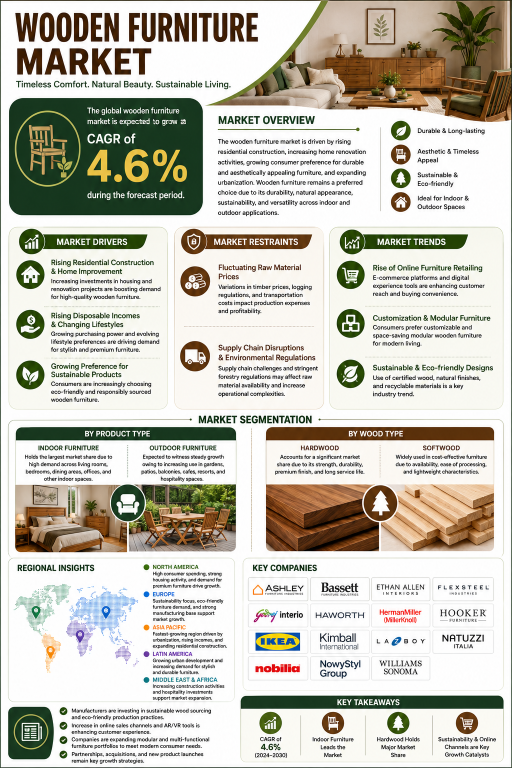
The global wooden furniture market is expected to grow at a CAGR of 4.6% during the forecast period. Market growth is being driven by rising residential construction activities, increasing home renovation spending, growing consumer preference for aesthetically appealing and durable furniture, and expanding urbanization worldwide. Wooden furniture remains one of the most preferred furniture categories due to its durability, natural appearance, sustainability, and versatility across residential and commercial applications. Growing demand for customized furniture, premium interior décor solutions, and eco-friendly materials is further supporting market expansion.
Market Drivers
Rising Residential Construction and Home Improvement Activities
The growth of the housing sector and increasing investments in home renovation projects are significantly driving demand for wooden furniture. Consumers are increasingly seeking high-quality furniture products that offer durability, functionality, and visual appeal. The growing trend of home ownership, particularly in developing economies, along with rising disposable incomes and changing lifestyle preferences, continues to create strong demand for wooden furniture across living rooms, bedrooms, dining areas, kitchens, and outdoor spaces.
Market Restraints
Fluctuating Raw Material Prices and Supply Chain Challenges
Wood prices are influenced by factors such as logging regulations, transportation costs, climate conditions, and global supply-demand dynamics. Fluctuations in timber availability and pricing can affect manufacturing costs and profit margins. Additionally, supply chain disruptions and increasing environmental regulations related to forestry practices may pose challenges for manufacturers operating in the wooden furniture market.
Wooden Furniture Market Trends
The market is witnessing growing consumer preference for sustainable and environmentally certified furniture products. Manufacturers are increasingly utilizing responsibly sourced wood, recycled materials, and eco-friendly finishes to meet sustainability expectations. The rise of online furniture retailing, customization services, modular furniture solutions, and smart furniture designs is reshaping purchasing behavior. Demand for multifunctional furniture suitable for compact urban living spaces is also increasing across major markets.
Market Segmentation
By Product Type
Based on product type, the market is segmented into Indoor Furniture and Outdoor Furniture. Indoor furniture accounts for the largest market share due to extensive demand across residential and commercial spaces, including living room furniture, bedroom furniture, dining furniture, office furniture, and storage solutions. Consumers continue to prioritize comfort, functionality, and design aesthetics when purchasing indoor wooden furniture. Outdoor furniture is expected to witness steady growth due to increasing investments in gardens, patios, balconies, resorts, hospitality facilities, and outdoor recreational spaces.
By Wood Type
Based on wood type, the market is segmented into Hardwood and Softwood. Hardwood furniture holds a significant market share due to its superior durability, strength, premium appearance, and long service life. Hardwood materials such as oak, walnut, teak, mahogany, and maple are widely used in premium furniture applications. Softwood furniture continues to maintain strong demand due to its affordability, lightweight characteristics, ease of processing, and suitability for mass-market furniture products. Pine, cedar, spruce, and fir remain popular choices within this segment.
Regional Insights
North America represents a major market for wooden furniture due to high consumer spending on home furnishings, strong housing activity, and growing demand for premium furniture products. Europe continues to witness stable demand supported by sustainability initiatives, strong furniture manufacturing traditions, and increasing preference for eco-friendly furniture solutions. Asia Pacific is expected to register the fastest growth during the forecast period owing to rapid urbanization, rising middle-class incomes, expanding residential construction, and growing furniture consumption across China, India, Japan, South Korea, and Southeast Asia. Latin America and the Middle East & Africa are also experiencing gradual growth as urban development and residential construction activities increase.
Competitive Landscape
The wooden furniture market is highly competitive, with manufacturers focusing on product innovation, design differentiation, sustainability initiatives, and omnichannel retail strategies. Companies are investing in advanced manufacturing technologies, customization capabilities, digital sales platforms, and sustainable sourcing practices to strengthen their market positions. Strategic acquisitions, product portfolio expansion, and partnerships with e-commerce platforms remain key competitive strategies across the industry.
Key companies operating in the market include Ashley Furniture Industries LLC, Bassett Furniture Industries Inc., Ethan Allen Interiors Inc., Flexsteel Industries Inc., Godrej & Boyce (Godrej Interio), Haworth Inc., Herman Miller Inc. (MillerKnoll), Hooker Furniture Corporation, IKEA (Inter IKEA Systems B.V.), Kimball International Inc., La-Z-Boy Incorporated, Natuzzi S.p.A., Nobilia-Werke GmbH, Nowy Styl Group, and Williams-Sonoma Inc.
Wooden Furniture Industry News
The industry is witnessing increasing investments in sustainable manufacturing, certified wood sourcing, and digital furniture retailing platforms. Furniture manufacturers are expanding customizable product offerings and introducing modular furniture collections to meet evolving consumer preferences. The growing popularity of direct-to-consumer sales channels and augmented reality-based furniture visualization tools is enhancing customer purchasing experiences. Sustainability certifications and responsible forestry practices continue to gain importance across global furniture supply chains.
Historical & Forecast Period
This study report represents analysis of each segment from 2024 to 2034 considering 2025 as the base year. Compounded Annual Growth Rate (CAGR) for each of the respective segments estimated for the forecast period of 2026 to 2034.
The current report comprises of quantitative market estimations for each micro market for every geographical region and qualitative market analysis such as micro and macro environment analysis, market trends, competitive intelligence, segment analysis, porters five force model, top winning strategies, top investment markets, emerging trends and technological analysis, case studies, strategic conclusions and recommendations and other key market insights.
Research Methodology
The complete research study was conducted in three phases, namely: secondary research, primary research, and expert panel review. key data point that enables the estimation of Wooden Furniture market are as follows:
Market forecast was performed through proprietary software that analyzes various qualitative and quantitative factors. Growth rate and CAGR were estimated through intensive secondary and primary research. Data triangulation across various data points provides accuracy across various analyzed market segments in the report. Application of both top down and bottom-up approach for validation of market estimation assures logical, methodical and mathematical consistency of the quantitative data.
| ATTRIBUTE | DETAILS |
|---|---|
| Research Period | 2024-2034 |
| Base Year | 2025 |
| Forecast Period | 2026-2034 |
| Historical Year | 2024 |
| Unit | USD Million |
| Segmentation | |
Product Type
|
|
Wood Type
|
|
Price
|
|
Application
|
|
Distribution Channel
|
|
|
Region Segment (2024-2034; US$ Million)
|
Frequently Asked Questions
What is the expected growth rate of the wooden furniture market?
The wooden furniture market is expected to grow at a CAGR of 4.6% during the forecast period.
Which product type segment holds the largest market share?
Indoor furniture holds the largest market share due to widespread demand across residential and commercial applications.
Which wood type segment dominates the market?
Hardwood furniture dominates the market owing to its durability, premium appearance, and long service life.
What are the major growth drivers?
Major growth drivers include rising residential construction, increasing home renovation activities, growing disposable incomes, and expanding demand for sustainable furniture products.
Who are the major companies operating in the market?
Major companies include Ashley Furniture Industries LLC, Bassett Furniture Industries Inc., Ethan Allen Interiors Inc., Flexsteel Industries Inc., Godrej Interio, Haworth Inc., Herman Miller Inc. (MillerKnoll), Hooker Furniture Corporation, IKEA, Kimball International Inc., La-Z-Boy Incorporated, Natuzzi S.p.A., Nobilia-Werke GmbH, Nowy Styl Group, and Williams-Sonoma Inc.