
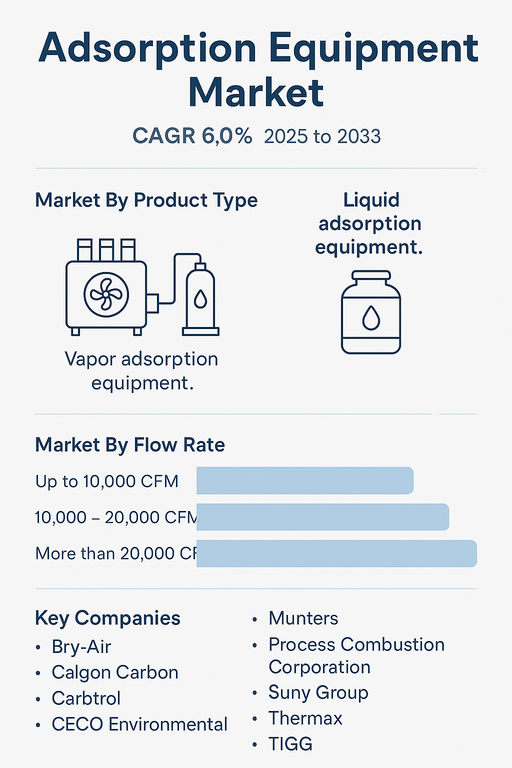
The adsorption equipment market is projected to grow at a CAGR of 6.0% from 2026 to 2034, fueled by rising environmental regulations, increased industrial air quality compliance requirements, and expanding adoption across manufacturing and chemical processing sectors. Adsorption equipment is primarily used for removing contaminants, volatile organic compounds (VOCs), and hazardous gases from process air and liquid streams. These systems are critical in meeting air pollution control standards across industries such as petrochemical, pharmaceutical, food & beverage, and electronics. Advancements in adsorbent materials, coupled with automation in flow monitoring and energy-efficient designs, are further stimulating market demand.
Market Drivers
Stringent Environmental Regulations on Emissions and Air Quality
Government regulations globally, including the U.S. Environmental Protection Agency (EPA), the European Industrial Emissions Directive, and emerging frameworks in Asia Pacific, are mandating the reduction of VOCs and hazardous air pollutants (HAPs) from industrial processes. This is prompting industries to install adsorption-based air purification systems for compliance, particularly in sectors like paint manufacturing, metal coating, and chemical processing.
Growth in Industrial and Wastewater Treatment Applications
Industries with complex waste management needs, including semiconductor fabrication, food processing, and pharmaceutical production, are increasingly relying on adsorption systems for both air and liquid purification. Granular activated carbon (GAC) and advanced media-based systems are gaining traction for odor control, solvent recovery, and purification of industrial effluents, further boosting demand for high-performance adsorption equipment.
Technological Advancements in Adsorbent Materials and Modular Systems
Innovations in adsorbent technologies such as impregnated carbons, zeolites, and silica gels are enhancing adsorption efficiency, regeneration cycles, and life span of equipment. Modular adsorption systems with integrated flow controls, remote monitoring, and scalable architecture are becoming attractive for small and mid-sized facilities seeking compliance with minimal operational complexity.
Market Restraint
High Capital Investment and Maintenance Costs
The upfront cost of adsorption systems including housing structures, adsorbent media, automation controls, and compliance instrumentation can be substantial. Additionally, maintenance requirements such as periodic media replacement, system backflushing, and disposal of saturated adsorbents increase operating costs. These challenges can limit adoption in small-scale industries and facilities with limited capital budgets, especially in developing regions.
Market Segmentation by Product Type
By product type, the market is segmented into Vapor Adsorption Equipment and Liquid Adsorption Equipment. In 2025, Vapor adsorption systems dominated the market, widely used for air purification, VOC removal, and solvent recovery in emission-intensive industries. These include carbon bed systems and regenerative adsorption units integrated with thermal oxidizers. Liquid adsorption equipment, on the other hand, is commonly used for the treatment of wastewater, chemical purification, and heavy metal removal in municipal and industrial settings. This segment is expected to grow steadily with increasing global attention on water reuse and industrial effluent treatment.
Market Segmentation by Flow Rate
The market is also segmented by flow rate capacity into Up to 10,000 CFM, 10,000–20,000 CFM, and More than 20,000 CFM. The Up to 10,000 CFM category led the market in 2025, due to its widespread use in small- to mid-sized industrial operations, labs, and pilot-scale facilities. However, systems with More than 20,000 CFM are expected to register the highest growth rate during the forecast period, driven by large-scale manufacturing, petrochemical plants, and high-volume processing units where centralized purification is essential for regulatory compliance.
Geographic Trends
In 2025, North America held the leading market share in adsorption equipment, driven by rigorous VOC emission standards, especially in the U.S. under EPA’s Clean Air Act. Retrofit activities and aging industrial infrastructure further support steady replacement demand. Asia Pacific is projected to experience the fastest CAGR from 2026 to 2034, as countries like China, India, and South Korea introduce stricter environmental norms and upgrade manufacturing capabilities. Rapid industrialization, combined with public pressure for air and water quality improvements, is a major tailwind in the region. Europe remains a mature but environmentally proactive market, with industrial producers investing in sustainable emissions technology. Latin America and Middle East & Africa are emerging, supported by growing investments in industrialization, oil & gas, and environmental infrastructure in Brazil, Mexico, GCC countries, and South Africa.
Competitive Trends
The adsorption equipment market features a competitive landscape composed of established environmental engineering firms and niche providers focused on process-specific purification solutions. In 2025, companies like Dürr, CECO Environmental, and Thermax led the market through large-scale vapor phase adsorption systems integrated with scrubbers, oxidizers, and real-time monitoring. Calgon Carbon, TIGG, and General Carbon focused on carbon-based equipment for air and water purification applications. Evoqua, KCH, and Bry-Air offered modular and turnkey systems tailored to mid-tier industrial users. Carbtrol, Process Combustion Corporation, and Microtrac emphasized odor control, indoor air quality, and customized design solutions. Munters, Suny Group, and GUNT expanded their reach through international contracts, low-maintenance systems, and adsorbent media innovations. Through 2034, the market is expected to consolidate around companies offering energy-efficient, scalable, and automation-ready solutions to support evolving compliance requirements.
Historical & Forecast Period
This study report represents analysis of each segment from 2024 to 2034 considering 2025 as the base year. Compounded Annual Growth Rate (CAGR) for each of the respective segments estimated for the forecast period of 2026 to 2034.
The current report comprises of quantitative market estimations for each micro market for every geographical region and qualitative market analysis such as micro and macro environment analysis, market trends, competitive intelligence, segment analysis, porters five force model, top winning strategies, top investment markets, emerging trends and technological analysis, case studies, strategic conclusions and recommendations and other key market insights.
Research Methodology
The complete research study was conducted in three phases, namely: secondary research, primary research, and expert panel review. key data point that enables the estimation of Adsorption Equipment Market By Product Type, By Flow Rate, By End Use Industry, By Distribution Channel - Growth, Share, Opportunities & Competitive Analysis, 2026 - 2034 market are as follows:
Market forecast was performed through proprietary software that analyzes various qualitative and quantitative factors. Growth rate and CAGR were estimated through intensive secondary and primary research. Data triangulation across various data points provides accuracy across various analyzed market segments in the report. Application of both top down and bottom-up approach for validation of market estimation assures logical, methodical and mathematical consistency of the quantitative data.
| ATTRIBUTE | DETAILS |
|---|---|
| Research Period | 2024-2034 |
| Base Year | 2025 |
| Forecast Period | 2026-2034 |
| Historical Year | 2024 |
| Unit | USD Million |
| Segmentation | |
Product Type
|
|
Flow Rate
|
|
End Use Industry
|
|
Distribution Channel
|
|
|
Region Segment (2024-2034; US$ Million)
|
Key questions answered in this report


