
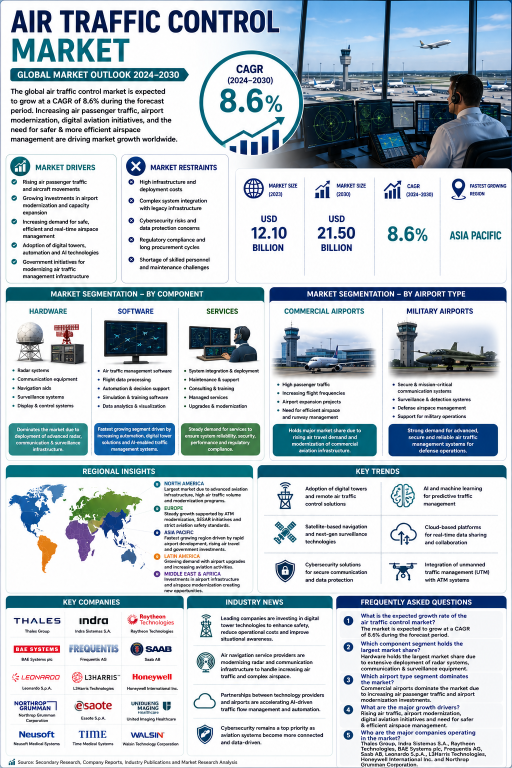
The global air traffic control market is expected to grow at a CAGR of 8.6% during the forecast period. Market growth is driven by increasing air passenger traffic, rising airport modernization projects, growing demand for safer airspace management, and expanding investments in digital aviation infrastructure. Air traffic control systems play a critical role in aircraft navigation, runway safety, airspace coordination, flight communication, and real-time monitoring. The growing need to manage congested air routes, improve operational efficiency, and strengthen aviation safety is further supporting market expansion worldwide.
Market Drivers
Rising Air Traffic and Airport Modernization Investments
The continuous growth of commercial aviation is creating strong demand for advanced air traffic control systems across major airports and regional aviation networks. Airports are investing in radar systems, communication equipment, surveillance platforms, automation software, and digital tower technologies to improve traffic handling capacity and safety. Governments and aviation authorities are also modernizing legacy air traffic management infrastructure to support efficient flight operations and reduce delays.
Market Restraints
High Infrastructure Cost and Complex System Integration
Air traffic control systems require large capital investments in hardware, software, communication networks, radar platforms, and skilled personnel. Integration with existing aviation infrastructure can be complex and time-consuming, especially in older airports. Cybersecurity risks, regulatory compliance requirements, and long procurement cycles may further limit faster market adoption in certain regions.
Air Traffic Control Market Trends
The market is witnessing increasing adoption of digital towers, satellite-based navigation, automation software, AI-enabled traffic flow management, and remote air traffic control solutions. Aviation authorities are focusing on improving real-time data sharing, airspace efficiency, and runway safety through advanced surveillance and communication systems. The use of cloud-based platforms, cybersecurity solutions, and predictive analytics is also increasing as airports move toward connected aviation infrastructure.
Market Segmentation
By Component
Based on component, the market is segmented into Hardware, Software, and Services. Hardware accounts for a significant market share due to extensive deployment of radar systems, communication equipment, navigation aids, surveillance systems, and control tower infrastructure. Software is expected to witness strong growth due to increasing demand for automation, flight data processing, traffic flow management, and digital tower solutions. Services continue to generate steady demand through system integration, maintenance, training, consulting, and operational support.
By Airport Type
Based on airport type, the market is segmented into Commercial Airports and Military Airports. Commercial airports hold a major market share owing to rising passenger traffic, increasing flight frequencies, and growing investments in airport capacity expansion. Military airports continue to generate strong demand for secure airspace management, defense aviation operations, surveillance systems, and mission-critical communication platforms.
Regional Insights
North America represents a major market for air traffic control systems due to advanced aviation infrastructure, high air traffic volume, and strong investments in airspace modernization programs. The United States continues to lead regional demand due to airport upgrades, defense aviation requirements, and adoption of next-generation air traffic management technologies. Europe is witnessing steady growth supported by digital aviation programs, strict aviation safety standards, and modernization of air traffic networks. Asia Pacific is expected to record the fastest growth during the forecast period due to rapid airport construction, increasing air travel demand, expanding airline fleets, and rising aviation infrastructure investments across China, India, Japan, South Korea, and Southeast Asia. Latin America and the Middle East & Africa are also experiencing growing demand as airport development, airspace modernization, and aviation safety investments continue to expand.
Competitive Landscape
The air traffic control market is highly competitive, with companies focusing on radar modernization, automation software, digital towers, cybersecurity, communication systems, and integrated air traffic management platforms. Market participants are investing in AI-enabled traffic control, satellite-based surveillance, remote tower operations, and advanced data analytics to strengthen their market positions. Strategic partnerships with aviation authorities, airports, defense agencies, and technology providers remain important growth strategies. Competitive differentiation increasingly depends on system reliability, safety performance, regulatory compliance, cybersecurity strength, integration capability, and long-term service support.
Key Companies Operating in the Market Include
Key companies operating in the air traffic control market include Thales Group, Indra Sistemas S.A., Raytheon Technologies, BAE Systems plc, Frequentis AG, Saab AB, Leonardo S.p.A., L3Harris Technologies, Honeywell International Inc., and Northrop Grumman Corporation. These companies are focusing on advanced radar systems, digital tower solutions, automation software, secure communication platforms, satellite-based surveillance, and integrated air traffic management technologies to strengthen their market positions. Continuous investments in aviation safety, defense airspace systems, cybersecurity, and digital aviation infrastructure are helping these companies address rising demand from commercial and military airports.
Air Traffic Control Industry News
The industry is witnessing increasing investments in digital tower technologies, satellite-based surveillance, automation platforms, and airport modernization programs. Aviation authorities are upgrading legacy air traffic control systems to improve runway safety, reduce congestion, and support future air mobility operations. Manufacturers are developing AI-supported traffic management tools, remote tower platforms, and cybersecurity-focused communication systems. The expansion of commercial aviation, defense aviation modernization, and smart airport infrastructure is expected to remain a major driver of innovation and market growth during the forecast period.
Historical & Forecast Period
This study report represents analysis of each segment from 2024 to 2034 considering 2025 as the base year. Compounded Annual Growth Rate (CAGR) for each of the respective segments estimated for the forecast period of 2026 to 2034.
The current report comprises of quantitative market estimations for each micro market for every geographical region and qualitative market analysis such as micro and macro environment analysis, market trends, competitive intelligence, segment analysis, porters five force model, top winning strategies, top investment markets, emerging trends and technological analysis, case studies, strategic conclusions and recommendations and other key market insights.
Research Methodology
The complete research study was conducted in three phases, namely: secondary research, primary research, and expert panel review. key data point that enables the estimation of Air Traffic Control Market - Growth, Share, Opportunities & Competitive Analysis, 2026 - 2034 market are as follows:
Market forecast was performed through proprietary software that analyzes various qualitative and quantitative factors. Growth rate and CAGR were estimated through intensive secondary and primary research. Data triangulation across various data points provides accuracy across various analyzed market segments in the report. Application of both top down and bottom-up approach for validation of market estimation assures logical, methodical and mathematical consistency of the quantitative data.
| ATTRIBUTE | DETAILS |
|---|---|
| Research Period | 2024-2034 |
| Base Year | 2025 |
| Forecast Period | 2026-2034 |
| Historical Year | 2024 |
| Unit | USD Million |
| Segmentation | |
Component
|
|
Center
|
|
Application
|
|
End User
|
|
|
Region Segment (2024-2034; US$ Million)
|
Frequently Asked Questions
What is the expected growth rate of the air traffic control market?
The air traffic control market is expected to grow at a CAGR of 8.6% during the forecast period.
Which component segment holds a significant market share?
Hardware holds a significant market share due to the deployment of radar systems, communication equipment, navigation aids, surveillance systems, and tower infrastructure.
Which airport type dominates the market?
Commercial airports dominate the market owing to rising passenger traffic, increasing flight frequencies, and growing airport modernization investments.
What are the major growth drivers?
Major growth drivers include increasing air passenger traffic, airport modernization projects, growing need for safer airspace management, and rising investments in digital aviation infrastructure.
Who are the major companies operating in the market?
Major companies include Thales Group, Indra Sistemas S.A., Raytheon Technologies, BAE Systems plc, Frequentis AG, Saab AB, Leonardo S.p.A., L3Harris Technologies, Honeywell International Inc., and Northrop Grumman Corporation.


