
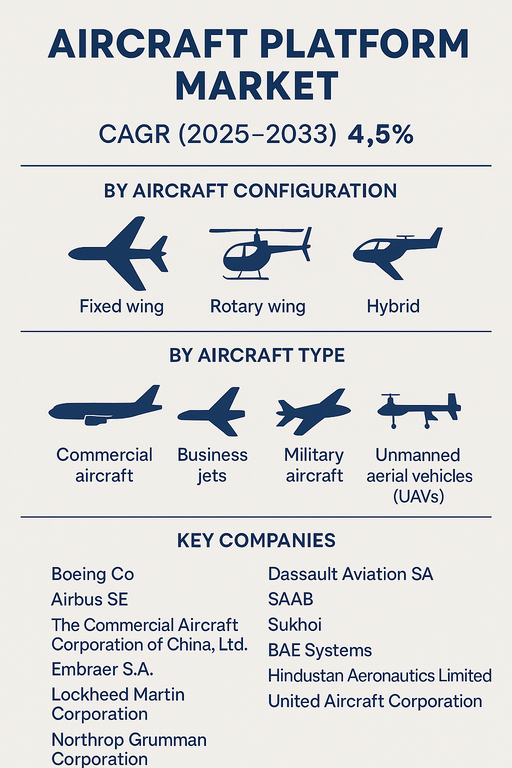
The global aircraft platform market is expected to grow at a CAGR of 4.5% between 2026 and 2034, driven by rising global air traffic, defense modernization programs, and expanding applications of unmanned aerial systems. Aircraft platforms encompass the structural and functional configuration of fixed-wing, rotary-wing, hybrid, and unmanned systems tailored to commercial, business, and military use. Growing demand for next-generation fuel-efficient aircraft, the increasing utility of UAVs in both civil and defense sectors, and rising investments in indigenous aircraft development across emerging economies are major contributors to the market’s steady expansion.
Market Drivers
Recovery of Global Commercial Aviation and Fleet Modernization
After the post-pandemic rebound, the commercial aviation sector is experiencing strong momentum with increasing passenger traffic, aging aircraft fleets, and renewed aircraft procurement by airline operators. As a result, aircraft manufacturers are experiencing renewed orders for advanced, lightweight, and fuel-efficient fixed-wing platforms. The push for sustainability and net-zero emissions in aviation is also accelerating investments in hybrid-electric and hydrogen-powered aircraft platforms, further supporting market growth.
Defense Spending and Indigenous Military Aircraft Programs
Governments across the globe are investing in indigenous defense manufacturing to enhance national security and reduce reliance on foreign suppliers. This trend has significantly boosted the demand for military aircraft platforms, including fighter jets, surveillance aircraft, and strategic bombers. Countries like India, China, South Korea, and Turkey are expanding domestic R&D capabilities and entering joint ventures to develop next-generation platforms for air superiority, reconnaissance, and electronic warfare. In parallel, advanced economies continue to upgrade existing fleets with stealth and autonomous capabilities, contributing to stable market demand.
Market Restraint
High Development Costs and Lengthy Certification Cycles
The design, development, and testing of aircraft platforms require significant capital investment and extended timelines, particularly for commercial and military platforms. Compliance with strict airworthiness, safety, and emission standards extends certification cycles and increases the risk of project delays and cost overruns. These challenges are particularly significant for small and medium-sized players, limiting their entry and scalability. Additionally, geopolitical disruptions and supply chain constraints further complicate platform development and global delivery schedules.
Market Segmentation by Aircraft Configuration
The market is segmented into Fixed-wing, Rotary-wing, and Hybrid aircraft configurations. In 2025, fixed-wing platforms dominated the market due to their extensive use in commercial airlines, cargo transport, and defense aircraft. These platforms offer superior speed, range, and payload capacity, making them ideal for both civil and military applications. Rotary-wing platforms, primarily helicopters, are widely used in short-range transport, emergency response, search and rescue, and battlefield operations. Hybrid configurations integrating features of both rotary and fixed-wing systems are gaining momentum in urban air mobility and advanced drone applications, where vertical takeoff and landing (VTOL) capabilities and longer range are required. From 2026 to 2034, the hybrid segment is expected to witness the fastest growth due to innovations in electric propulsion and emerging applications in surveillance, logistics, and air taxis.
Market Segmentation by Aircraft Type
By aircraft type, the market is segmented into Commercial Aircraft, Business Jets, Military Aircraft, and Unmanned Aerial Vehicles (UAVs). In 2025, commercial aircraft held the largest market share, driven by global air fleet expansion and replacement of older jets with new-generation aircraft offering better fuel efficiency and lower maintenance. Military aircraft followed closely, supported by global defense budgets and acquisition of advanced platforms with multi-role capabilities. UAVs are witnessing robust growth in both civil and military domains, with applications in surveillance, delivery, mapping, and border security. Business jets maintain a niche but stable presence, with high-net-worth individuals, corporations, and government agencies investing in mobility, privacy, and on-demand connectivity. Between 2026 and 2034, UAVs are projected to post the highest CAGR due to expanding defense applications and growing integration into commercial sectors like agriculture, infrastructure, and disaster response.
Geographic Trends
North America led the global aircraft platform market in 2025, with the U.S. accounting for a dominant share due to the presence of major OEMs like Boeing, Lockheed Martin, and Northrop Grumman. Strong defense budgets, high demand for commercial aircraft, and technological leadership drive consistent platform innovation. Europe followed, with Airbus and Dassault spearheading regional leadership in both commercial and military aircraft production. Asia Pacific is expected to register the highest CAGR from 2026 to 2034, driven by rising air travel, increasing defense procurement, and growing indigenous manufacturing efforts in China, India, and South Korea. Latin America and the Middle East & Africa are emerging markets, with rising investments in military modernization, regional air connectivity, and civil aviation infrastructure in countries such as Brazil, Saudi Arabia, and the UAE.
Competitive Trends
The aircraft platform market in 2025 was dominated by major global aerospace manufacturers and regional defense contractors. Boeing Co and Airbus SE led the commercial segment, with extensive fixed-wing aircraft offerings and global delivery networks. Embraer S.A. catered to regional and business jet markets with a strong foothold in Latin America and expanding global presence. Lockheed Martin and Northrop Grumman maintained leadership in the military aircraft domain, supplying next-generation fighter jets, surveillance platforms, and strategic bombers. Dassault Aviation, SAAB, Sukhoi, and BAE Systems offered specialized defense aircraft suited to European, Russian, and allied military forces. Hindustan Aeronautics Limited (HAL) and United Aircraft Corporation supported indigenous defense platforms in India and Russia, respectively. Across the market, R&D focus remains on electrification, modular airframes, digital avionics, autonomous systems, and next-generation propulsion technologies to meet evolving requirements across civilian and defense aviation sectors.
Historical & Forecast Period
This study report represents analysis of each segment from 2024 to 2034 considering 2025 as the base year. Compounded Annual Growth Rate (CAGR) for each of the respective segments estimated for the forecast period of 2026 to 2034.
The current report comprises of quantitative market estimations for each micro market for every geographical region and qualitative market analysis such as micro and macro environment analysis, market trends, competitive intelligence, segment analysis, porters five force model, top winning strategies, top investment markets, emerging trends and technological analysis, case studies, strategic conclusions and recommendations and other key market insights.
Research Methodology
The complete research study was conducted in three phases, namely: secondary research, primary research, and expert panel review. key data point that enables the estimation of Aircraft Platform Market By Aircraft Configuration, By Aircraft Type, By Air Propulsion Type, By End Use - Growth, Share, Opportunities & Competitive Analysis, 2026 - 2034 market are as follows:
Market forecast was performed through proprietary software that analyzes various qualitative and quantitative factors. Growth rate and CAGR were estimated through intensive secondary and primary research. Data triangulation across various data points provides accuracy across various analyzed market segments in the report. Application of both top down and bottom-up approach for validation of market estimation assures logical, methodical and mathematical consistency of the quantitative data.
| ATTRIBUTE | DETAILS |
|---|---|
| Research Period | 2024-2034 |
| Base Year | 2025 |
| Forecast Period | 2026-2034 |
| Historical Year | 2024 |
| Unit | USD Million |
| Segmentation | |
Aircraft Configuration
|
|
Aircraft Type
|
|
Aircraft Propulsion Type
|
|
End Use
|
|
|
Region Segment (2024-2034; US$ Million)
|
Key questions answered in this report


