
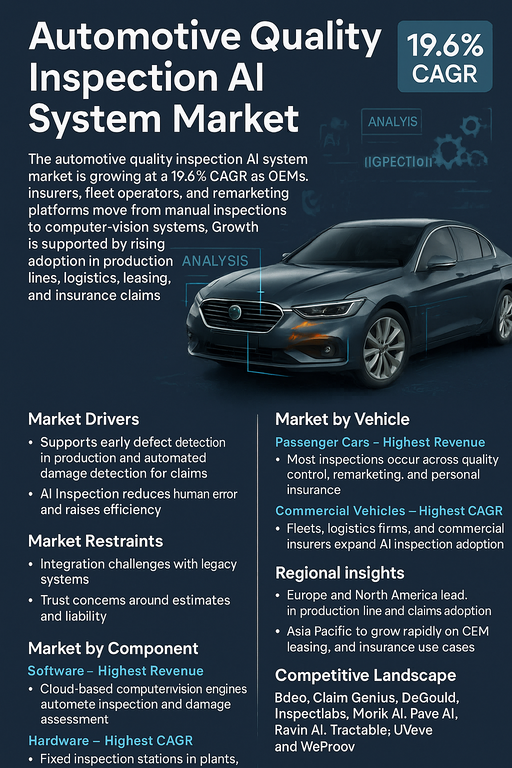
The automotive quality inspection AI system market is growing at a 19.6% CAGR as OEMs, insurers, fleet operators, and remarketing platforms move from manual and rule-based inspections to computer-vision and machine-learning systems that can capture, classify, and quantify vehicle damage with higher speed and consistency. These AI-driven solutions analyze images and video from smartphones, fixed inspection portals, and production-line cameras to detect defects, estimate repair costs, and standardize quality decisions across plants, dealers, and claims networks. Growth is supported by rising volumes of digital inspections in production, aftersales, leasing, and insurance claims, and by the push to reduce human error and inspection bottlenecks.
Market Drivers
Growth is driven by the need to cut inspection time, reduce subjective assessments, and manage rising quality expectations in both new and used vehicles. In manufacturing, AI-based inspection supports early detection of paint, body, and assembly defects, improving first-time quality and reducing rework. In aftersales and remarketing, automated damage detection at check-in and handover helps reduce disputes, improve transparency, and speed up reconditioning. Insurers and fleet operators increasingly use AI inspection to shorten claim cycles, streamline triage, and lower adjusting costs. The rapid adoption of smartphones and high-resolution cameras makes it easy to capture inspection images, while advances in deep learning and cloud computing allow fast model training and deployment. Growing use of digital twins, connected workshops, and online used-vehicle marketplaces further supports integration of AI inspection into end-to-end workflows.
Market Restraints
Adoption is restrained by integration challenges, data-quality issues, and trust in AI outputs. Many OEMs, dealers, and insurers run legacy claim and workshop systems that are not yet ready for automated decision inputs, requiring custom interfaces and change management. AI models are sensitive to lighting, camera angles, and image quality, and performance can drop in uncontrolled environments if data standards are not enforced. Some stakeholders remain cautious about relying on AI for cost estimates and liability decisions, especially in high-value or complex damage cases, which means human reviewers are still required. Regulatory and data-privacy requirements around customer images and telematics can also slow deployment. In addition, smaller repairers and dealers may be reluctant to invest in new processes and training when they are used to manual inspection practices.
Market by Component
By component, software generates the highest revenue because cloud-based AI models, computer-vision engines, and analytics platforms sit at the core of automated inspection workflows and are monetized through licenses, subscriptions, and per-inspection fees across OEM, dealer, fleet, and insurance users, while hardware is expected to record the highest CAGR as more vehicle plants, logistics hubs, rental locations, and drive-through inspection stations deploy fixed camera tunnels, high-resolution sensor arrays, and edge devices to standardize image capture and support real-time scoring at scale, complementing smartphone-based capture and strengthening the end-to-end accuracy of software algorithms.
Market by Vehicle
By vehicle, passenger cars account for the highest revenue share because they dominate retail sales, leasing, rental, and personal insurance volumes, generating the largest number of inspections across new-vehicle quality control, end-of-lease assessments, remarketing, and motor claims, while commercial vehicles are expected to post the highest CAGR as fleets, logistics operators, and commercial insurers adopt AI inspection to monitor damage across large truck and van fleets, reduce downtime, standardize handover conditions, and better control lifecycle cost in high-utilization vehicles.
Regional Insights
Europe and North America are leading regions for automotive quality inspection AI systems due to strong OEM presence, well-developed leasing and rental markets, and advanced digitalization of insurance and claims processes. Large insurers, captive finance companies, and auction platforms in these regions are early adopters of automated damage detection and AI-based triage. Asia Pacific is expected to record one of the highest CAGRs as China, Japan, South Korea, and India scale up automotive production, expand used-vehicle and online marketplaces, and invest in smart factories and digital claims. Growing vehicle parc, rising insurance penetration, and rapid smartphone adoption support wider use of app-based inspections. Other regions, including Latin America and the Middle East, are at earlier stages but show increasing interest through multinational OEMs, rental companies, and regional insurers that import AI inspection workflows standardized in global operations. Markets with strong telematics use, large leasing and rental fleets, and high digital maturity in claims handling will see faster adoption.
Competitive Landscape
Bdeo, Claim Genius, DeGould, Inspektlabs, Monk.AI, Pave AI, Ravin.AI, Tractable, UVeye, and WeProov are key players in the automotive quality inspection AI system market, offering a mix of smartphone-based inspection apps, drive-through scanning portals, and cloud-based damage-detection engines. Some focus more on production and logistics inspections (for example automated body and underbody scans in plants, ports, and compounds), while others specialize in insurance claims, end-of-lease inspections, or dealer intake. Their platforms typically bundle AI-based damage detection and classification, repair cost estimation, fraud checks, workflow integration, and analytics dashboards. Strategic priorities include improving model accuracy across more makes, models, and geographies; expanding integrations with OEM systems, DMS and bodyshop software, and insurer claim platforms; and adding value-added services such as benchmarking, pricing insights, and portfolio risk analysis. Companies that can demonstrate high detection accuracy, low false positives, simple integration, and measurable reductions in claim cycle times and inspection costs are likely to lead revenue, while those that scale globally, support both passenger and commercial fleets, and extend into factory and logistics quality control are positioned to capture the highest CAGR in the automotive quality inspection AI system market.
Historical & Forecast Period
This study report represents analysis of each segment from 2024 to 2034 considering 2025 as the base year. Compounded Annual Growth Rate (CAGR) for each of the respective segments estimated for the forecast period of 2026 to 2034.
The current report comprises of quantitative market estimations for each micro market for every geographical region and qualitative market analysis such as micro and macro environment analysis, market trends, competitive intelligence, segment analysis, porters five force model, top winning strategies, top investment markets, emerging trends and technological analysis, case studies, strategic conclusions and recommendations and other key market insights.
Research Methodology
The complete research study was conducted in three phases, namely: secondary research, primary research, and expert panel review. key data point that enables the estimation of Automotive Quality Inspection AI System Market By Component, By Vehicle, By Application, By End Use, By Deployment Mode - Global Market Analysis & Forecast, 2025 to 2033 market are as follows:
Market forecast was performed through proprietary software that analyzes various qualitative and quantitative factors. Growth rate and CAGR were estimated through intensive secondary and primary research. Data triangulation across various data points provides accuracy across various analyzed market segments in the report. Application of both top down and bottom-up approach for validation of market estimation assures logical, methodical and mathematical consistency of the quantitative data.
| ATTRIBUTE | DETAILS |
|---|---|
| Research Period | 2024-2034 |
| Base Year | 2025 |
| Forecast Period | 2026-2034 |
| Historical Year | 2024 |
| Unit | USD Million |
| Segmentation | |
Component
|
|
Vehicle
|
|
Application
|
|
End use
|
|
Deployment mode
|
|
|
Region Segment (2024-2034; US$ Million)
|
Key questions answered in this report


