
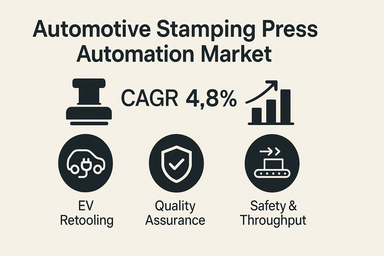
The global automotive stamping press automation market is projected to grow at a CAGR of 4.8% from 2026 to 2034, supported by OEM retooling cycles for EV platforms, tighter quality and traceability requirements, and continued focus on safety and throughput in press shops. Investments are centered on upgrading legacy lines with servo presses, automated feeder/transfer solutions, and connected controls that reduce changeover time and scrap rates. Vendors are aligning offers with Industry 4.0 roadmaps—integrating vision, condition monitoring, and MES connectivity—to stabilize output and enable predictive maintenance across high-volume body-in-white and component stamping.
EV-Driven Retooling and Line Modernization
Automakers are reconfiguring stamping lines to handle mixed materials (advanced high-strength steels, aluminum) and shorter model refresh cycles linked to EV body architectures. This is lifting demand for robotic handling, coil feed/transfer automation, and die-change automation that cut unplanned downtime and setup times. Plants are deploying closed-loop controls for dimensional accuracy, end-of-line vision inspection for defect detection, and digital twins to validate press curves and line balancing before physical changes. The shift to connected plants is improving OEE, enabling remote diagnostics, and aligning press operations with upstream scheduling and downstream welding/assembly.
Challenges: Integration Complexity and Capital Constraints
Adoption is moderated by integration complexity across heterogeneous press fleets, cybersecurity concerns when linking controls to enterprise networks, and capital allocation trade-offs amid cyclical automotive demand. Shortages of skilled maintenance staff slow commissioning and ramp-up, and interoperability across PLCs, robots, and quality systems remains uneven without standardized data models. However, modular retrofit kits, edge analytics, and subscription models for monitoring and optimization are helping lower upfront costs and accelerate ROI, particularly in Tier-1 and Tier-2 supplier facilities.
Market Segmentation by Product
By product, the market is segmented into Press Automation Systems, Robotic Material Handling, Process Control & Monitoring, and Integration & Services. Press Automation Systems account for the largest share today, driven by demand for coil feed lines, transfer systems, die-change automation, lubrication units, and servo feed upgrades that directly lift line speed and repeatability. Robotic Material Handling is expected to deliver the highest growth through 2034 as OEMs and suppliers expand robotized blank loading, part transfer, and end-of-line stacking with force/torque and vision guidance for multi-SKU runs. Process Control & Monitoring is scaling with closed-loop force/tonnage monitoring, vibration/temperature analytics, and inline dimensional checks to reduce rework. Integration & Services remain critical across greenfield and brownfield deployments, including line engineering, safety upgrades, cell integration, and lifecycle maintenance contracts.
Market Segmentation by Automation Level
By automation level, the market is categorized into Semi-Automated, Fully Automated, and Smart/Connected. Semi-Automated retains a sizable installed base due to incremental retrofits on legacy presses and cost-sensitive Tier-2 sites. Fully Automated lines are expanding within OEM press shops and leading Tier-1s to standardize quality and throughput across global plants. Smart/Connected is projected to post the highest CAGR, underpinned by IIoT gateways, OPC UA-enabled controllers, edge analytics for predictive maintenance, and integrated MES/quality data that support real-time decision-making and traceability.
Regional Insights
Asia Pacific leads the market, anchored by high installed press capacity and ongoing investments in China, Japan, South Korea, and India for EVs and export platforms. Europe follows with strong demand from Germany, Italy, and Central/Eastern Europe where premium OEMs and Tier-1s prioritize servo presses, safety compliance, and energy-efficient operations. North America remains resilient as U.S. and Mexican plants retool for EVs and nearshoring drives supplier capacity additions. Latin America (notably Brazil and Mexico) and the Middle East & Africa are emerging with selective upgrades in OEM and Tier-1/2 ecosystems, often emphasizing retrofit automation to stretch existing assets.
Competitive Landscape
Competition is characterized by integrated solutions spanning presses, robotics, controls, and lifecycle services. ABB, FANUC, KUKA, and Universal Robots focus on robotic handling, vision, and safety ecosystems integrated with press lines. ANDRITZ/Schuler, Komatsu Industries, AIDA Engineering, AMADA, SEYI Machinery, and Bihler of America leverage deep press and forming expertise to deliver turnkey automation cells and servo technology. Vendors differentiate through faster commissioning, standardized cell libraries, energy-efficient drives, and predictive service offerings. Strategic priorities include open connectivity to plant MES/ERP, advanced vision for defect prevention, and modular retrofit packages that de-risk brownfield modernization.
Historical & Forecast Period
This study report represents analysis of each segment from 2024 to 2034 considering 2025 as the base year. Compounded Annual Growth Rate (CAGR) for each of the respective segments estimated for the forecast period of 2026 to 2034.
The current report comprises of quantitative market estimations for each micro market for every geographical region and qualitative market analysis such as micro and macro environment analysis, market trends, competitive intelligence, segment analysis, porters five force model, top winning strategies, top investment markets, emerging trends and technological analysis, case studies, strategic conclusions and recommendations and other key market insights.
Research Methodology
The complete research study was conducted in three phases, namely: secondary research, primary research, and expert panel review. key data point that enables the estimation of Automotive Stamping Press Automation Market By Product, By Automation Level, By Vehicle, By Application - Growth, Share, Opportunities & Competitive Analysis, 2026 - 2034 market are as follows:
Market forecast was performed through proprietary software that analyzes various qualitative and quantitative factors. Growth rate and CAGR were estimated through intensive secondary and primary research. Data triangulation across various data points provides accuracy across various analyzed market segments in the report. Application of both top down and bottom-up approach for validation of market estimation assures logical, methodical and mathematical consistency of the quantitative data.
| ATTRIBUTE | DETAILS |
|---|---|
| Research Period | 2024-2034 |
| Base Year | 2025 |
| Forecast Period | 2026-2034 |
| Historical Year | 2024 |
| Unit | USD Million |
| Segmentation | |
Product
|
|
Automation Level
|
|
Vehicle
|
|
Application
|
|
|
Region Segment (2024-2034; US$ Million)
|
Key questions answered in this report


