
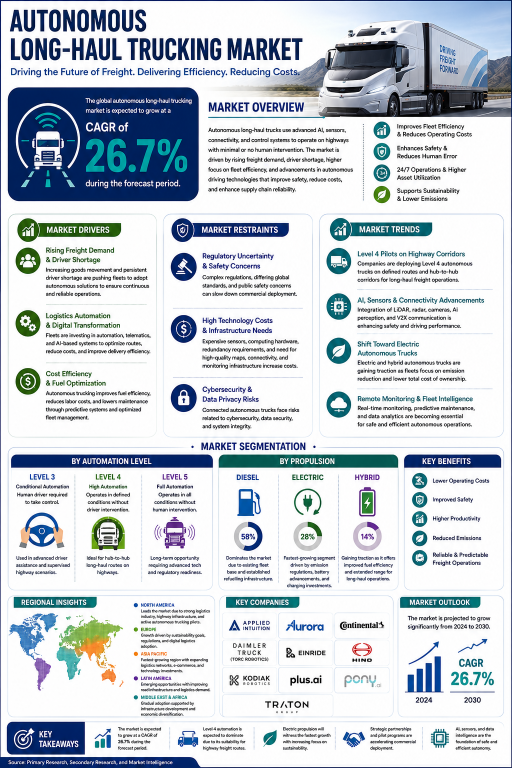
The global autonomous long-haul trucking market is expected to grow at a CAGR of 26.7% during the forecast period. Market growth is driven by rising freight transportation demand, driver shortage issues, increasing logistics automation, higher focus on fleet efficiency, and advancements in artificial intelligence, sensors, vehicle control systems, and autonomous driving software. Autonomous long-haul trucks are designed to reduce driver dependency, improve route efficiency, enhance fuel economy, lower operating costs, and support continuous freight movement across long-distance highway corridors.
Market Drivers
Rising Freight Demand and Driver Shortage
The shortage of skilled truck drivers remains one of the major factors supporting demand for autonomous long-haul trucking solutions. Logistics operators are facing increasing pressure to move goods faster, reduce delivery delays, and control labor-related costs. Autonomous trucking technologies can improve fleet utilization by enabling longer vehicle operating hours, reducing human error, and supporting more predictable freight operations. Growing e-commerce, manufacturing activity, and cross-border trade are further strengthening demand for autonomous freight solutions.
Market Restraints
Regulatory Uncertainty and Safety Concerns
Autonomous long-haul trucking faces challenges related to safety validation, public acceptance, liability, cybersecurity, and regulatory approval. Different countries and states have varying rules for autonomous vehicle testing and deployment, which can slow commercial rollout. High technology costs, sensor redundancy requirements, and the need for reliable mapping, connectivity, and monitoring infrastructure also increase implementation complexity.
Autonomous Long-Haul Trucking Market Trends
The market is witnessing growing deployment of Level 4 autonomous trucking pilots across defined highway routes and logistics corridors. Companies are focusing on hub-to-hub freight models where autonomous trucks operate on highways while human drivers manage first-mile and last-mile operations. Integration of AI-based perception systems, LiDAR, radar, cameras, telematics, remote fleet monitoring, and predictive maintenance platforms is becoming a key trend. Electric and hybrid autonomous trucks are also gaining attention as fleets seek lower emissions and improved operating efficiency.
Market Segmentation
By Automation Level
Based on automation level, the market is segmented into Level 3, Level 4, and Level 5. Level 4 automation is expected to hold a significant market share due to its suitability for defined long-haul routes, controlled operating domains, and hub-to-hub freight applications. Level 3 systems are gaining adoption in advanced driver assistance and supervised highway automation, but they require human fallback. Level 5 automation remains a long-term opportunity as full autonomy across all conditions requires further progress in safety validation, regulation, infrastructure readiness, and technology maturity.
By Propulsion
Based on propulsion, the market is segmented into Diesel, Electric, and Hybrid. Diesel-powered autonomous trucks currently hold a major share due to the existing long-haul trucking fleet base, established refueling infrastructure, and suitability for long-distance freight movement. Electric autonomous trucks are expected to record the fastest growth due to rising emission regulations, fleet decarbonization targets, battery technology improvements, and charging infrastructure investments. Hybrid trucks are also gaining interest as they offer improved fuel efficiency and lower emissions while addressing range-related concerns.
Regional Insights
North America represents the leading market for autonomous long-haul trucking due to strong logistics activity, long highway freight corridors, driver shortage pressure, and active testing by autonomous trucking companies. The United States is a key market due to large freight volumes, advanced vehicle technology development, and growing partnerships between logistics operators and autonomous driving technology providers. Europe is witnessing steady growth supported by emission reduction goals, digital logistics adoption, and strong commercial vehicle manufacturing capabilities. Asia Pacific is expected to grow rapidly due to expanding logistics networks, e-commerce growth, infrastructure development, and technology investments across China, Japan, South Korea, and India. Latin America and the Middle East & Africa are emerging markets, with adoption expected to increase gradually as road infrastructure, regulation, and fleet modernization improve.
Competitive Landscape
The autonomous long-haul trucking market is highly competitive, with technology developers, truck manufacturers, mobility companies, and logistics players focusing on autonomous driving software, sensor integration, safety validation, and commercial pilot programs. Companies are forming partnerships with carriers, shippers, OEMs, and fleet operators to test autonomous freight routes and develop scalable deployment models. Competitive advantage depends on safety performance, route coverage, regulatory approvals, vehicle integration capabilities, data quality, and ability to reduce total cost of ownership for fleet operators.
Key companies operating in the market include Applied Intuition, Aurora Innovation, Continental, Daimler Truck through Torc Robotics, Einride, Hino Motors, Kodiak Robotics, Plus.ai, Pony AI, and TRATON. These companies are investing in autonomous driving platforms, simulation systems, electric freight solutions, Level 4 trucking technologies, and strategic partnerships to strengthen their position in the autonomous logistics ecosystem.
Autonomous Long-Haul Trucking Industry News
The industry is witnessing increasing pilot deployments and commercial testing of autonomous trucks on highway freight corridors. Companies are expanding hub-to-hub autonomous freight programs, improving safety validation through simulation and real-world testing, and partnering with logistics providers to prepare for scaled commercialization. Growing investment in AI, sensor redundancy, remote monitoring, and connected fleet systems is expected to support wider adoption of autonomous long-haul trucking during the forecast period.
Historical & Forecast Period
This study report represents analysis of each segment from 2024 to 2034 considering 2025 as the base year. Compounded Annual Growth Rate (CAGR) for each of the respective segments estimated for the forecast period of 2026 to 2034.
The current report comprises of quantitative market estimations for each micro market for every geographical region and qualitative market analysis such as micro and macro environment analysis, market trends, competitive intelligence, segment analysis, porters five force model, top winning strategies, top investment markets, emerging trends and technological analysis, case studies, strategic conclusions and recommendations and other key market insights.
Research Methodology
The complete research study was conducted in three phases, namely: secondary research, primary research, and expert panel review. key data point that enables the estimation of Autonomous Long-Haul Trucking Market - Growth, Share, Opportunities & Competitive Analysis, 2026 - 2034 market are as follows:
Market forecast was performed through proprietary software that analyzes various qualitative and quantitative factors. Growth rate and CAGR were estimated through intensive secondary and primary research. Data triangulation across various data points provides accuracy across various analyzed market segments in the report. Application of both top down and bottom-up approach for validation of market estimation assures logical, methodical and mathematical consistency of the quantitative data.
| ATTRIBUTE | DETAILS |
|---|---|
| Research Period | 2024-2034 |
| Base Year | 2025 |
| Forecast Period | 2026-2034 |
| Historical Year | 2024 |
| Unit | USD Million |
| Segmentation | |
Automation Level
|
|
Propulsion
|
|
Vehicle Class
|
|
Application
|
|
End Use
|
|
|
Region Segment (2024-2034; US$ Million)
|
Frequently Asked Questions
What is the expected growth rate of the autonomous long-haul trucking market?
The autonomous long-haul trucking market is expected to grow at a CAGR of 26.7% during the forecast period.
Which automation level segment holds a significant market share?
Level 4 automation holds a significant market share due to its suitability for defined highway routes and hub-to-hub freight operations.
Which propulsion segment dominates the market?
Diesel-powered autonomous trucks currently dominate the market due to the existing fleet base and established fueling infrastructure.
What are the major growth drivers?
Major growth drivers include freight demand growth, truck driver shortage, logistics automation, AI advancements, improved fleet efficiency, and increasing investment in autonomous driving technologies.
Who are the major companies operating in the market?
Major companies include Applied Intuition, Aurora Innovation, Continental, Daimler Truck/Torc Robotics, Einride, Hino Motors, Kodiak Robotics, Plus.ai, Pony AI, and TRATON.


