
Growing demand for sustainable biomaterials, increasing adoption of advanced bio-based composites, and expanding applications across healthcare, packaging, electronics, and specialty industrial sectors are driving the growth of the bacterial cellulose composites market worldwide
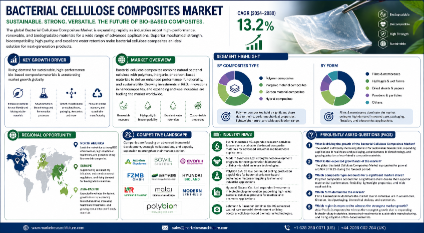
The global bacterial cellulose composites market is witnessing strong growth as industries increasingly seek renewable, biodegradable, and high-performance materials to replace conventional synthetic alternatives. Bacterial cellulose offers exceptional mechanical strength, high purity, excellent water retention, superior biocompatibility, and customizable structural properties, making it suitable for a wide range of composite applications. Continuous advancements in biotechnology, biofabrication processes, nanomaterial integration, and sustainable manufacturing technologies are further supporting market expansion. The market is projected to register a CAGR of 13.2% during the forecast period.
Key Growth Driver
Rising demand for sustainable, high-performance bio-based composite materials is accelerating market growth globally
Manufacturers across medical, packaging, textile, electronics, and specialty materials industries are increasingly adopting bacterial cellulose composites to improve product performance while reducing environmental impact. Ongoing developments in microbial fermentation, nanocomposite engineering, polymer reinforcement technologies, and circular economy initiatives continue to strengthen commercialization opportunities for bacterial cellulose-based materials.
Segment Highlight
Polymer composites and film & membrane applications continue to create significant growth opportunities
Based on composites type, Polymer Composites account for a significant share of the market owing to their enhanced mechanical strength, flexibility, lightweight characteristics, and broad applicability across biomedical devices, packaging materials, and advanced industrial products. Hybrid Composites are witnessing rapid growth due to their ability to combine multiple functional materials for improved durability, conductivity, and multifunctional performance. Inorganic Material Composites and Carbon Material Composites continue to attract increasing research and commercial interest for high-performance engineering and electronic applications.
By form, Films & Membranes dominate the market owing to their widespread use in wound care, food packaging, filtration systems, flexible electronics, and biomedical applications. Hydrogels & Wet Forms continue to experience strong demand in tissue engineering and regenerative medicine. Dried Sheets & Papers are increasingly utilized in sustainable packaging and specialty paper products, while Powders & Particles support composite manufacturing, coatings, and additive formulations. Other forms include customized materials designed for advanced industrial applications.
Regional Opportunity
North America remains the leading market, while Asia-Pacific is emerging as the fastest-growing region for bacterial cellulose composites
North America maintains a dominant position in the Bacterial Cellulose Composites Market due to strong biotechnology research capabilities, growing adoption of sustainable materials, advanced healthcare infrastructure, and increasing investment in bio-based manufacturing technologies. Europe continues to witness significant growth supported by circular economy initiatives, strict environmental regulations, and increasing use of biodegradable materials across multiple industries. Meanwhile, Asia-Pacific is expected to experience the fastest growth driven by expanding biotechnology industries, increasing industrial production, growing healthcare investments, rising demand for eco-friendly materials, and supportive government initiatives across China, Japan, South Korea, India, and Southeast Asia.
Competitive Landscape
Market participants are focusing on advanced biomaterial development, sustainable manufacturing technologies, nanocomposite engineering, and application-specific product innovation to strengthen their competitive position
Leading companies are investing in microbial fermentation technologies, scalable production processes, polymer reinforcement techniques, advanced composite formulations, and strategic collaborations with research institutions to improve material performance and commercial adoption. Expansion of production capacity, product portfolio diversification, investments in biomedical and sustainable packaging applications, and innovation in high-value bio-based materials continue to shape market competition.
Key companies operating in the market include Axcelon Biopolymers, BOWIL Biotech Sp. z o.o., Evonik Industries AG, FZMB GmbH, Hainan Guangyu Bio-technology, Hyundai Bioland Co., Ltd., Lohmann & Rauscher GmbH & Co. KG, Malai Biomaterials Design, Modern Synthesis Ltd., and Polybion S.A. de C.V.
Bacterial Cellulose Composites Industry News
Jun 2026: Evonik Industries AG expanded research activities focused on sustainable bio-based composite materials for advanced industrial and healthcare applications.
Apr 2026: Modern Synthesis Ltd. strengthened development programs for next-generation biomaterials utilizing microbial cellulose technologies.
Jan 2026: Polybion S.A. de C.V. continued scaling production capabilities for bacterial cellulose-based sustainable materials targeting fashion and industrial applications.
Oct 2025: Hyundai Bioland Co., Ltd. expanded investments in biotechnology innovation supporting high-value bacterial cellulose products for medical and cosmetic applications.
Aug 2025: Lohmann & Rauscher GmbH & Co. KG advanced wound care material development utilizing bacterial cellulose-based biomaterial technologies.
Historical & Forecast Period
This study report represents analysis of each segment from 2024 to 2034 considering 2025 as the base year. Compounded Annual Growth Rate (CAGR) for each of the respective segments estimated for the forecast period of 2026 to 2034.
The current report comprises of quantitative market estimations for each micro market for every geographical region and qualitative market analysis such as micro and macro environment analysis, market trends, competitive intelligence, segment analysis, porters five force model, top winning strategies, top investment markets, emerging trends and technological analysis, case studies, strategic conclusions and recommendations and other key market insights.
Research Methodology
The complete research study was conducted in three phases, namely: secondary research, primary research, and expert panel review. key data point that enables the estimation of Bacterial Cellulose Composites Market - Growth, Share, Opportunities & Competitive Analysis, 2026 - 2034 market are as follows:
Market forecast was performed through proprietary software that analyzes various qualitative and quantitative factors. Growth rate and CAGR were estimated through intensive secondary and primary research. Data triangulation across various data points provides accuracy across various analyzed market segments in the report. Application of both top down and bottom-up approach for validation of market estimation assures logical, methodical and mathematical consistency of the quantitative data.
| ATTRIBUTE | DETAILS |
|---|---|
| Research Period | 2024-2034 |
| Base Year | 2025 |
| Forecast Period | 2026-2034 |
| Historical Year | 2024 |
| Unit | USD Million |
| Segmentation | |
Composites Type
|
|
Form
|
|
End Use Industry
|
|
|
Region Segment (2024-2034; US$ Million)
|
Frequently Asked Questions
Q1. What is driving the growth of the Bacterial Cellulose Composites Market?
The market is primarily driven by increasing demand for sustainable biomaterials, expanding applications in healthcare and packaging, advancements in biotechnology, and growing adoption of environmentally friendly composite materials.
Q2. What is the expected growth rate of the Bacterial Cellulose Composites Market?
The global Bacterial Cellulose Composites Market is projected to expand at a CAGR of 13.2% during the forecast period.
Q3. Which composite type accounts for a significant market share?
Polymer Composites account for a significant market share due to their superior mechanical performance, flexibility, lightweight properties, and broad applicability across medical, packaging, and industrial sectors.
Q4. Which form dominates the Bacterial Cellulose Composites Market?
Films & Membranes dominate the market owing to their extensive use in wound care, filtration, food packaging, biomedical devices, and flexible electronic applications.
Q5. Which region is expected to witness the strongest market growth?
Asia-Pacific is expected to witness the strongest market growth due to expanding biotechnology industries, increasing investment in sustainable manufacturing, rising healthcare demand, and growing adoption of bio-based materials across multiple industrial sectors.


