
Growing demand for sustainable chemicals, increasing adoption of bio-based materials, and rising focus on reducing carbon emissions across industrial manufacturing are driving the growth of the bio-adipic acid market worldwide.
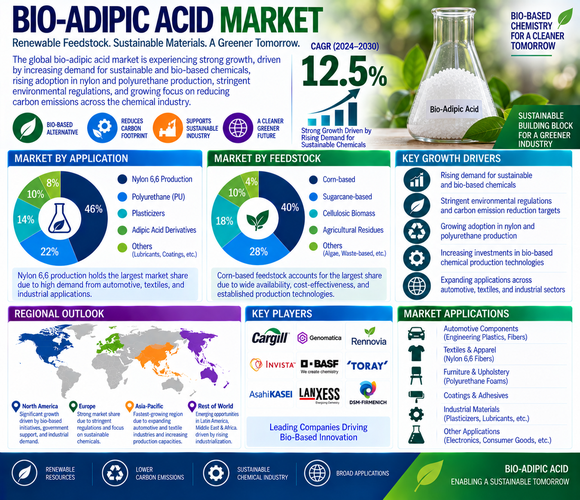
The global bio-adipic acid market is gaining strong momentum as manufacturers increasingly shift toward renewable feedstocks and environmentally sustainable chemical production. Bio-adipic acid serves as a sustainable alternative to petroleum-based adipic acid and is widely used in nylon production, polyurethanes, plasticizers, lubricants, coatings, and specialty chemicals. Rising regulatory support for green chemicals, corporate sustainability initiatives, and growing investment in industrial biotechnology continue to accelerate market development. Advancements in microbial fermentation, catalytic conversion technologies, and hybrid biosynthetic processes are improving production efficiency and commercial scalability. The market is projected to register a CAGR of 12.5% during the forecast period.
Key Growth Driver
Increasing demand for renewable and low-carbon chemical intermediates is accelerating market growth globally.
Chemical manufacturers, automotive suppliers, textile producers, and consumer goods companies are increasingly adopting bio-based raw materials to reduce greenhouse gas emissions and achieve sustainability targets. Bio-adipic acid offers lower environmental impact while maintaining comparable performance to conventional adipic acid. Continuous advancements in biotechnology, process optimization, renewable feedstock utilization, and large-scale commercial production are further supporting market expansion.
Segment Highlight
Advanced bio-production technologies and expanding industrial applications continue to create significant growth opportunities.
Based on production technology, Microbial Fermentation accounts for a significant share of the market due to continuous improvements in industrial biotechnology, higher production efficiency, and increasing commercialization of bio-based chemical manufacturing. Catalytic Conversion is witnessing strong growth through technological advancements that enable efficient conversion of renewable feedstocks into adipic acid. Semi-Biosynthetic (Hybrid) production methods are gaining increasing attention by combining biological and chemical processes to improve production yields and cost efficiency.
By application, Nylon 6,6 Production dominates the market owing to increasing demand for sustainable engineering plastics across automotive, textiles, industrial equipment, and consumer goods industries. Polyurethanes continue to witness strong growth driven by rising demand from construction, furniture, and automotive applications. Adipate Esters (Plasticizers) are gaining wider adoption in flexible plastics and specialty materials, while Lubricants, Coatings & Paints, and Food Additives continue to benefit from increasing preference for renewable chemical ingredients. Others include specialty chemicals and emerging bio-based industrial applications.
Regional Opportunity
Europe remains the leading market, while Asia-Pacific is emerging as the fastest-growing region for bio-adipic acid.
Europe maintains a dominant position in the Bio-Adipic Acid Market due to stringent environmental regulations, strong circular economy initiatives, extensive investment in industrial biotechnology, and increasing demand for renewable chemicals across manufacturing industries. North America continues to witness significant growth supported by technological innovation, commercialization of bio-based chemicals, and expanding sustainability commitments from major chemical manufacturers. Meanwhile, Asia-Pacific is expected to experience the fastest growth driven by expanding chemical manufacturing capacity, increasing investment in green technologies, rising demand for sustainable polymers, supportive government initiatives, and rapid industrial development across China, India, Japan, South Korea, and Southeast Asia.
Competitive Landscape
Market participants are focusing on renewable feedstock utilization, advanced biotechnology platforms, process optimization, and commercial-scale bio-based chemical production to strengthen their competitive position.
Leading companies are investing in next-generation microbial fermentation technologies, catalytic process innovation, production capacity expansion, and strategic collaborations to improve manufacturing efficiency and reduce production costs. Research and development activities focused on improving fermentation yields, enhancing process scalability, and developing sustainable value chains continue to shape market competition. Companies are also emphasizing carbon footprint reduction, supply chain sustainability, and partnerships with downstream polymer and specialty chemical manufacturers to expand commercial adoption.
Key companies operating in the market include Invista, Ascend Performance Materials, Genomatica Inc., Radici Group, and Asahi Kasei Corporation.
Bio-Adipic Acid Industry News
Jun 2026: Genomatica Inc. continued advancing bio-based chemical production technologies to strengthen commercialization of renewable industrial intermediates.
Apr 2026: Asahi Kasei Corporation expanded sustainability initiatives supporting the development of low-carbon specialty chemical manufacturing.
Jan 2026: Ascend Performance Materials enhanced research efforts focused on sustainable raw materials for high-performance polymer production.
Oct 2025: Radici Group increased investment in circular economy solutions and bio-based materials to support sustainable chemical manufacturing.
Aug 2025: Invista continued evaluating innovative production technologies aimed at improving the sustainability and efficiency of adipic acid manufacturing.
Historical & Forecast Period
This study report represents analysis of each segment from 2024 to 2034 considering 2025 as the base year. Compounded Annual Growth Rate (CAGR) for each of the respective segments estimated for the forecast period of 2026 to 2034.
The current report comprises of quantitative market estimations for each micro market for every geographical region and qualitative market analysis such as micro and macro environment analysis, market trends, competitive intelligence, segment analysis, porters five force model, top winning strategies, top investment markets, emerging trends and technological analysis, case studies, strategic conclusions and recommendations and other key market insights.
Research Methodology
The complete research study was conducted in three phases, namely: secondary research, primary research, and expert panel review. key data point that enables the estimation of Bio-Adipic Acid Market - Growth, Share, Opportunities & Competitive Analysis, 2026 - 2034 market are as follows:
Market forecast was performed through proprietary software that analyzes various qualitative and quantitative factors. Growth rate and CAGR were estimated through intensive secondary and primary research. Data triangulation across various data points provides accuracy across various analyzed market segments in the report. Application of both top down and bottom-up approach for validation of market estimation assures logical, methodical and mathematical consistency of the quantitative data.
| ATTRIBUTE | DETAILS |
|---|---|
| Research Period | 2024-2034 |
| Base Year | 2025 |
| Forecast Period | 2026-2034 |
| Historical Year | 2024 |
| Unit | USD Million |
| Segmentation | |
Production Technology
|
|
Application
|
|
Grade
|
|
End User
|
|
|
Region Segment (2024-2034; US$ Million)
|
Frequently Asked Questions
Q1. What is driving the growth of the Bio-Adipic Acid Market?
The market is primarily driven by increasing demand for sustainable chemicals, rising adoption of renewable feedstocks, growing environmental regulations, expanding industrial biotechnology, and increasing investment in low-carbon manufacturing processes.
Q2. What is the expected growth rate of the Bio-Adipic Acid Market?
The global Bio-Adipic Acid Market is projected to expand at a CAGR of 12.5% during the forecast period.
Q3. Which production technology accounts for a significant market share?
Microbial Fermentation accounts for a significant market share due to advancements in biotechnology, improved production efficiency, commercial scalability, and increasing demand for renewable chemical manufacturing.
Q4. Which application dominates the Bio-Adipic Acid Market?
Nylon 6,6 Production dominates the market owing to growing demand for sustainable engineering plastics across automotive, textile, industrial, and consumer product applications.
Q5. Which region is expected to witness the strongest market growth?
Asia-Pacific is expected to witness the strongest market growth due to expanding industrial manufacturing, increasing investment in green chemicals, supportive government policies, and growing demand for sustainable polymers and bio-based materials.


