
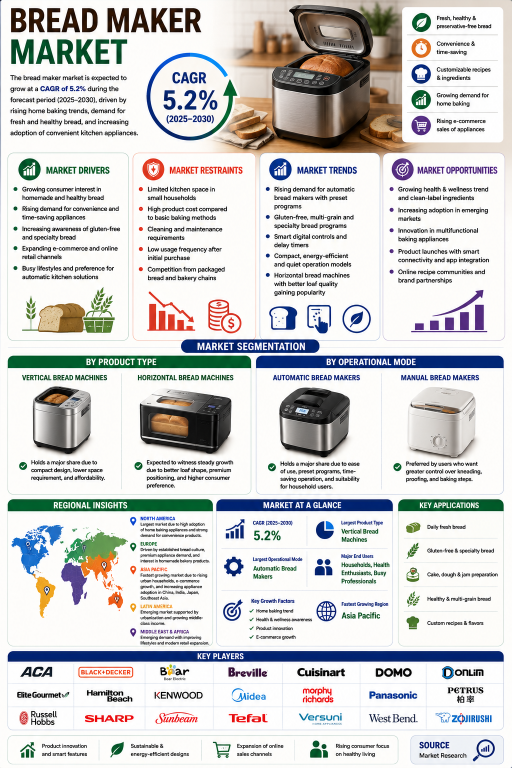
The bread maker market is expected to grow at a CAGR of 5.2% during the forecast period, driven by rising home baking trends, demand for fresh and preservative-free bread, convenience-focused kitchen appliances, and increasing adoption of automatic cooking solutions.
Market Drivers
The market is mainly driven by increasing consumer interest in homemade bread, healthier ingredients, and customized recipes. Bread makers help users prepare fresh bread with lower effort, consistent quality, and control over ingredients.
Growth in compact kitchen appliances, rising demand for gluten-free and specialty bread, and expansion of e-commerce appliance sales are supporting market growth. Busy households are also adopting automatic bread makers for convenience and time savings.
Market Restraints
The market faces challenges related to limited kitchen space, product cost, cleaning requirements, and low usage frequency after initial purchase.
Competition from packaged bread, bakery chains, and multifunctional cooking appliances may also restrict market growth in some regions.
Bread Maker Market Trends
The market is witnessing strong demand for automatic bread makers with preset programs, delay timers, gluten-free settings, and compact designs.
Manufacturers are focusing on smart controls, energy efficiency, non-stick pans, quiet operation, and multifunctional baking modes. Premium models with horizontal loaf design and advanced kneading systems are gaining demand.
Market Segmentation
By Product Type
By product type, the market is segmented into vertical bread machines and horizontal bread machines. Vertical bread machines hold a major share due to compact design, lower space requirement, and affordability.
Horizontal bread machines are expected to witness steady growth due to better loaf shape, premium positioning, and higher consumer preference for bakery-style bread.
By Operational Mode
By operational mode, the market is segmented into automatic bread makers and manual bread makers. Automatic bread makers hold a major share due to ease of use, preset programs, time-saving operation, and suitability for household users.
Manual bread makers remain relevant for users who prefer greater control over kneading, proofing, and baking steps.
Regional Insights
North America holds a significant share of the bread maker market due to high adoption of home baking appliances, strong demand for convenience products, and rising preference for specialty bread.
Europe is driven by established bread consumption culture, premium kitchen appliance demand, and growing interest in homemade bakery products. Asia Pacific is expected to witness strong growth due to rising urban households, e-commerce penetration, and increasing adoption of small kitchen appliances in China, Japan, India, and Southeast Asia.
Latin America and the Middle East & Africa are emerging markets supported by urbanization, growing middle-class income, and rising demand for convenient kitchen solutions.
Competitive Landscape
The bread maker market is competitive, with companies focusing on preset baking programs, compact design, loaf quality, durability, and affordability. Competition is based on product capacity, baking modes, ease of cleaning, pricing, energy efficiency, and brand trust.
Key companies operating in the market include ACA, BLACK+DECKER, Bear Electric, Breville, Cuisinart, Domo, Donlim, Elite Gourmet, Hamilton Beach, Kenwood, Midea, Morphy Richards, Panasonic, Petrus, Russell Hobbs, Sharp, Sunbeam, Tefal, Versuni, West Bend, and Zojirushi.
Bread Maker Industry News
The industry is witnessing increasing launches of compact automatic bread makers, gluten-free bread programs, multifunctional baking appliances, and energy-efficient models.
Manufacturers are focusing on digital controls, improved kneading systems, recipe customization, and online distribution to reach household consumers.
Historical & Forecast Period
This study report represents analysis of each segment from 2024 to 2034 considering 2025 as the base year. Compounded Annual Growth Rate (CAGR) for each of the respective segments estimated for the forecast period of 2026 to 2034.
The current report comprises of quantitative market estimations for each micro market for every geographical region and qualitative market analysis such as micro and macro environment analysis, market trends, competitive intelligence, segment analysis, porters five force model, top winning strategies, top investment markets, emerging trends and technological analysis, case studies, strategic conclusions and recommendations and other key market insights.
Research Methodology
The complete research study was conducted in three phases, namely: secondary research, primary research, and expert panel review. key data point that enables the estimation of Bread Maker Market - Growth, Share, Opportunities & Competitive Analysis, 2026 - 2034 market are as follows:
Market forecast was performed through proprietary software that analyzes various qualitative and quantitative factors. Growth rate and CAGR were estimated through intensive secondary and primary research. Data triangulation across various data points provides accuracy across various analyzed market segments in the report. Application of both top down and bottom-up approach for validation of market estimation assures logical, methodical and mathematical consistency of the quantitative data.
| ATTRIBUTE | DETAILS |
|---|---|
| Research Period | 2024-2034 |
| Base Year | 2025 |
| Forecast Period | 2026-2034 |
| Historical Year | 2024 |
| Unit | USD Million |
| Segmentation | |
Product Type
|
|
Operational Mode
|
|
Capacity
|
|
Price
|
|
Application
|
|
Distribution Channel
|
|
|
Region Segment (2024-2034; US$ Million)
|
Frequently Asked Questions
What is the growth outlook for the bread maker market?
The market is expected to grow at a CAGR of 5.2% during the forecast period.
Which product type holds a major share?
Vertical bread machines hold a major share due to compact design and affordability.
Which operational mode dominates the market?
Automatic bread makers dominate due to preset programs, ease of use, and time-saving benefits.
What are the major challenges?
Limited kitchen space, product cost, cleaning needs, low repeat usage, and competition from packaged bread are major challenges.
Who are the key players?
Major companies include Panasonic, Zojirushi, Breville, Cuisinart, BLACK+DECKER, Hamilton Beach, Kenwood, Midea, Tefal, and Versuni.


