
Convenience-oriented kitchen tools, evolving consumer lifestyles, and ergonomic product designs continue to support market growth
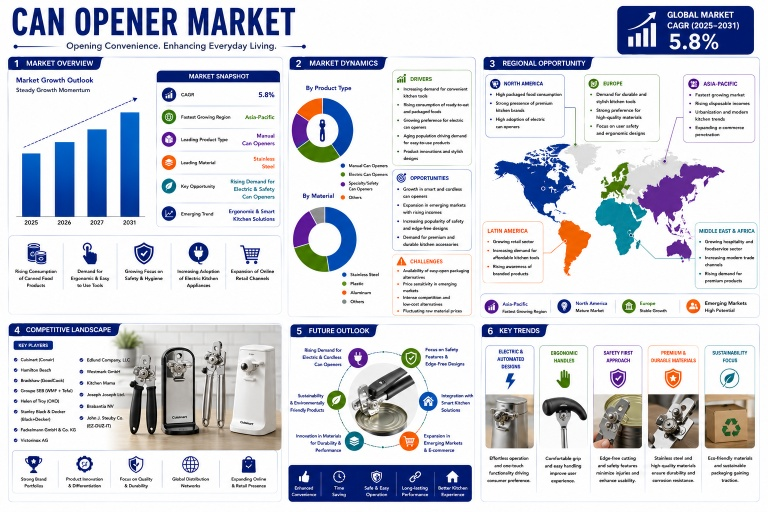
The global Can Opener Market is witnessing steady expansion driven by increasing household consumption of packaged food products, growing demand for user-friendly kitchen accessories, and rising preference for multifunctional kitchen appliances. Can openers remain essential tools in residential and commercial kitchens, offering convenience, safety, and improved efficiency in food preparation. Manufacturers are increasingly focusing on innovative designs, enhanced durability, and electric automation features to address changing consumer preferences. The market is projected to register a CAGR of 5.8% during the forecast period.
Key Growth Driver
Rising consumption of canned food products and demand for ergonomic kitchen tools are accelerating market expansion.
The growing popularity of ready-to-eat meals, preserved food products, and convenient cooking solutions is increasing the demand for reliable can opening devices. Consumers are increasingly seeking products that offer comfortable grip mechanisms, smooth cutting performance, and enhanced safety features. In addition, the expanding elderly population and increasing adoption of electric kitchen appliances are further supporting market growth.
Segment Highlight
Product innovation and safety-oriented designs continue to create new opportunities.
Based on product type, Manual Can Openers account for a significant share of the market due to their affordability, portability, and widespread household usage. Electric Can Openers are witnessing growing adoption as consumers seek effortless and convenient kitchen solutions. Specialty/Safety Can Openers are gaining popularity because they minimize sharp edges and improve user safety. Other product categories continue to cater to niche consumer requirements and commercial foodservice applications.
By material, Stainless Steel remains the dominant segment owing to its corrosion resistance, durability, and premium appearance. Plastic components continue to be widely utilized in lightweight and cost-effective products, while Aluminum offers advantages in terms of reduced weight and aesthetic appeal. Other materials are supporting specialized and decorative kitchen accessory designs.
Regional Opportunity
Asia-Pacific is emerging as a high-growth market supported by urbanization and increasing demand for modern kitchen accessories.
North America maintains a strong market presence driven by high packaged food consumption, premium kitchenware adoption, and widespread use of electric appliances. Europe benefits from sophisticated culinary practices, strong preference for durable kitchen tools, and increasing demand for innovative household products. Meanwhile, Asia-Pacific is expected to witness accelerated growth due to rising disposable incomes, expanding middle-class populations, increasing urbanization, and growing investments in modern home improvement products across China, India, Japan, South Korea, and Southeast Asian countries.
Competitive Landscape
Manufacturers are emphasizing product durability, ergonomic designs, and smart kitchen integration to strengthen market positioning.
Leading companies are investing in stainless steel construction, automated opening mechanisms, safety-enhanced cutting systems, and aesthetically appealing designs to differentiate their offerings. Strategic partnerships, product launches, and expansion through online retail platforms continue to influence the competitive environment. Companies are also focusing on sustainable packaging and premium kitchen accessory collections to address evolving consumer expectations.
Key companies operating in the market include Cuisinart (Conair), Hamilton Beach, Bradshaw (GoodCook), Groupe SEB (WMF + Tefal), Helen of Troy (OXO), Stanley Black & Decker (Black+Decker), Fackelmann GmbH & Co. KG, Victorinox AG, Edlund Company, LLC, Westmark GmbH, Kitchen Mama, Joseph Joseph Ltd., Brabantia NV, and John J. Steuby Co.
Historical & Forecast Period
This study report represents analysis of each segment from 2024 to 2034 considering 2025 as the base year. Compounded Annual Growth Rate (CAGR) for each of the respective segments estimated for the forecast period of 2026 to 2034.
The current report comprises of quantitative market estimations for each micro market for every geographical region and qualitative market analysis such as micro and macro environment analysis, market trends, competitive intelligence, segment analysis, porters five force model, top winning strategies, top investment markets, emerging trends and technological analysis, case studies, strategic conclusions and recommendations and other key market insights.
Research Methodology
The complete research study was conducted in three phases, namely: secondary research, primary research, and expert panel review. key data point that enables the estimation of Can Opener Market - Growth, Share, Opportunities & Competitive Analysis, 2026 - 2034 market are as follows:
Market forecast was performed through proprietary software that analyzes various qualitative and quantitative factors. Growth rate and CAGR were estimated through intensive secondary and primary research. Data triangulation across various data points provides accuracy across various analyzed market segments in the report. Application of both top down and bottom-up approach for validation of market estimation assures logical, methodical and mathematical consistency of the quantitative data.
| ATTRIBUTE | DETAILS |
|---|---|
| Research Period | 2024-2034 |
| Base Year | 2025 |
| Forecast Period | 2026-2034 |
| Historical Year | 2024 |
| Unit | USD Million |
| Segmentation | |
Product Type
|
|
Material
|
|
Price Range
|
|
Application
|
|
Distribution Channel
|
|
|
Region Segment (2024-2034; US$ Million)
|
Frequently Asked Questions
Q1. What is driving the growth of the Can Opener Market?
The market is primarily driven by increasing consumption of canned food products, growing preference for convenient kitchen tools, rising adoption of electric appliances, and demand for ergonomic product designs.
Q2. What is the expected growth rate of the Can Opener Market?
The global Can Opener Market is projected to expand at a CAGR of 5.8% during the forecast period.
Q3. Which product segment accounts for a significant market share?
Manual Can Openers account for a notable market share due to their affordability, portability, and extensive usage in residential kitchens.
Q4. Why are safety can openers gaining popularity?
Safety can openers help eliminate sharp lid edges, reduce the risk of injuries, and provide smoother cutting performance, making them increasingly attractive to consumers.
Q5. Which material segment dominates the market?
Stainless Steel dominates the market owing to its durability, corrosion resistance, ease of cleaning, and premium aesthetic appeal.
Q6. Which region is expected to witness the fastest market growth?
Asia-Pacific is anticipated to emerge as the fastest-growing market due to increasing urbanization, rising disposable incomes, and growing demand for modern kitchen accessories.
Q7. What trends are influencing the can opener industry?
Key trends include electric can openers, battery-powered devices, ergonomic handles, touchless opening mechanisms, and premium kitchenware collections.
Q8. What challenges could affect market expansion?
Intense competition, availability of low-cost alternatives, fluctuations in raw material prices, and increasing preference for easy-open packaging may influence market growth.
Q9. Who are the leading companies operating in the Can Opener Market?
Major companies include Cuisinart (Conair), Hamilton Beach, Bradshaw (GoodCook), Groupe SEB (WMF + Tefal), Helen of Troy (OXO), Stanley Black & Decker (Black+Decker), Fackelmann GmbH & Co. KG, Victorinox AG, Edlund Company, LLC, Westmark GmbH, Kitchen Mama, Joseph Joseph Ltd., Brabantia NV, and John J. Steuby Co. (EZ-DUZ-IT).
Q10. What opportunities are expected to shape the future of the market?
Growing demand for premium kitchen tools, increasing popularity of smart kitchen appliances, rising online retail penetration, and advancements in safety-focused designs are expected to create substantial growth opportunities.


