
Growing awareness of child safety, increasing participation in outdoor recreational activities, and rising adoption of protective gear are driving the growth of the child safety helmet market worldwide.
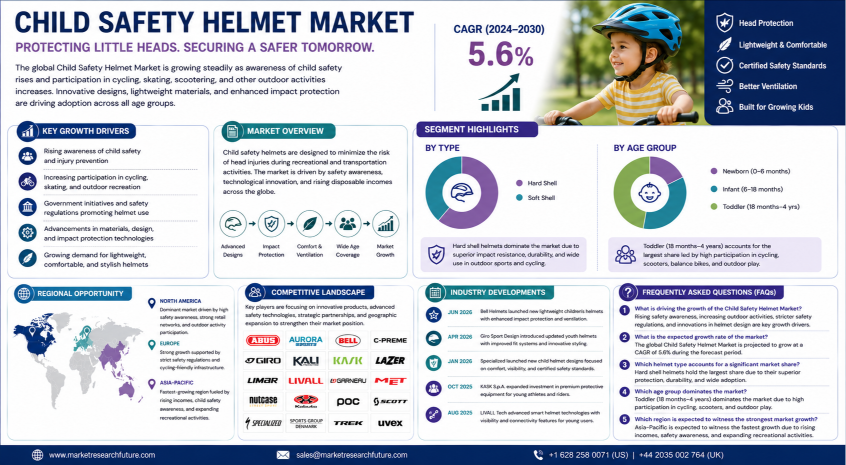
The global child safety helmet market is witnessing steady growth as parents and caregivers increasingly prioritize head protection for infants, toddlers, and young children during cycling, skating, scootering, and other recreational activities. Child safety helmets are designed to minimize the risk of head injuries through impact-absorbing materials, ergonomic designs, lightweight construction, and enhanced comfort features. Continuous advancements in helmet engineering, smart safety technologies, breathable materials, and child-friendly designs are further supporting market expansion. Increasing government initiatives promoting road safety and growing awareness of injury prevention continue to strengthen market demand. The market is projected to register a CAGR of 5.6% during the forecast period.
Key Growth Driver
Increasing awareness of child injury prevention and adoption of certified protective equipment is accelerating market growth globally.
Parents, educational institutions, sports organizations, and healthcare professionals are increasingly encouraging the use of certified helmets to reduce the risk of head injuries during recreational and transportation activities. Manufacturers continue to develop lightweight shells, improved ventilation systems, adjustable fitting mechanisms, enhanced impact protection, and attractive child-focused designs to improve product adoption across different age groups.
Segment Highlight
Hard shell helmets and toddler applications continue to create significant growth opportunities.
Based on type, Hard Shell helmets account for a significant share of the market owing to their superior impact resistance, durability, extended product lifespan, and widespread use across cycling, skating, and other outdoor sports. Soft Shell helmets continue to witness growing demand for indoor safety applications, early childhood protection, and lightweight everyday use where flexibility and comfort are prioritized.
By age group, Toddler (18 months–4 years) dominates the market due to increasing participation in cycling, balance bikes, scooters, playground activities, and outdoor recreation during early childhood. Infant (6–18 months) continues to experience steady demand for protective helmets designed for early mobility and developmental activities. Newborn (0–6 months) represents a specialized segment serving medical support and protective care applications where appropriate.
Regional Opportunity
North America remains the leading market, while Asia-Pacific is emerging as the fastest-growing region for child safety helmets.
North America maintains a dominant position in the Child Safety Helmet Market due to high consumer awareness of child safety, established safety standards, widespread participation in outdoor recreational activities, and strong retail distribution networks. Europe continues to witness significant growth supported by strict product safety regulations, cycling-friendly infrastructure, and increasing adoption of protective sports equipment. Meanwhile, Asia-Pacific is expected to experience the fastest growth driven by rising disposable incomes, expanding middle-class populations, growing awareness of child safety, increasing participation in outdoor sports, and improving access to premium protective equipment across China, India, Japan, South Korea, and Southeast Asia.
Competitive Landscape
Market participants are focusing on lightweight helmet designs, advanced impact protection technologies, sustainable materials, and child-centric product innovation to strengthen their competitive position.
Leading companies are investing in advanced foam technologies, multi-impact protection systems, adjustable sizing mechanisms, smart safety features, and enhanced ventilation systems to improve comfort and protection. Strategic partnerships with sports organizations, retailers, educational institutions, and bicycle manufacturers continue to expand market reach. Manufacturers are also emphasizing compliance with international safety standards, environmentally responsible materials, customizable designs, and premium product offerings to meet evolving consumer expectations.
Key companies operating in the market include August Bremicker Sohne KG, Aurora Sports Limited, Bell Helmets, C-Preme Limited LLC, Giro Sport Design, Kali Protectives, KASK S.p.A., Lazer Sport NV, Limar Srl, LIVALL Tech S.L., Louis Garneau Sports Inc., MET Helmets, Nutcase Helmets, OGK Kabuto Co., Ltd., POC Sweden AB, Scott Sports SA, Specialized Bicycle Components, Inc., Sports Group Denmark A/S, Strategic Sports Limited, Trek Bicycle Corporation, and Uvex Sports GmbH & Co. KG.
Child Safety Helmet Industry News
Jun 2026: Bell Helmets expanded development of lightweight children's helmets featuring enhanced impact protection and improved ventilation systems.
Apr 2026: Giro Sport Design strengthened its youth helmet portfolio with updated safety technologies and improved fit systems for young riders.
Jan 2026: Specialized Bicycle Components, Inc. introduced new child helmet designs focused on comfort, visibility, and certified impact protection.
Oct 2025: KASK S.p.A. expanded investments in premium protective equipment supporting advanced safety standards for youth sports.
Aug 2025: LIVALL Tech S.L. continued advancing smart helmet technologies integrating visibility and connected safety features for recreational users.
Historical & Forecast Period
This study report represents analysis of each segment from 2024 to 2034 considering 2025 as the base year. Compounded Annual Growth Rate (CAGR) for each of the respective segments estimated for the forecast period of 2026 to 2034.
The current report comprises of quantitative market estimations for each micro market for every geographical region and qualitative market analysis such as micro and macro environment analysis, market trends, competitive intelligence, segment analysis, porters five force model, top winning strategies, top investment markets, emerging trends and technological analysis, case studies, strategic conclusions and recommendations and other key market insights.
Research Methodology
The complete research study was conducted in three phases, namely: secondary research, primary research, and expert panel review. key data point that enables the estimation of Child Safety Helmet Market - Growth, Share, Opportunities & Competitive Analysis, 2026 - 2034 market are as follows:
Market forecast was performed through proprietary software that analyzes various qualitative and quantitative factors. Growth rate and CAGR were estimated through intensive secondary and primary research. Data triangulation across various data points provides accuracy across various analyzed market segments in the report. Application of both top down and bottom-up approach for validation of market estimation assures logical, methodical and mathematical consistency of the quantitative data.
| ATTRIBUTE | DETAILS |
|---|---|
| Research Period | 2024-2034 |
| Base Year | 2025 |
| Forecast Period | 2026-2034 |
| Historical Year | 2024 |
| Unit | USD Million |
| Segmentation | |
Type
|
|
Material
|
|
Age Group
|
|
Price Range
|
|
Distribution Channel
|
|
|
Region Segment (2024-2034; US$ Million)
|
Frequently Asked Questions
Q1. What is driving the growth of the Child Safety Helmet Market?
The market is primarily driven by increasing awareness of child safety, growing participation in outdoor recreational activities, stricter safety regulations, and continuous innovation in lightweight and impact-resistant helmet technologies.
Q2. What is the expected growth rate of the Child Safety Helmet Market?
The global Child Safety Helmet Market is projected to expand at a CAGR of 5.6% during the forecast period.
Q3. Which helmet type accounts for a significant market share?
Hard Shell helmets account for a significant market share due to their superior durability, enhanced impact protection, and broad adoption across cycling, skating, and other outdoor recreational activities.
Q4. Which age group dominates the Child Safety Helmet Market?
The Toddler (18 months–4 years) segment dominates the market owing to increased participation in cycling, scooters, balance bikes, playground activities, and other outdoor recreational sports requiring protective headgear.
Q5. Which region is expected to witness the strongest market growth?
Asia-Pacific is expected to witness the strongest market growth due to increasing child safety awareness, rising disposable incomes, expanding participation in recreational activities, and growing demand for certified protective equipment across developing economies.


