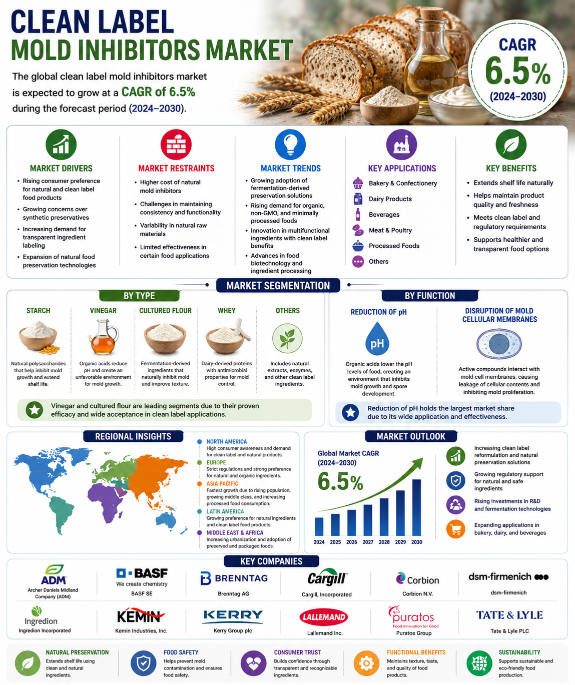
The global clean label mold inhibitors market is expected to grow at a CAGR of 6.5% during the forecast period. Market growth is driven by increasing consumer preference for natural food ingredients, rising demand for clean label food products, growing concerns regarding synthetic preservatives, and expanding adoption of natural food preservation technologies. Clean label mold inhibitors help extend product shelf life while meeting consumer demand for recognizable and minimally processed ingredients. The growing trend toward healthier eating habits and transparent ingredient labeling continues to support market expansion across bakery, dairy, beverage, and processed food applications.
Market Drivers
Growing Consumer Demand for Clean Label and Natural Food Products
Consumers are increasingly scrutinizing ingredient labels and seeking food products free from artificial additives and chemical preservatives. Food manufacturers are responding by reformulating products with natural preservation solutions that maintain product quality and safety. Clean label mold inhibitors derived from natural sources such as vinegar, cultured flour, and fermentation-based ingredients are gaining significant traction as food producers seek to align with evolving consumer preferences and regulatory requirements.
Market Restraints
Higher Cost and Formulation Challenges
Clean label mold inhibitors often involve higher production costs compared to conventional synthetic preservatives. Manufacturers may face challenges in maintaining consistent product performance, flavor profiles, texture characteristics, and shelf-life stability when replacing traditional preservation systems. Variability in natural raw materials and limited effectiveness in certain food applications may also impact market adoption.
Clean Label Mold Inhibitors Market Trends
The market is witnessing increasing adoption of fermentation-derived preservation solutions and multifunctional ingredients that provide both mold inhibition and product quality enhancement. Food manufacturers are investing in natural preservation technologies that support extended shelf life without compromising clean label positioning. Demand for organic, non-GMO, and minimally processed food products continues to drive innovation in mold inhibition solutions. Additionally, advances in microbial fermentation, food biotechnology, and natural ingredient processing are enabling the development of more effective clean label preservation systems.
Market Segmentation
By Type
Based on type, the market is segmented into Starch, Vinegar, Cultured Flour, Whey, and Others. Vinegar-based mold inhibitors account for a significant market share due to their proven antimicrobial effectiveness, consumer acceptance, clean label compatibility, and broad application across bakery and processed food products. Cultured flour is witnessing strong growth due to its ability to provide natural preservation while maintaining product quality and label transparency. Whey-based and starch-based solutions also continue to gain adoption across specialized food applications.
By Function
Based on function, the market is segmented into Reduction of pH and Disruption of Mold Cellular Membranes. Reduction of pH holds a major market share due to its widespread use in preventing mold growth through the creation of unfavorable conditions for microbial development. This approach is extensively utilized in bakery, dairy, and processed food applications. Disruption of mold cellular membranes is gaining importance as manufacturers seek more targeted preservation mechanisms that provide effective mold control while maintaining product quality and clean label claims.
Regional Insights
North America represents a major market for clean label mold inhibitors due to strong consumer demand for natural food ingredients, well-established clean label trends, and increasing reformulation efforts by food manufacturers. The United States continues to lead regional demand owing to growing preference for preservative-free and minimally processed food products. Europe is witnessing significant growth supported by stringent food ingredient regulations, increasing organic food consumption, and strong clean label adoption across bakery and dairy sectors. Asia Pacific is expected to record the fastest growth during the forecast period due to rising health awareness, expanding processed food consumption, growing middle-class populations, and increasing demand for premium food products across China, India, Japan, South Korea, and Southeast Asia. Latin America and the Middle East & Africa are also experiencing increasing demand as clean label food trends gain momentum.
Competitive Landscape
The clean label mold inhibitors market is moderately competitive, with companies focusing on natural ingredient innovation, fermentation technologies, product performance enhancement, and expansion of clean label product portfolios. Manufacturers are investing in research and development to improve mold inhibition effectiveness while maintaining ingredient transparency and consumer acceptance. Strategic partnerships with food manufacturers, acquisitions, and expansion into emerging food markets remain key growth strategies. Competitive differentiation increasingly depends on preservation efficiency, formulation flexibility, regulatory compliance, clean label positioning, and application expertise.
Key companies operating in the market include Archer Daniels Midland Company (ADM), BASF SE, Brenntag AG, Cargill, Incorporated, Corbion N.V., dsm-firmenich, Ingredion Incorporated, Kemin Industries, Inc., Kerry Group plc, Lallemand Inc., Puratos Group, and Tate & Lyle PLC.
Clean Label Mold Inhibitors Industry News
The industry is witnessing increasing investment in natural preservation technologies and fermentation-based ingredient solutions. Food ingredient manufacturers are introducing new clean label mold inhibition products designed to support extended shelf life while meeting evolving consumer expectations for ingredient transparency. Growing demand for organic foods, preservative-free bakery products, and minimally processed packaged foods continues to create opportunities for market participants. The development of multifunctional clean label ingredients that combine preservation, texture enhancement, and flavor optimization is expected to remain a major industry focus during the forecast period.
Historical & Forecast Period
This study report represents analysis of each segment from 2024 to 2034 considering 2025 as the base year. Compounded Annual Growth Rate (CAGR) for each of the respective segments estimated for the forecast period of 2026 to 2034.
The current report comprises of quantitative market estimations for each micro market for every geographical region and qualitative market analysis such as micro and macro environment analysis, market trends, competitive intelligence, segment analysis, porters five force model, top winning strategies, top investment markets, emerging trends and technological analysis, case studies, strategic conclusions and recommendations and other key market insights.
Research Methodology
The complete research study was conducted in three phases, namely: secondary research, primary research, and expert panel review. key data point that enables the estimation of Clean Label Mold Inhibitors market are as follows:
Market forecast was performed through proprietary software that analyzes various qualitative and quantitative factors. Growth rate and CAGR were estimated through intensive secondary and primary research. Data triangulation across various data points provides accuracy across various analyzed market segments in the report. Application of both top down and bottom-up approach for validation of market estimation assures logical, methodical and mathematical consistency of the quantitative data.
| ATTRIBUTE | DETAILS |
|---|---|
| Research Period | 2024-2034 |
| Base Year | 2025 |
| Forecast Period | 2026-2034 |
| Historical Year | 2024 |
| Unit | USD Million |
| Segmentation | |
Type
|
|
Function
|
|
Application
|
|
|
Region Segment (2024-2034; US$ Million)
|
Frequently Asked Questions
What is the expected growth rate of the clean label mold inhibitors market?
The clean label mold inhibitors market is expected to grow at a CAGR of 6.5% during the forecast period.
Which type segment holds a significant market share?
Vinegar-based mold inhibitors hold a significant market share due to their strong antimicrobial properties, clean label compatibility, and broad food industry applications.
Which function dominates the market?
Reduction of pH dominates the market owing to its proven effectiveness in inhibiting mold growth across a wide range of food products.
What are the major growth drivers?
Major growth drivers include increasing consumer demand for clean label foods, rising preference for natural ingredients, growing concerns regarding synthetic preservatives, and expanding adoption of natural food preservation technologies.
Who are the major companies operating in the market?
Major companies include Archer Daniels Midland Company (ADM), BASF SE, Cargill, Incorporated, Corbion N.V., dsm-firmenich, Ingredion Incorporated, Kemin Industries, Inc., Kerry Group plc, Lallemand Inc., Puratos Group, and Tate & Lyle PLC.