
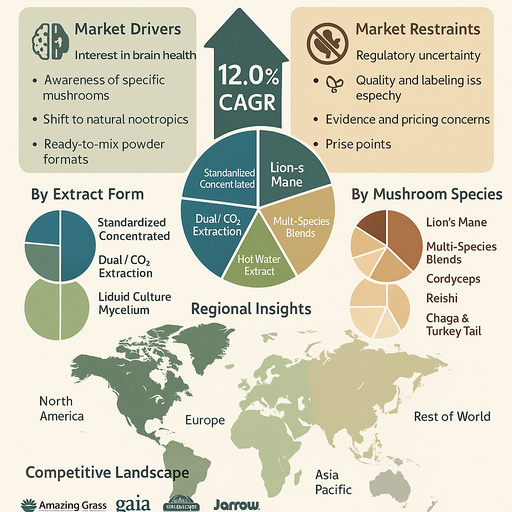
The cognitive enhancement mushroom extract market is growing at a 12.0% CAGR as consumers look for natural support for focus, memory, mood, and resilience rather than relying only on synthetic nootropics or caffeine-heavy products. Mushroom extracts are being added into capsules, powders, functional beverages, gummies, and snack formats, with brands positioning them for brain health, mental clarity, and stress support. Demand is rising from biohackers, knowledge workers, students, and wellness-focused consumers, as well as from supplement brands and functional food manufacturers that want recognizable botanical ingredients backed by traditional use and emerging research.
Market Drivers
Growth is driven by rising interest in brain health and long-term cognitive performance, especially as populations age and more people work in mentally demanding roles. Consumers are increasingly aware of lion’s mane, reishi, cordyceps, and other medicinal mushrooms through social media, practitioner recommendations, and expanded retail presence in health stores and online channels. The shift toward adaptogens and “natural nootropics” supports use of mushroom extracts alongside ingredients such as ashwagandha, bacopa, and L-theanine. Ready-to-mix powders and beverage formats make it easy to integrate mushroom extracts into daily routines, for example in coffee alternatives and smoothies. E-commerce brands and D2C subscription models help educate consumers, build loyalty, and support premium pricing for organic, standardized, and traceable extracts. At the same time, supply chains for cultivated fruiting bodies and organic raw materials are expanding, improving availability and consistency for larger supplement and functional food companies.
Market Restraints
The market faces restraints from regulatory uncertainty, quality variability, and skepticism about exaggerated claims. Rules for dietary supplements, health claims, and novel ingredients differ across countries, and some jurisdictions are stricter about what can be said on labels and in marketing, which limits promotion of cognitive benefits. Quality differences between fruiting-body extracts, mycelium-based products, and low-potency powders can confuse consumers and create trust issues, especially where labelling around beta-glucans and active compounds is not clear. Scientific evidence for specific cognitive endpoints in humans is still developing, so some buyers remain cautious or see mushroom extracts as general wellness rather than targeted nootropics. Price points for high-quality, standardized extracts can be higher than for generic herbal products, which may limit adoption in price-sensitive channels. In addition, competition from other natural nootropics and from mainstream energy and focus products keeps marketing and formulation pressure high.
Market by Extract Form
By extract form, standardized concentrated extracts (such as 8:1 and 10:1) generate the highest revenue because they are widely used in capsules, tablets, and premium powders that highlight known extract ratios, support consistent dosing, and fit well into established dietary supplement formats, while dual extraction (water plus alcohol) and supercritical CO₂ extracts are expected to post the highest CAGR as brands and informed consumers look for broader spectra of active compounds (including both water-soluble beta-glucans and alcohol- or CO₂-soluble triterpenes and other constituents), and as liquid culture mycelium and simple hot water 1:1 extracts remain important in value and entry-level products but grow more slowly than higher-potency and “full-spectrum” offerings.
Market by Mushroom Species
By mushroom species, lion’s mane (Hericium erinaceus) accounts for the highest revenue share because it is most directly associated in the consumer mind with focus, memory, and nerve support, leading to strong use in stand-alone cognitive formulas and coffee alternatives, while multi-species blends are expected to record the highest CAGR as brands increasingly combine lion’s mane, reishi, cordyceps, chaga, and turkey tail into “stacked” cognitive and adaptogenic products that target mental clarity, stress resilience, and immune support together, with cordyceps also gaining traction in energy and endurance-focused cognitive products and reishi, chaga, and turkey tail contributing to mood, sleep, and immune-positioned formulas that sit adjacent to the core brain-health space.
Regional Insights
North America is a leading market for cognitive enhancement mushroom extracts, supported by strong supplement consumption, high awareness of functional mushrooms, and a large number of D2C and specialty brands promoting brain and focus formulas through online channels. Europe shows growing demand, driven by interest in natural and organic products, although claims and labelling are more tightly regulated and often frame mushrooms around general wellness, stress, and immune support. Asia Pacific has long-standing traditional use of many of these species and is important both as a supply base and a consumer market; Japan, China, and South Korea have established medicinal mushroom traditions, while Australia and parts of Southeast Asia are seeing rapid growth in modern supplement and beverage formats. Other regions, including Latin America and the Middle East & Africa, are at earlier stages but are starting to pick up interest through specialty stores, online retail, and imported brands. Markets with strong online supplement channels, high health awareness, and openness to adaptogens will see faster adoption of cognitive mushroom extract products.
Competitive Landscape
Amazing Grass, Doctor’s Best, Gaia Herbs, Garden of Life, Jarrow Formulas, Life Extension, New Chapter, NOW Foods, Nature’s Way, Source Naturals, Swanson Health Products, and similar supplement brands incorporate mushroom extracts into capsules, tablets, and blends that target brain health, focus, mood, and overall wellness, often combining mushrooms with vitamins, minerals, and other botanicals. Four Sigmatic, Om Mushroom Superfood, Real Mushrooms, and Mushroom Wisdom focus more directly on mushroom-centered portfolios, offering powders, coffees, drink mixes, and concentrated capsules that emphasize organic sourcing, fruiting-body content, and standardized extract ratios. Fungi Perfecti (Host Defense), Nammex, and other specialist suppliers sit deeper in the supply chain, providing bulk extracts and ingredients to other brands while also selling finished products under their own labels. Herbal and Ayurvedic-oriented companies such as Himalaya Herbal Healthcare, Organic India, and Planetary Herbals integrate mushroom extracts into broader herbal and adaptogenic ranges. As the market grows, companies that can ensure clear quality differentiation (for example fruiting body versus mycelium, standardized beta-glucan content, and transparent sourcing), back their products with credible science and conservative claims, and offer convenient formats for daily use are likely to lead revenue, while brands that innovate in multi-species cognitive stacks, functional beverages, and clinically backed formulations are positioned to capture the highest CAGR in the cognitive enhancement mushroom extract market.
Historical & Forecast Period
This study report represents analysis of each segment from 2024 to 2034 considering 2025 as the base year. Compounded Annual Growth Rate (CAGR) for each of the respective segments estimated for the forecast period of 2026 to 2034.
The current report comprises of quantitative market estimations for each micro market for every geographical region and qualitative market analysis such as micro and macro environment analysis, market trends, competitive intelligence, segment analysis, porters five force model, top winning strategies, top investment markets, emerging trends and technological analysis, case studies, strategic conclusions and recommendations and other key market insights.
Research Methodology
The complete research study was conducted in three phases, namely: secondary research, primary research, and expert panel review. key data point that enables the estimation of Cognitive Enhancement Mushroom Extract Market By Extract Form, By Mushroom Species, By Cognitive Application, By End Use, By Distribution Channel - Global Market Analysis & Forecast, 2025 to 2033 market are as follows:
Market forecast was performed through proprietary software that analyzes various qualitative and quantitative factors. Growth rate and CAGR were estimated through intensive secondary and primary research. Data triangulation across various data points provides accuracy across various analyzed market segments in the report. Application of both top down and bottom-up approach for validation of market estimation assures logical, methodical and mathematical consistency of the quantitative data.
| ATTRIBUTE | DETAILS |
|---|---|
| Research Period | 2024-2034 |
| Base Year | 2025 |
| Forecast Period | 2026-2034 |
| Historical Year | 2024 |
| Unit | USD Million |
| Segmentation | |
Extract Form
|
|
Mushroom Species
|
|
Cognitive Application
|
|
End use
|
|
Distribution Channel
|
|
|
Region Segment (2024-2034; US$ Million)
|
Key questions answered in this report


