
The global Cork Insulation Market is expected to register a CAGR of 6.5% during the forecast period 2026–2034, supported by increasing demand for sustainable building materials, growing adoption of energy-efficient construction practices, and rising awareness of environmentally friendly insulation solutions. Cork insulation is manufactured from cork oak bark and offers thermal insulation, sound absorption, vibration resistance, and moisture-management properties, making it suitable for residential, commercial, and industrial construction applications. The growing emphasis on reducing building energy consumption and improving indoor environmental quality is encouraging the adoption of cork-based insulation products in new construction and renovation projects.
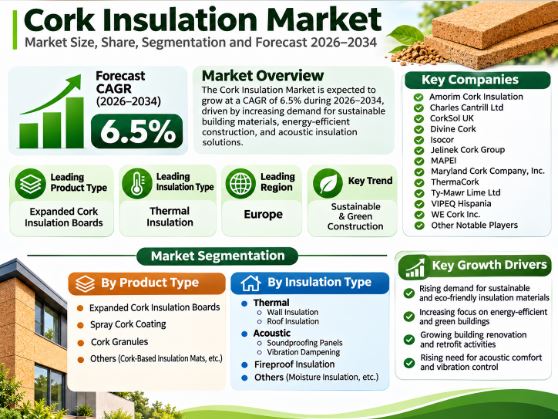
The expansion of green building initiatives, increasing investment in building retrofits, and growing preference for renewable and recyclable insulation materials are expected to create growth opportunities for market participants. Expanded cork insulation boards are widely used in walls, roofs, floors, and building envelopes, while spray cork coatings are gaining attention for exterior refurbishment, surface protection, and thermal-performance improvements. Additionally, rising demand for acoustic comfort in residential buildings, offices, hospitality facilities, and commercial spaces is expected to strengthen the adoption of cork-based insulation materials. Technological improvements in cork processing, product design, and installation techniques are further expected to support market expansion throughout the forecast period.
Cork Insulation Market Trends
The cork insulation market is witnessing increasing demand for natural, renewable, and low-embodied-carbon insulation materials as the construction industry focuses on reducing environmental impact and improving building energy performance. Builders and property owners are increasingly considering expanded cork boards for thermal and acoustic insulation in walls, roofs, floors, and interior partitions. The growing adoption of sustainable renovation practices, particularly in Europe, is supporting the use of breathable insulation materials compatible with older buildings and traditional construction systems.
Spray cork coatings are also gaining attention in building refurbishment due to their application flexibility, weather resistance, and ability to provide a protective surface layer. Manufacturers are focusing on improving insulation performance, durability, installation efficiency, and compatibility with different building materials. The increasing use of cork-based products in soundproofing panels, vibration dampening systems, and specialized construction applications is expected to further support market development.
Cork Insulation Market Growth Drivers
Increasing demand for sustainable and energy-efficient building materials is a major factor driving the cork insulation market. Governments, construction companies, and property developers are placing greater emphasis on reducing energy consumption in buildings and incorporating renewable materials into construction projects. Cork insulation offers a combination of thermal resistance, durability, and sound absorption, supporting its use in building envelopes and interior applications. Expanded cork insulation boards can also be manufactured using cork's naturally occurring binding properties, reducing the need for added synthetic binders in certain products. These characteristics are expected to strengthen demand from green construction and renovation projects.
Growing investment in building renovation and acoustic comfort is also supporting market growth. The need to improve thermal performance in older buildings is creating opportunities for cork insulation in wall, roof, and floor retrofits. In addition, increasing urbanization, higher residential density, and growing awareness of indoor noise pollution are encouraging the use of sound-absorbing and vibration-dampening materials. Cork's combination of thermal and acoustic properties makes it suitable for residential housing, commercial offices, hospitality facilities, and specialized industrial applications.
Cork Insulation Market Restraints
Higher initial costs compared with several conventional insulation materials are expected to limit the adoption of cork insulation in price-sensitive construction markets. Expanded cork boards and specialized cork coatings may involve higher material or installation costs than commonly used alternatives such as mineral wool, expanded polystyrene, and certain foam insulation products. Limited awareness among contractors, variations in regional product availability, and the need for specialized installation expertise can also affect market penetration.
Furthermore, cork production depends on geographically concentrated cork oak resources and established harvesting and processing systems. Supply limitations, transportation costs, and fluctuations in raw material availability may influence product pricing and distribution. These challenges are expected to encourage manufacturers to improve production efficiency, expand distribution partnerships, and develop cost-effective cork-based insulation products.
Cork Insulation Market Opportunities
The growing adoption of green building renovation, natural insulation materials, and advanced cork-based coatings is expected to create opportunities for market participants. Increasing investment in energy-efficient building upgrades is supporting demand for insulation products that improve thermal performance while reducing the use of fossil-based materials. Cork insulation manufacturers can benefit from growing interest in low-carbon construction, particularly in markets where building owners and developers prioritize environmental performance and material lifecycle considerations.
The development of spray-applied cork coatings, high-performance acoustic panels, and specialized vibration-dampening products is expected to expand the range of commercial applications. Opportunities are also emerging in modular construction, prefabricated building components, sustainable interior design, and renovation of historic properties. Manufacturers offering certified products, technical installation support, and reliable distribution networks are expected to strengthen their competitive position during the forecast period.
Cork Insulation Market Segment Analysis
By Product Type
Based on product type, the cork insulation market is segmented into expanded cork insulation boards, spray cork coating, cork granules, and others. Expanded cork insulation boards are expected to account for the largest market share, supported by their established use in thermal and acoustic insulation across residential and commercial construction. These boards are widely used in external and internal walls, roofs, floors, and building envelope systems due to their insulating properties, durability, and compatibility with sustainable construction practices.
The spray cork coating segment is expected to register attractive growth as demand increases for flexible insulation coatings used in exterior refurbishment, façade protection, and renovation projects. Cork granules are utilized in cavity filling, lightweight construction materials, flooring systems, and acoustic insulation applications. The others segment, including cork-based insulation mats and specialty products, is expected to benefit from growing requirements for customized thermal and soundproofing solutions.
By Insulation Type
Based on insulation type, the cork insulation market is categorized into thermal, acoustic, fireproof insulation, and others. Thermal insulation is expected to represent the largest market share, driven by growing demand for energy-efficient building envelopes and insulation materials that reduce heat transfer through walls and roofs. Within thermal insulation, wall insulation is expected to generate substantial revenue due to increasing adoption in residential construction and building renovation. Roof insulation is also expected to witness sustained demand as developers seek to improve indoor temperature control and building energy performance.
The acoustic insulation segment is expected to experience strong growth, supported by increasing demand for soundproofing panels and vibration-dampening materials in residential, commercial, and industrial environments. Cork-based materials are used to reduce sound transmission and vibration in floors, partitions, and equipment installations. The fireproof insulation segment is expected to benefit from interest in specialized cork-based systems with tested fire-performance characteristics. However, fire resistance varies by product and installation system, and cork products should not be assumed to be non-combustible. The others segment, including moisture-related insulation applications, is expected to generate additional opportunities in specialized construction and renovation projects.
Cork Insulation Market Regional Analysis
Europe is expected to remain a major regional market for cork insulation, supported by established cork processing industries, growing demand for sustainable construction materials, and increasing investment in energy-efficient building renovation. Portugal and Spain play important roles in the cork supply chain, while Germany, France, the United Kingdom, and other European countries represent important markets for natural insulation materials. Growing demand for low-carbon building products and renovation of older structures is expected to support regional adoption.
North America is expected to witness steady growth as architects, property developers, and construction companies increase their focus on sustainable building materials and thermal performance. The United States and Canada are expected to generate opportunities in residential construction, green building projects, acoustic insulation, and specialized commercial applications.
Asia Pacific is expected to present attractive long-term opportunities, driven by expanding construction activity, increasing interest in environmentally responsible building materials, and growing awareness of energy-efficient insulation solutions. China, Japan, India, South Korea, and Australia are expected to contribute to regional market development, although cost sensitivity and product availability may influence adoption.
Latin America is expected to experience gradual market expansion through increasing awareness of sustainable construction practices and development of specialized building applications. The Middle East and Africa are expected to provide opportunities in commercial construction, hospitality projects, and building insulation applications where thermal performance and indoor comfort are important considerations.
Cork Insulation Market Competitive Landscape
The global cork insulation market includes established cork manufacturers, specialized insulation suppliers, building material companies, and distributors of natural construction products. Market participants are focusing on improving thermal performance, acoustic insulation capabilities, product durability, and environmental sustainability to strengthen their competitive positions. Companies are expanding their product portfolios to include expanded cork insulation boards, spray cork coatings, cork granules, and specialized soundproofing materials for residential, commercial, and industrial applications. Product certification, distribution partnerships, and technical support for architects and construction contractors are becoming important competitive factors.
Leading participants are also focusing on sustainable manufacturing, innovative coating formulations, and compatibility with modern building insulation systems. For example, Amorim offers expanded cork insulation products for thermal and acoustic applications, Jelinek Cork Group supplies cork boards and spray products, and VIPEQ offers cork coatings and external insulation systems.
Historical & Forecast Period
This study report represents analysis of each segment from 2024 to 2034 considering 2025 as the base year. Compounded Annual Growth Rate (CAGR) for each of the respective segments estimated for the forecast period of 2026 to 2034.
The current report comprises of quantitative market estimations for each micro market for every geographical region and qualitative market analysis such as micro and macro environment analysis, market trends, competitive intelligence, segment analysis, porters five force model, top winning strategies, top investment markets, emerging trends and technological analysis, case studies, strategic conclusions and recommendations and other key market insights.
Research Methodology
The complete research study was conducted in three phases, namely: secondary research, primary research, and expert panel review. key data point that enables the estimation of Cork Insulation Market - Growth, Share, Opportunities & Competitive Analysis, 2026 - 2034 market are as follows:
Market forecast was performed through proprietary software that analyzes various qualitative and quantitative factors. Growth rate and CAGR were estimated through intensive secondary and primary research. Data triangulation across various data points provides accuracy across various analyzed market segments in the report. Application of both top down and bottom-up approach for validation of market estimation assures logical, methodical and mathematical consistency of the quantitative data.
| ATTRIBUTE | DETAILS |
|---|---|
| Research Period | 2024-2034 |
| Base Year | 2025 |
| Forecast Period | 2026-2034 |
| Historical Year | 2024 |
| Unit | USD Million |
| Segmentation | |
Product Type
|
|
Insulation Type
|
|
Usage
|
|
Construction Type
|
|
End Use
|
|
Sales Channel
|
|
|
Region Segment (2024-2034; US$ Million)
|
Frequently Asked Questions
1. What is the expected CAGR of the global Cork Insulation Market from 2026 to 2034?
The global Cork Insulation Market is expected to grow at a CAGR of 6.5% from 2026 to 2034, supported by increasing demand for sustainable construction materials, growing investment in energy-efficient buildings, and rising adoption of natural thermal and acoustic insulation products.
2. What is cork insulation, and what are its main applications?
Cork insulation is a natural building insulation material produced from cork oak bark. It is used to reduce heat transfer, absorb sound, and control vibration in buildings. Major applications include wall insulation, roof insulation, soundproofing panels, flooring underlayment, vibration dampening, and specialized building protection systems.
3. Which product type holds the largest share of the Cork Insulation Market?
Expanded cork insulation boards are expected to account for the largest market share due to their established applications in walls, roofs, floors, and building envelopes. Their combination of thermal performance, sound absorption, durability, and renewable raw material content supports demand in residential and commercial construction.
4. Which region is expected to dominate the Cork Insulation Market?
Europe is expected to remain a major regional market for cork insulation, supported by established cork manufacturing industries, growing adoption of sustainable building materials, and increasing investment in energy-efficient renovation projects. Portugal, Spain, Germany, France, and the United Kingdom represent important markets within the region.
5. What are the major factors driving growth in the Cork Insulation Market?
Major growth drivers include increasing demand for sustainable insulation materials, greater focus on building energy efficiency, rising investment in green construction, growing residential and commercial renovation activity, and increasing use of acoustic insulation solutions. Demand for renewable and recyclable materials is also expected to support market expansion.
6. Is cork insulation better than conventional insulation materials?
Cork insulation offers several advantages, including renewable raw material content, thermal insulation, sound absorption, durability, and compatibility with certain breathable construction systems. However, conventional materials such as mineral wool, fiberglass, and expanded polystyrene may offer lower initial costs or different fire and thermal performance characteristics. The most suitable insulation depends on the building application, required thermal resistance, fire rating, installation conditions, and project budget.


