
Growing demand for food traceability, increasing regulatory requirements for supply chain transparency, and rapid adoption of digital technologies are driving the growth of the digital product passport for food market worldwide.
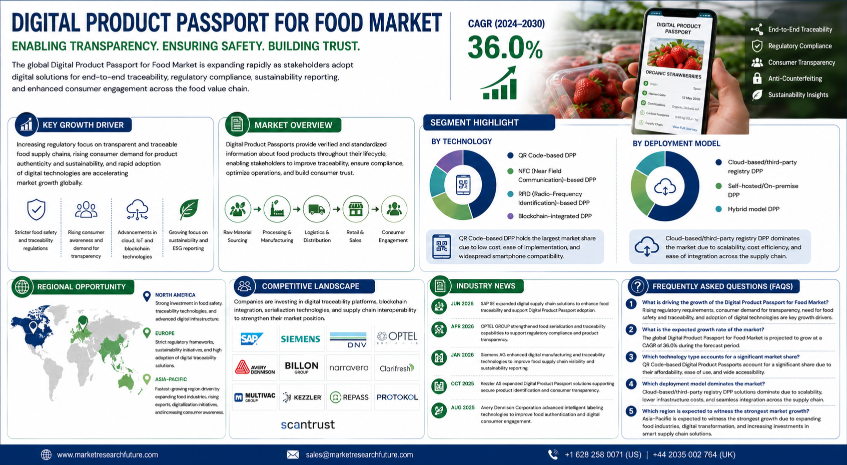
The global digital product passport for food market is witnessing exceptional growth as food manufacturers, retailers, distributors, and regulatory authorities increasingly prioritize end-to-end product transparency and traceability. Digital Product Passports provide consumers and stakeholders with verified information regarding product origin, ingredients, production processes, sustainability metrics, certifications, transportation history, and recycling or disposal guidance through digital identifiers such as QR codes, NFC, RFID, and blockchain technologies. Rising emphasis on food safety, sustainability reporting, anti-counterfeiting initiatives, and compliance with evolving digital traceability regulations continues to accelerate market adoption. The market is projected to register a CAGR of 36.0% during the forecast period.
Key Growth Driver
Increasing regulatory focus on transparent, traceable, and sustainable food supply chains is accelerating market growth globally.
Governments, food manufacturers, retailers, and consumers are demanding greater visibility throughout the food value chain to improve food safety, product authenticity, sustainability reporting, and recall management. Advances in cloud computing, blockchain, IoT, digital identity platforms, and mobile scanning technologies are enabling scalable deployment of Digital Product Passport solutions across global food ecosystems.
Segment Highlight
QR Code-based Digital Product Passports and cloud-based deployment models continue to create significant growth opportunities.
Based on technology, QR Code-based DPP accounts for a significant share of the market owing to its low implementation cost, widespread smartphone compatibility, ease of deployment, and ability to provide instant access to product information. Blockchain-integrated DPP is witnessing the fastest growth due to increasing demand for secure, tamper-resistant, and verifiable food traceability records. NFC-based DPP and RFID-based DPP continue to gain adoption for premium food products, automated inventory management, and logistics applications.
By deployment model, Cloud-based/Third-party Registry DPP dominates the market owing to its scalability, lower infrastructure costs, simplified regulatory compliance, and ease of integration across multi-party supply chains. Hybrid Model DPP continues to experience rapid growth as organizations combine centralized cloud infrastructure with internal enterprise systems for enhanced flexibility. Self-hosted/On-premise DPP solutions remain relevant among large enterprises with strict data governance and security requirements.
Regional Opportunity
Europe remains the leading market, while Asia-Pacific is emerging as the fastest-growing region for Digital Product Passport solutions in the food industry.
Europe maintains a dominant position in the Digital Product Passport for Food Market due to strong regulatory initiatives promoting product transparency, sustainability reporting, circular economy objectives, and digital traceability across food supply chains. North America continues to witness significant growth supported by increasing food safety investments, digital transformation initiatives, and adoption of advanced supply chain technologies. Meanwhile, Asia-Pacific is expected to experience the fastest growth driven by expanding food processing industries, rising exports, increasing consumer awareness of food authenticity, government-led digitalization programs, and growing investments in smart supply chain infrastructure across China, India, Japan, South Korea, and Southeast Asia.
Competitive Landscape
Market participants are focusing on digital traceability platforms, blockchain integration, cloud-based passport infrastructure, and supply chain interoperability to strengthen their competitive position.
Leading companies are investing in advanced serialization technologies, secure digital identity platforms, IoT-enabled product tracking, AI-powered supply chain analytics, and blockchain verification systems to improve food transparency and regulatory compliance. Strategic collaborations with food manufacturers, retailers, certification bodies, logistics providers, and regulatory agencies continue to support market expansion. Companies are also emphasizing consumer engagement, sustainability reporting, anti-counterfeiting capabilities, and real-time product lifecycle visibility to address evolving industry requirements.
Key companies operating in the market include SAP SE, Siemens AG, Det Norske Veritas Group, OPTEL GROUP, Avery Dennison Corporation, Billon Group, Narravero, Clarifresh, MULTIVAC Group, Kezzler AS, Repass, Protokol, and Scantrust.
Digital Product Passport for Food Industry News
Jun 2026: SAP SE expanded digital supply chain solutions supporting end-to-end food traceability and Digital Product Passport implementation.
Apr 2026: OPTEL GROUP strengthened food serialization and traceability capabilities to support regulatory compliance and product transparency initiatives.
Jan 2026: Siemens AG enhanced digital manufacturing and traceability technologies to improve food supply chain visibility and sustainability reporting.
Oct 2025: Kezzler AS expanded Digital Product Passport solutions supporting secure product identification and consumer transparency across food value chains.
Aug 2025: Avery Dennison Corporation advanced intelligent labeling technologies designed to improve food authentication, traceability, and digital consumer engagement.
Historical & Forecast Period
This study report represents analysis of each segment from 2024 to 2034 considering 2025 as the base year. Compounded Annual Growth Rate (CAGR) for each of the respective segments estimated for the forecast period of 2026 to 2034.
The current report comprises of quantitative market estimations for each micro market for every geographical region and qualitative market analysis such as micro and macro environment analysis, market trends, competitive intelligence, segment analysis, porters five force model, top winning strategies, top investment markets, emerging trends and technological analysis, case studies, strategic conclusions and recommendations and other key market insights.
Research Methodology
The complete research study was conducted in three phases, namely: secondary research, primary research, and expert panel review. key data point that enables the estimation of Digital Product Passport (DPP) for Food Market - Growth, Share, Opportunities & Competitive Analysis, 2026 - 2034 market are as follows:
Market forecast was performed through proprietary software that analyzes various qualitative and quantitative factors. Growth rate and CAGR were estimated through intensive secondary and primary research. Data triangulation across various data points provides accuracy across various analyzed market segments in the report. Application of both top down and bottom-up approach for validation of market estimation assures logical, methodical and mathematical consistency of the quantitative data.
| ATTRIBUTE | DETAILS |
|---|---|
| Research Period | 2024-2034 |
| Base Year | 2025 |
| Forecast Period | 2026-2034 |
| Historical Year | 2024 |
| Unit | USD Million |
| Segmentation | |
Technology
|
|
Deployment Model
|
|
|
Region Segment (2024-2034; US$ Million)
|
Frequently Asked Questions
Q1. What is driving the growth of the Digital Product Passport for Food Market?
The market is primarily driven by increasing food traceability requirements, stricter regulatory compliance, rising consumer demand for product transparency, growing sustainability initiatives, and rapid adoption of digital supply chain technologies.
Q2. What is the expected growth rate of the Digital Product Passport for Food Market?
The global Digital Product Passport for Food Market is projected to expand at a CAGR of 36.0% during the forecast period.
Q3. Which technology accounts for a significant market share?
QR Code-based Digital Product Passports account for a significant market share due to their affordability, ease of implementation, widespread smartphone compatibility, and ability to provide instant access to product information.
Q4. Which deployment model dominates the Digital Product Passport for Food Market?
Cloud-based/Third-party Registry DPP solutions dominate the market owing to their scalability, simplified deployment, cost efficiency, and seamless integration across multiple supply chain participants.
Q5. Which region is expected to witness the strongest market growth?
Asia-Pacific is expected to witness the strongest market growth due to expanding food manufacturing industries, increasing digital transformation, rising food export activities, growing regulatory focus on traceability, and accelerating investments in smart food supply chain technologies.


