
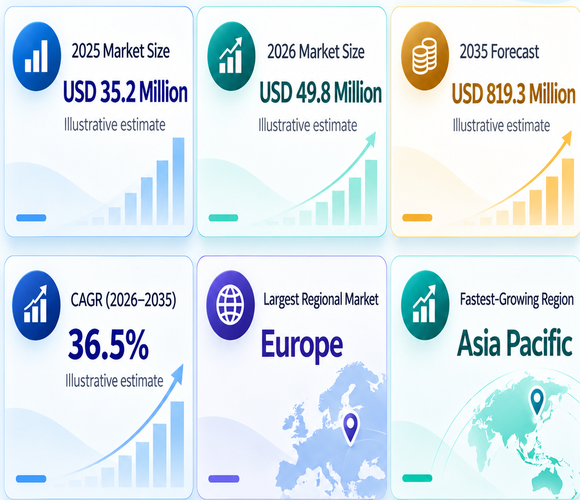
The global E-Gasoline Market is estimated at approximately USD 35.2 million in 2025 and is projected to reach USD 49.8 million in 2026. Based on the illustrative forecast scenario, the market could reach nearly USD 819.3 million by 2035, registering a compound annual growth rate (CAGR) of 36.5% between 2026 and 2034.
Increasing investment in synthetic fuel production, growing efforts to reduce transport-related carbon emissions, and wider adoption of renewable energy technologies are expected to support market development. E-gasoline, commonly produced through Power-to-Liquid (PtL) processes using renewable hydrogen and captured carbon dioxide, offers a potential lower-carbon alternative for selected applications that continue to depend on liquid fuels.
E-Gasoline Market Overview
The global E-Gasoline Market is gradually moving from pilot-scale development toward early commercial production as energy companies, automotive manufacturers, and clean technology developers explore alternatives to petroleum-based gasoline. Increasing attention to carbon emission reduction and renewable fuel production has created opportunities for synthetic gasoline manufactured using renewable electricity, green hydrogen, and captured carbon dioxide.
The automotive industry represents an important potential application, particularly in regions with a substantial existing internal combustion engine vehicle fleet. Unlike battery-electric technologies, e-gasoline may be usable within existing fuel distribution and engine systems, subject to applicable fuel specifications and vehicle compatibility. This characteristic creates opportunities to reduce lifecycle emissions in selected combustion-based applications without requiring the immediate replacement of all existing vehicles and infrastructure.
However, e-gasoline remains considerably more expensive to manufacture than conventional gasoline. Large-scale commercialization depends on declining renewable electricity costs, improvement in hydrogen production efficiency, carbon capture availability, supportive fuel policies, and long-term purchasing agreements.
E-Gasoline Market Trends, Growth Drivers and Forecast Outlook
Key Market Growth Drivers
| Growth Driver | Market Impact |
|---|---|
| Increasing demand for lower-carbon liquid fuels | Supports investments in synthetic fuel manufacturing and early commercial deployment. |
| Expansion of renewable electricity and green hydrogen | Provides essential inputs for scaling Power-to-Liquid fuel production. |
| Interest in reducing emissions from existing combustion-engine fleets | Creates potential demand in automotive, specialty transport and premium fuel applications. |
| Government policies supporting renewable fuels | Improves investment prospects for qualifying low-carbon fuel projects. |
| Technological advances in fuel synthesis and carbon capture | May reduce production costs and improve plant efficiency over time. |
Growing Demand for Low-Carbon Transportation Fuels
Increasing pressure to reduce greenhouse gas emissions from transportation is supporting research and investment in synthetic gasoline. Governments and industrial stakeholders are evaluating renewable fuel pathways that can complement electrification, particularly where existing combustion engines remain in operation for many years.
E-gasoline offers a potential solution for selected automotive and transport applications because it uses carbon-based fuel molecules manufactured through synthetic processes. Its environmental benefit depends heavily on the lifecycle emissions associated with electricity supply, carbon dioxide sourcing, fuel manufacturing and distribution.
Expansion of Renewable Energy Infrastructure
The development of solar and wind energy infrastructure plays an important role in future e-gasoline production. Renewable electricity is required to produce hydrogen through electrolysis, which can then be combined with captured carbon dioxide for synthetic fuel manufacturing.
As renewable energy capacity increases, developers may benefit from improved access to electricity at competitive prices. Regions with strong solar and wind resources could emerge as attractive production locations, particularly when renewable electricity availability is supported by industrial infrastructure and access to captured carbon dioxide.
Technology Development in Power-to-Liquid Processes
Continuous improvements in electrolysis, carbon capture, synthesis reactors and refining processes are expected to influence the economics of e-gasoline manufacturing. Technology providers are focusing on improving energy conversion efficiency, lowering operating costs and integrating production systems.
Development of modular production facilities is also creating opportunities for phased investment. Such facilities may allow producers to begin commercial operations at smaller capacities before expanding output as demand and project financing improve.
E-Gasoline Market Restraints and Challenges
| Market Restraint | Expected Impact |
|---|---|
| High production costs | Restricts adoption in price-sensitive fuel markets. |
| Limited commercial manufacturing capacity | Reduces near-term availability for large-volume fuel buyers. |
| Significant renewable electricity requirements | Creates competition for low-cost clean electricity. |
| Complex certification and lifecycle emission requirements | Increases project planning and compliance costs. |
| Uncertainty regarding long-term policy support | May delay investment and commercial purchasing agreements. |
High Manufacturing Costs Remain a Major Barrier
The relatively high cost of synthetic gasoline manufacturing remains one of the most significant challenges facing the global market. E-gasoline production involves electricity-intensive hydrogen generation, carbon dioxide sourcing, fuel synthesis and downstream processing. These activities create a considerable production-cost premium compared with conventional petroleum refining.
Consequently, commercial adoption is expected to remain concentrated initially among customers willing to pay additional costs for certified lower-carbon fuels, including premium automotive brands, motorsport organizations and companies operating under environmental commitments.
Limited Commercial Production Infrastructure
Although several synthetic fuel projects have entered demonstration or early commercial phases, global e-gasoline production capacity remains limited. Expanding output requires capital investment, reliable renewable electricity, specialized equipment and long-term agreements with fuel buyers.
Project delays, financing constraints and uncertainty regarding future fuel demand could slow commercialization. Successful scaling will depend on the ability of developers to establish financially viable facilities and secure stable supply-chain partnerships.
E-Gasoline Market Segment Analysis
By Renewable Source
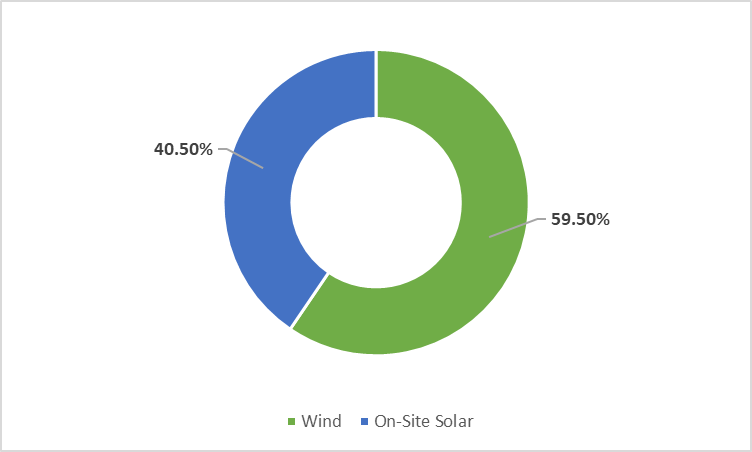
Wind-based e-gasoline production is estimated to account for approximately 59.5% of global market revenue in 2025 under the illustrative scenario. Wind power remains an important renewable electricity source for synthetic fuel developers because favorable wind conditions can support relatively consistent electricity generation and hydrogen production.
Wind-powered facilities are particularly relevant in regions with established renewable energy infrastructure, including parts of Europe and Latin America. Over the forecast period, wind-based production is expected to maintain a substantial market presence, although increasing investment in solar-powered facilities may gradually diversify the renewable energy mix.
On-Site Solar Energy
The on-site solar segment is estimated to represent nearly 40.5% of market revenue in 2025. Solar-powered e-gasoline production is attracting interest as countries expand photovoltaic installations and improve renewable energy infrastructure.
Countries with high solar irradiation, available industrial land and access to suitable carbon dioxide sources may offer favorable conditions for solar-based synthetic fuel production. Investment in integrated solar, electrolysis and fuel synthesis projects could strengthen the segment's long-term market prospects.
By Technology
Fischer-Tropsch technology is estimated to account for approximately 69.5% of global e-gasoline market revenue in 2025. This technology enables the conversion of synthesis gas into hydrocarbons that can undergo further processing to produce liquid fuels.
Its established industrial background, ability to integrate with renewable hydrogen production and compatibility with existing refining processes make it an important technology pathway for synthetic fuel developers.
Electrified Reverse Water-Gas Shift (eRWGS)
The eRWGS technology segment is estimated to represent nearly 22.5% of market revenue in 2025. This pathway supports the conversion of carbon dioxide into carbon monoxide, which can subsequently be used in synthetic fuel production.
The technology is attracting interest because of its potential integration with renewable electricity, hydrogen production and carbon capture facilities. Continued development of reactor efficiency and system integration may support commercial expansion.
Other Technologies
Other production technologies account for an illustrative 8.0% of market revenue in 2025. These include emerging synthetic fuel processes and alternative conversion technologies designed to improve operating efficiency and production flexibility.
By Application
The automotive industry represents the largest application segment, with an illustrative share of 44.5% in 2025. Increasing interest in reducing emissions from existing internal combustion engine fleets is expected to support demand for synthetic gasoline.
Premium automotive manufacturers, motorsport organizations and specialized vehicle operators are likely to represent important early users. The ability to use appropriately specified synthetic gasoline within existing vehicle platforms could help support selected decarbonization strategies.
Industrial
Industrial applications are estimated to account for approximately 20.5% of global revenue in 2025. Demand opportunities exist in specialized combustion equipment, industrial testing operations and facilities requiring liquid hydrocarbon fuels.
Adoption is expected to depend on fuel economics, equipment compatibility and the availability of alternative technologies such as electrification and hydrogen.
Marine
Marine applications represent an illustrative 10.5% of global revenue in 2025. Increasing attention to the environmental performance of maritime operations is supporting the assessment of synthetic fuels as alternatives to conventional petroleum products.
Commercial opportunities may develop in selected vessel categories, although e-gasoline faces competition from other marine fuel pathways, including e-methanol and synthetic diesel.
Aviation
Aviation accounts for an illustrative 5.5% of market revenue in 2025. Power-to-Liquid technologies can support the production of synthetic hydrocarbon fuel components for the aviation industry.
However, aviation fuel must comply with applicable technical certification standards, and synthetic aviation kerosene is a distinct product from finished e-gasoline. The relevance of aviation demand therefore depends on how production facilities allocate intermediate and finished fuel output.
Other Applications
Other applications represent approximately 19.0% of the illustrative market in 2025. These include motorsport, fuel research, product testing and specialized transport applications. Such uses can support early adoption because buyers may place greater value on fuel performance, innovation and lower lifecycle emissions.
E-Gasoline Market Regional Analysis
North America E-Gasoline Market
North America is estimated to represent approximately 25.0% of global market revenue in 2025 under the illustrative allocation. The region benefits from renewable energy resources, an established automotive industry, low-carbon fuel development activity and interest in clean hydrogen production.
The United States is expected to remain the leading North American market due to investment in synthetic fuels, carbon management technologies and renewable energy infrastructure. Federal and state-level fuel programs may influence project economics, although eligibility and incentive availability vary by pathway and regulatory requirements.
Canada also presents development opportunities because of its renewable electricity resources, clean energy investment activity and potential demand for alternative transportation fuels.
Europe E-Gasoline Market
Europe accounts for an estimated 49.0% of global market revenue in 2025 in the illustrative scenario, making it the largest regional market.
The region's position is supported by environmental policies, established automotive manufacturing capabilities and commercial interest in renewable fuels. Germany, the Netherlands, Norway, the United Kingdom and Spain are important markets to monitor because of their industrial capabilities and synthetic fuel development opportunities.
Germany remains a major center for synthetic fuel innovation, supported by automotive manufacturers, engineering companies and research organizations. The Netherlands benefits from its port infrastructure and fuel distribution networks, while Spain offers opportunities for renewable electricity-based production.
European market growth will depend on implementation of fuel certification requirements, investment in production facilities and future policy treatment of renewable fuels of non-biological origin.
Asia Pacific E-Gasoline Market
Asia Pacific is expected to record the fastest regional growth over the forecast period. Growing renewable energy investment, clean hydrogen development and interest in alternative transport technologies are expected to create opportunities for synthetic fuel manufacturers.
China has the potential to become an important production market because of its renewable energy manufacturing capacity and expanding clean energy infrastructure. Japan is expected to remain an important participant in synthetic fuel technology development, supported by its automotive and energy sectors.
South Korea offers opportunities through its automotive, maritime and industrial industries. India could also emerge as a developing market as renewable hydrogen projects expand and industrial stakeholders evaluate lower-carbon fuel alternatives.
Despite these opportunities, high production costs and limited commercial supply are expected to restrict near-term adoption across several Asia Pacific countries.
Latin America, Middle East and Africa E-Gasoline Market
Latin America presents potential opportunities for renewable synthetic fuel production because several countries possess favorable wind and solar resources.
Chile is particularly relevant due to its renewable energy resources and existing synthetic fuel development activity. Other regional markets may gain importance as investments in green hydrogen and carbon utilization technologies increase.
The Middle East offers potential for industrial-scale synthetic fuel projects through investments in renewable energy, hydrogen and energy infrastructure. In Africa, future development opportunities may emerge in countries with competitive renewable electricity resources, although financing and infrastructure requirements remain significant.
E-Gasoline Market Share and Competitive Landscape
The global E-Gasoline Market remains at an early commercial stage, with competition driven by technology capabilities, production costs, access to renewable power, carbon dioxide sourcing and long-term customer agreements.
Key companies operating or developing technologies within the broader e-gasoline and synthetic fuel value chain include:
HIF Global
INERATEC
Prometheus Fuels
Synhelion
P1 Performance Fuels
CAC Engineering GmbH
German eFuel One GmbH
eFuel Pacific Limited
HIF Global
HIF Global is involved in developing renewable synthetic fuel production projects, with a focus on combining renewable electricity, hydrogen and carbon dioxide to manufacture low-carbon fuels. Its activities include collaboration with companies in the automotive and energy sectors. The Haru Oni project in Chile represents an important example of early synthetic fuel commercialization.
INERATEC
INERATEC focuses on modular Power-to-Liquid technologies and synthetic fuel production systems. The company's approach supports the development of facilities that can combine renewable hydrogen and captured carbon dioxide to manufacture synthetic hydrocarbons.
Prometheus Fuels
Prometheus Fuels is developing technology intended to produce synthetic fuels using atmospheric carbon dioxide and renewable electricity. Its commercial prospects depend on achieving competitive production economics and reliable large-scale technology performance.
Synhelion
Synhelion is developing solar-based fuel production technologies using concentrated solar energy. Its approach represents an alternative pathway for manufacturing synthetic liquid fuels and may offer opportunities in regions with strong solar resources.
P1 Performance Fuels
P1 Performance Fuels is active in renewable and synthetic fuel development, particularly for high-performance automotive and motorsport applications. These markets provide opportunities for product testing and early commercialization.
E-Gasoline Market Future Outlook
The global E-Gasoline Market is expected to develop rapidly from its relatively small current commercial base, supported by investment in renewable fuel technologies and increasing interest in decarbonizing combustion-based applications.
Over the near term, market activity is likely to remain concentrated in technology demonstration, premium automotive applications and projects backed by long-term fuel supply agreements. Production economics will remain a key factor determining the pace of commercialization.
Over the longer term, falling renewable electricity costs, advances in electrolysis, improved carbon dioxide utilization and the development of larger production facilities could improve market competitiveness.
Europe is expected to remain an important regional market, while Asia Pacific offers considerable growth potential. Competition is likely to increase as technology developers, energy companies and automotive manufacturers pursue commercial opportunities across the synthetic fuel value chain.
Under the illustrative forecast scenario, the market is projected to reach approximately USD 819.3 million by 2035, expanding at a CAGR of 36.5% from 2026 to 2035. Actual market performance will depend on project execution, production economics, certification requirements and government policy.
Historical & Forecast Period
This study report represents analysis of each segment from 2024 to 2034 considering 2025 as the base year. Compounded Annual Growth Rate (CAGR) for each of the respective segments estimated for the forecast period of 2026 to 2034.
The current report comprises of quantitative market estimations for each micro market for every geographical region and qualitative market analysis such as micro and macro environment analysis, market trends, competitive intelligence, segment analysis, porters five force model, top winning strategies, top investment markets, emerging trends and technological analysis, case studies, strategic conclusions and recommendations and other key market insights.
Research Methodology
The complete research study was conducted in three phases, namely: secondary research, primary research, and expert panel review. key data point that enables the estimation of E-Gasoline Market - Growth, Share, Opportunities & Competitive Analysis, 2026 - 2034 market are as follows:
Market forecast was performed through proprietary software that analyzes various qualitative and quantitative factors. Growth rate and CAGR were estimated through intensive secondary and primary research. Data triangulation across various data points provides accuracy across various analyzed market segments in the report. Application of both top down and bottom-up approach for validation of market estimation assures logical, methodical and mathematical consistency of the quantitative data.
| ATTRIBUTE | DETAILS |
|---|---|
| Research Period | 2024-2034 |
| Base Year | 2025 |
| Forecast Period | 2026-2034 |
| Historical Year | 2024 |
| Unit | USD Million |
| Segmentation | |
Renewable Source
|
|
Technology
|
|
Application
|
|
|
Region Segment (2024-2034; US$ Million)
|
Frequently Asked Questions
How large is the global E-Gasoline Market?
Under the adjusted illustrative scenario, the global market is estimated at USD 35.2 million in 2025 and USD 49.8 million in 2026.
What is the projected CAGR of the E-Gasoline Market?
The illustrative forecast assumes a CAGR of 36.5% during 2026–2035.
What will be the E-Gasoline Market size by 2035?
Based on the illustrative assumptions, the market could reach approximately USD 819.3 million by 2035.
Which region leads the global E-Gasoline Market?
Europe is identified as the largest regional market, supported by regulatory developments and synthetic fuel investment activity.
Which region is expected to grow fastest?
Asia Pacific is expected to offer the fastest regional growth opportunities, supported by renewable energy expansion, hydrogen investment and industrial demand.
Who are the key companies in the E-Gasoline Market?
Companies to monitor include HIF Global, INERATEC, Prometheus Fuels, Synhelion and P1 Performance Fuels.


