
Growing enterprise mobility, increasing adoption of hybrid work models, and rising cybersecurity concerns are driving the growth of the enterprise mobility management (EMM) market worldwide.
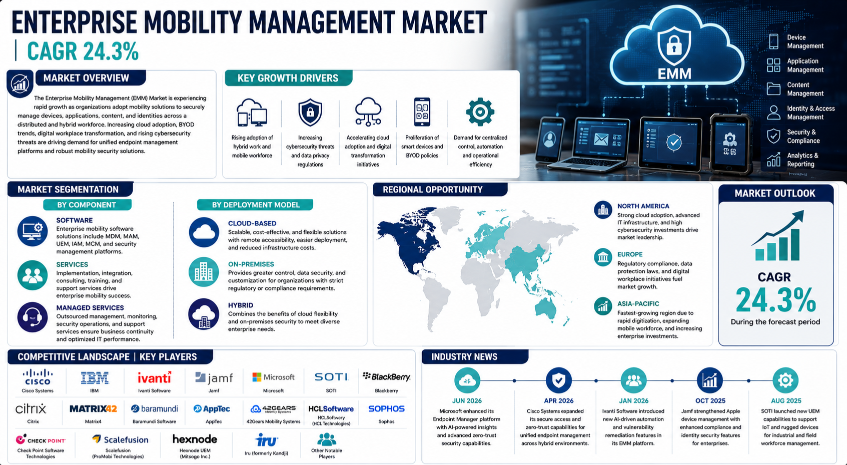
The global enterprise mobility management market is experiencing rapid growth as organizations increasingly deploy comprehensive mobility solutions to securely manage smartphones, tablets, laptops, rugged devices, and other enterprise endpoints. EMM platforms enable centralized device management, application security, identity management, policy enforcement, and secure access to enterprise resources across distributed workforces. Rising cloud adoption, bring-your-own-device (BYOD) initiatives, digital workplace transformation, and increasing regulatory compliance requirements are supporting market expansion. Advancements in unified endpoint management (UEM), AI-driven threat detection, zero-trust security frameworks, and cloud-native management platforms continue to accelerate market development. The market is projected to register a CAGR of 24.3% during the forecast period.
Key Growth Driver
Rapid digital workplace transformation and increasing demand for secure endpoint management are accelerating market growth globally.
Organizations are investing heavily in enterprise mobility solutions to protect corporate data while enabling employees to securely access applications and business resources from any location. Growing adoption of remote and hybrid work environments, increasing mobile workforce productivity, rising cyber threats, and stricter data privacy regulations are driving demand for advanced EMM platforms. AI-powered automation, endpoint analytics, identity-centric security, and zero-trust architectures continue to strengthen enterprise adoption.
Segment Highlight
Cloud-native management platforms and intelligent endpoint security continue to create significant growth opportunities across enterprise environments.
Based on component, Software accounts for a significant share of the market due to increasing deployment of mobile device management (MDM), mobile application management (MAM), mobile content management (MCM), and unified endpoint management platforms. Services continue to witness robust demand as enterprises seek implementation, consulting, integration, and technical support. Managed Services are expanding rapidly as organizations increasingly outsource mobility management, security monitoring, and compliance operations.
By deployment model, Cloud-based solutions dominate the market owing to their scalability, lower infrastructure costs, simplified management, and support for globally distributed workforces. Hybrid deployment models continue to gain popularity among organizations balancing cloud flexibility with regulatory requirements, while On-premises deployments remain relevant for enterprises operating in highly regulated industries requiring greater control over sensitive information.
Regional Opportunity
North America remains the leading market, while Asia-Pacific is emerging as the fastest-growing region for enterprise mobility management.
North America maintains a dominant position in the Enterprise Mobility Management Market due to widespread cloud adoption, strong cybersecurity investments, advanced enterprise IT infrastructure, and the presence of leading software vendors. Europe continues to witness steady growth supported by digital transformation initiatives, stringent data protection regulations, and increasing enterprise mobility adoption. Meanwhile, Asia-Pacific is expected to experience the fastest growth driven by rapid enterprise digitization, expanding mobile workforce, increasing cloud investments, rising cybersecurity awareness, and growing adoption of digital workplace solutions across China, India, Japan, South Korea, Singapore, and Southeast Asia.
Competitive Landscape
Market participants are focusing on unified endpoint management, AI-driven security, cloud-native deployment, and zero-trust architectures to strengthen their competitive position.
Leading companies are investing in advanced endpoint security, identity and access management, AI-powered automation, analytics-driven device monitoring, and integrated cybersecurity platforms to improve enterprise mobility management. Strategic acquisitions, cloud platform expansion, partnerships with enterprise software providers, and continuous product innovation continue to shape market competition. Companies are also emphasizing policy automation, compliance management, multi-platform device support, remote troubleshooting, and secure application delivery to meet evolving enterprise requirements.
Key companies operating in the market include Cisco Systems, IBM, Ivanti Software, Jamf, Microsoft, SOTI, BlackBerry, Citrix, Matrix42, baramundi Software, AppTec, 42Gears Mobility Systems, HCLSoftware (HCL Technologies), Sophos, Check Point Software Technologies, Scalefusion (ProMobi Technologies), Hexnode UEM (Mitsogo Inc.), Iru (formerly Kandji), and other notable players.
Enterprise Mobility Management Industry News
Jun 2026: Microsoft expanded enterprise endpoint security capabilities across its cloud management platform with enhanced AI-driven threat detection and policy automation.
Apr 2026: Cisco Systems introduced advanced zero-trust mobility management features to strengthen enterprise device security across hybrid work environments.
Jan 2026: Jamf expanded Apple device management capabilities with enhanced compliance monitoring and automated deployment features for enterprise customers.
Oct 2025: Ivanti Software strengthened its unified endpoint management platform by integrating AI-powered endpoint intelligence and vulnerability management capabilities.
Aug 2025: Hexnode UEM (Mitsogo Inc.) expanded its cloud-based endpoint management platform with enhanced cross-platform support and enterprise automation features.
Historical & Forecast Period
This study report represents analysis of each segment from 2024 to 2034 considering 2025 as the base year. Compounded Annual Growth Rate (CAGR) for each of the respective segments estimated for the forecast period of 2026 to 2034.
The current report comprises of quantitative market estimations for each micro market for every geographical region and qualitative market analysis such as micro and macro environment analysis, market trends, competitive intelligence, segment analysis, porters five force model, top winning strategies, top investment markets, emerging trends and technological analysis, case studies, strategic conclusions and recommendations and other key market insights.
Research Methodology
The complete research study was conducted in three phases, namely: secondary research, primary research, and expert panel review. key data point that enables the estimation of Enterprise Mobility Management Market - Growth, Share, Opportunities & Competitive Analysis, 2026 - 2034 market are as follows:
Market forecast was performed through proprietary software that analyzes various qualitative and quantitative factors. Growth rate and CAGR were estimated through intensive secondary and primary research. Data triangulation across various data points provides accuracy across various analyzed market segments in the report. Application of both top down and bottom-up approach for validation of market estimation assures logical, methodical and mathematical consistency of the quantitative data.
| ATTRIBUTE | DETAILS |
|---|---|
| Research Period | 2024-2034 |
| Base Year | 2025 |
| Forecast Period | 2026-2034 |
| Historical Year | 2024 |
| Unit | USD Million |
| Segmentation | |
By Component
|
|
By Deployment Model
|
|
By Enterprise Size
|
|
By Ownership Model
|
|
By End Use
|
|
|
Region Segment (2024-2034; US$ Million)
|
Frequently Asked Questions
Q1. What is driving the growth of the Enterprise Mobility Management Market?
The market is primarily driven by increasing adoption of hybrid work, expanding BYOD policies, growing cybersecurity threats, enterprise digital transformation, and rising demand for centralized endpoint management solutions.
Q2. What is the expected growth rate of the Enterprise Mobility Management Market?
The global Enterprise Mobility Management Market is projected to expand at a CAGR of 24.3% during the forecast period.
Q3. Which component accounts for a significant market share?
Software accounts for a significant market share due to widespread adoption of mobile device management, unified endpoint management, application security, and enterprise mobility platforms across organizations.
Q4. Which deployment model dominates the Enterprise Mobility Management Market?
Cloud-based deployment dominates the market owing to its scalability, lower operational costs, simplified administration, rapid deployment, and ability to support distributed and hybrid workforces.
Q5. Which region is expected to witness the strongest market growth?
Asia-Pacific is expected to witness the strongest market growth due to rapid enterprise digitization, expanding cloud infrastructure, increasing mobile workforce adoption, rising cybersecurity investments, and growing demand for secure enterprise mobility solutions across emerging economies.


