
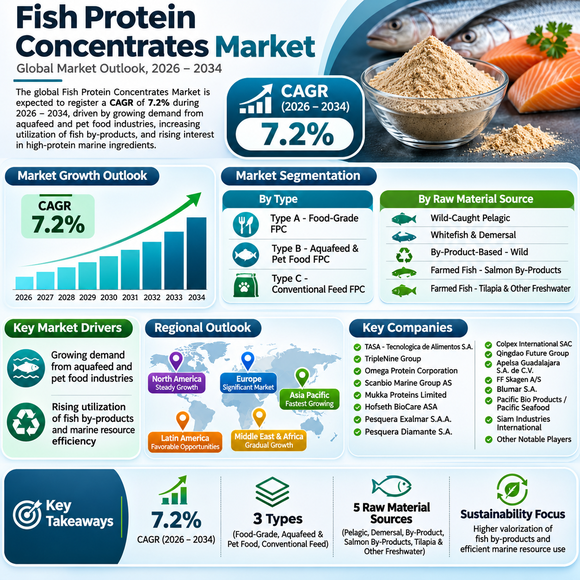
The global fish protein concentrates market is expected to register a CAGR of 7.2% during the forecast period from 2026 to 2034, supported by increasing demand for high-protein animal nutrition ingredients, greater utilization of fish by-products, and expanding applications in aquafeed, pet food, and selected food-grade formulations. Fish protein concentrates (FPC) are processed protein-rich materials derived from whole fish or fish by-products through methods that reduce water, fat, and non-protein components while preserving nutritional value. These concentrates are used across food, feed, aquaculture, and specialty nutrition applications depending on their quality grade and intended end use. Rising focus on marine resource optimization, increasing awareness regarding protein efficiency, and growing demand for value-added ingredients from fish processing streams are expected to support market growth. In addition, technological improvements in fish rendering, drying, concentration, and odor-control processes are expected to improve product quality and commercial viability across global markets.
Fish Protein Concentrates Market Growth Drivers
Growing Demand from Aquafeed and Pet Food Industries
Increasing demand from aquaculture and pet food industries is expected to remain a major growth driver for the Fish Protein Concentrates Market. Fish protein concentrates provide a rich source of digestible protein and amino acids, making them useful in feed formulations for aquaculture species as well as companion animals. As aquaculture production continues to expand globally, demand for efficient and nutritionally balanced protein ingredients is expected to support the use of Type B and Type C fish protein concentrates. Similarly, premiumization in pet food and increasing focus on high-protein formulations are expected to create additional demand for fish-derived protein ingredients.
Rising Utilization of Fish By-Products and Marine Resource Efficiency
The increasing emphasis on sustainable marine processing and utilization of fish by-products is expected to support market development. Fish heads, frames, trimmings, viscera, and skin generated during seafood processing can be converted into higher-value protein concentrate products, helping processors improve resource efficiency and reduce waste. Growing interest in circular economy principles and sustainable ingredient production is expected to encourage the use of by-product-based raw materials in fish protein concentrate manufacturing. This trend is particularly important in regions with strong fish processing industries and established marine by-product supply chains.
Fish Protein Concentrates Market Restraints
Raw Material Supply Fluctuations and Quality Variability
Fluctuations in fish landings, seasonal fishing patterns, and variability in by-product availability are expected to restrain market growth. The supply of wild-caught pelagic species, demersal fish, and fish-processing by-products can vary according to fishery conditions, quotas, environmental changes, and regulatory frameworks. In addition, the quality of raw materials may differ based on species, freshness, handling practices, and processing methods, which can affect the nutritional composition and commercial quality of the final protein concentrate. These factors can create challenges in maintaining consistent production and pricing.
Fish Protein Concentrates Market Opportunities
Expansion of Value-Added Marine Ingredients and Food-Grade Applications
The development of value-added marine ingredients and selected food-grade applications is expected to create growth opportunities in the Fish Protein Concentrates Market. Type A food-grade fish protein concentrates may find applications in human nutrition, functional ingredients, and specialized protein formulations where quality, digestibility, and processing standards are critical. Furthermore, rising interest in marine-derived proteins, protein fortification, and specialized nutritional products is expected to encourage additional product development. Manufacturers that can improve sensory characteristics, purity, safety, and nutritional consistency may benefit from expanding opportunities in higher-value market segments.
Fish Protein Concentrates Market Challenges
Odor Management, Processing Complexity, and Regulatory Compliance
Odor control, processing complexity, and regulatory compliance remain major challenges in the Fish Protein Concentrates Market. Fish-derived proteins often require specialized handling, drying, concentration, and stabilization processes to ensure acceptable product quality and shelf life. In food-grade segments, manufacturers must meet strict hygiene, contaminant, and compositional standards. In feed-related applications, companies must comply with local regulations governing ingredient safety, traceability, labeling, and permitted usage. Maintaining quality while controlling production costs is expected to remain an important challenge for market participants.
Fish Protein Concentrates Market Trends
Increasing Shift Toward By-Product-Based Marine Protein Production
One of the major trends in the Fish Protein Concentrates Market is the growing use of fish-processing by-products as feedstock for protein concentrate production. This trend supports sustainability goals while enabling seafood processors to create additional value from existing raw material streams. By-product-based fish protein concentrates are expected to gain traction in feed, aquafeed, and pet food applications, especially where cost competitiveness and protein recovery are key priorities.
Rising Focus on Functional and High-Performance Protein Ingredients
Manufacturers are increasingly focusing on improving nutritional profiles, digestibility, and product functionality in fish protein concentrates. This trend is expected to support the development of higher-value ingredients suited for aquaculture performance feeds, premium pet food formulations, and food-grade protein applications. Advances in enzymatic processing, filtration, drying, and fractionation technologies are expected to support this market trend.
Expansion of Aquaculture-Linked Ingredient Demand
The continued global expansion of aquaculture is expected to influence the Fish Protein Concentrates Market significantly. As fish farming intensifies and feed optimization becomes more important, demand for nutrient-dense and digestible protein ingredients is expected to increase. Fish protein concentrates can serve as part of balanced aquafeed formulations, especially in species requiring marine-based nutritional inputs or highly digestible protein sources.
Fish Protein Concentrates Market Segmentation Analysis
Fish Protein Concentrates Market by Type
Based on type, the Fish Protein Concentrates Market is segmented into Type A - Food-Grade FPC, Type B - Aquafeed & Pet Food FPC, and Type C - Conventional Feed FPC. Type A - Food-Grade FPC represents refined fish protein concentrates intended for higher-quality food and nutrition applications, where purity, safety, and sensory performance are important. This segment is expected to benefit from growing interest in marine-derived proteins and specialized nutritional ingredients. Type B - Aquafeed & Pet Food FPC is expected to account for an important share of the market due to rising demand for nutritionally efficient protein ingredients in aquaculture and companion animal nutrition. Type C - Conventional Feed FPC is used in broader feed applications where cost efficiency and protein supplementation are key considerations. Growth across all three categories is expected to depend on raw material availability, end-use demand, processing quality, and regulatory requirements.
Fish Protein Concentrates Market by Raw Material Source
Based on raw material source, the Fish Protein Concentrates Market is categorized into Wild-Caught Pelagic, Whitefish & Demersal, By-Product-Based - Wild, Farmed Fish - Salmon By-Products, and Farmed Fish - Tilapia & Other Freshwater. Wild-Caught Pelagic raw materials are important due to their established use in marine ingredient processing and protein recovery. Whitefish & Demersal sources support protein concentrate production where species availability and processing infrastructure are favorable. By-Product-Based - Wild is expected to gain increasing attention due to sustainability benefits and growing efforts to maximize utilization of fishery resources. Farmed Fish - Salmon By-Products represent an important source in regions with strong salmon aquaculture and processing industries. Farmed Fish - Tilapia & Other Freshwater sources are also expected to contribute to market growth, particularly in regions with large freshwater aquaculture sectors and increasing interest in resource-efficient protein ingredient production.
Fish Protein Concentrates Market Regional Analysis
North America Fish Protein Concentrates Market
North America is expected to remain an important market for fish protein concentrates, supported by developed pet food industries, aquaculture activity, seafood processing infrastructure, and increasing demand for sustainable protein ingredients. The region also presents opportunities in by-product utilization and value-added marine ingredient development. Demand is expected to remain strong in aquafeed, pet food, and selected specialty nutrition applications.
Europe Fish Protein Concentrates Market
Europe is expected to maintain a significant position in the Fish Protein Concentrates Market due to advanced seafood processing industries, strict sustainability standards, and growing focus on circular bioeconomy practices. The region has established demand for marine ingredients in aquafeed and pet food, while also offering opportunities for food-grade fish protein applications. Countries with strong marine processing and aquaculture industries are expected to contribute to regional market growth.
Asia Pacific Fish Protein Concentrates Market
Asia Pacific is expected to register strong growth in the Fish Protein Concentrates Market, supported by the expansion of aquaculture, rising seafood processing volumes, and growing demand for feed ingredients. Countries such as China, India, Vietnam, Thailand, and Indonesia are important contributors to regional marine ingredient supply and demand. Increasing use of fish by-products and continued growth in feed manufacturing are expected to support regional market development.
Latin America Fish Protein Concentrates Market
Latin America is expected to offer favorable opportunities for the Fish Protein Concentrates Market due to its strong fisheries base, fishmeal and marine ingredient industries, and developing aquaculture sector. Countries such as Peru and Chile play important roles in marine raw material processing, making the region relevant for fish-derived protein ingredient production. Export-oriented production and increasing utilization of by-products are expected to strengthen growth prospects.
Middle East & Africa Fish Protein Concentrates Market
The Middle East & Africa Fish Protein Concentrates Market is expected to grow steadily, supported by rising demand for feed ingredients, increasing investment in aquaculture, and expanding interest in protein-rich animal nutrition inputs. Market growth in the region will depend on marine resource access, feed manufacturing development, and the adoption of efficient fish processing practices. However, limitations in infrastructure and processing technology may restrain broader regional penetration.
Fish Protein Concentrates Market Competitive Landscape
The global Fish Protein Concentrates Market is characterized by the presence of marine ingredient producers, fishmeal and fish-processing companies, aquaculture nutrition suppliers, and seafood by-product utilization specialists. Competition is shaped by access to raw materials, processing efficiency, protein quality, production scale, export capabilities, and regulatory compliance. Companies are increasingly focusing on sustainable sourcing, by-product valorization, product quality improvement, and downstream application development to strengthen their market positions. Strategic expansion in aquafeed, pet food, and marine specialty ingredients is expected to remain a key competitive focus area.
Key Companies Operating in the Fish Protein Concentrates Market
Major companies operating in the Fish Protein Concentrates Market include TASA - Tecnologica de Alimentos S.A., TripleNine Group, Omega Protein Corporation, Scanbio Marine Group AS, Mukka Proteins Limited, Hofseth BioCare ASA, Pesquera Exalmar S.A.A., Pesquera Diamante S.A., Colpex International SAC, Qingdao Future Group, Apelsa Guadalajara S.A. de C.V., FF Skagen A/S, Blumar S.A., Pacific Bio Products / Pacific Seafood, Siam Industries International, and Other Notable Players. These companies participate in different parts of the marine ingredient value chain, including fishmeal, fish protein, fish oil, by-product recovery, and specialized protein ingredient manufacturing. Their competitive position depends on species access, raw material sourcing, processing technology, product quality, and distribution reach across food, feed, aquaculture, and pet nutrition sectors.
Historical & Forecast Period
This study report represents analysis of each segment from 2024 to 2034 considering 2025 as the base year. Compounded Annual Growth Rate (CAGR) for each of the respective segments estimated for the forecast period of 2026 to 2034.
The current report comprises of quantitative market estimations for each micro market for every geographical region and qualitative market analysis such as micro and macro environment analysis, market trends, competitive intelligence, segment analysis, porters five force model, top winning strategies, top investment markets, emerging trends and technological analysis, case studies, strategic conclusions and recommendations and other key market insights.
Research Methodology
The complete research study was conducted in three phases, namely: secondary research, primary research, and expert panel review. key data point that enables the estimation of Fish Protein Concentrates Market - Growth, Share, Opportunities & Competitive Analysis, 2026 - 2034 market are as follows:
Market forecast was performed through proprietary software that analyzes various qualitative and quantitative factors. Growth rate and CAGR were estimated through intensive secondary and primary research. Data triangulation across various data points provides accuracy across various analyzed market segments in the report. Application of both top down and bottom-up approach for validation of market estimation assures logical, methodical and mathematical consistency of the quantitative data.
| ATTRIBUTE | DETAILS |
|---|---|
| Research Period | 2024-2034 |
| Base Year | 2025 |
| Forecast Period | 2026-2034 |
| Historical Year | 2024 |
| Unit | USD Million |
| Segmentation | |
Type
|
|
Raw Material Source
|
|
Form
|
|
Application
|
|
|
Region Segment (2024-2034; US$ Million)
|
Frequently Asked Questions
1. What is the expected growth rate of the global Fish Protein Concentrates Market?
The global Fish Protein Concentrates Market is expected to grow at a CAGR of 7.2% from 2026 to 2034, based on the forecast assumption used in this study. Market growth is expected to be supported by increasing demand for protein-rich feed ingredients, expansion of aquaculture, and rising utilization of fish by-products for value-added applications.
2. What are fish protein concentrates used for?
Fish protein concentrates are used in a range of applications including aquafeed, pet food, conventional animal feed, and selected food-grade nutritional formulations. Their use depends on product quality grade, protein concentration, processing method, and regulatory suitability for the intended end-use industry.
3. What are the major types of fish protein concentrates?
The Fish Protein Concentrates Market is segmented into Type A - Food-Grade FPC, Type B - Aquafeed & Pet Food FPC, and Type C - Conventional Feed FPC. Type A is generally associated with higher-purity food applications, while Type B and Type C are commonly used in feed-related applications depending on quality and nutritional requirements.
4. What are the major raw material sources used in fish protein concentrates?
Major raw material sources include Wild-Caught Pelagic, Whitefish & Demersal, By-Product-Based - Wild, Farmed Fish - Salmon By-Products, and Farmed Fish - Tilapia & Other Freshwater. The choice of raw material source depends on regional availability, species composition, processing infrastructure, and the target application of the final product.
5. What factors are driving growth in the Fish Protein Concentrates Market?
Key growth drivers include expanding aquaculture production, increasing demand for high-protein feed ingredients, rising pet food premiumization, and growing focus on sustainable utilization of fish by-products. Technological advancements in marine ingredient processing and greater interest in value-added protein products are also contributing to market growth.
6. Which companies are operating in the global Fish Protein Concentrates Market?
Major companies operating in the market include TASA - Tecnologica de Alimentos S.A., TripleNine Group, Omega Protein Corporation, Scanbio Marine Group AS, Mukka Proteins Limited, Hofseth BioCare ASA, Pesquera Exalmar S.A.A., Pesquera Diamante S.A., Colpex International SAC, Qingdao Future Group, Apelsa Guadalajara S.A. de C.V., FF Skagen A/S, Blumar S.A., Pacific Bio Products / Pacific Seafood, and Siam Industries International, along with other notable players.


