
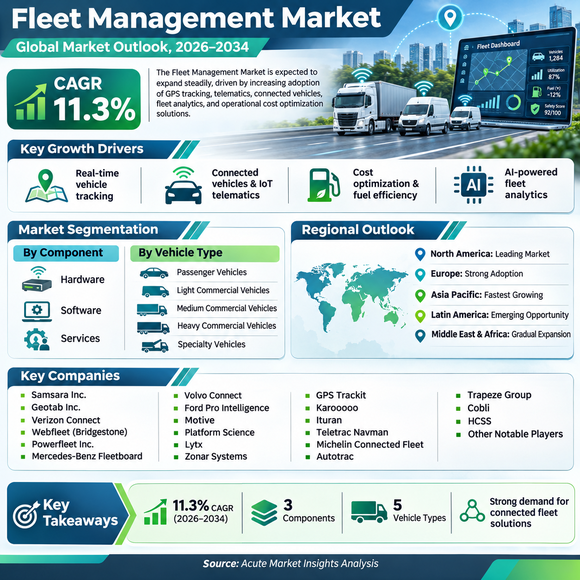
The global fleet management market is expected to register a CAGR of 11.3% during the forecast period from 2026 to 2034, driven by increasing demand for real-time vehicle tracking, operational cost optimization, connected vehicle technologies, and advanced fleet analytics. Fleet management solutions combine hardware, software, and services to support vehicle monitoring, route planning, fuel management, maintenance scheduling, driver safety, regulatory compliance, and overall fleet performance. Increasing adoption of GPS tracking systems, Internet of Things (IoT) devices, cloud-based platforms, and artificial intelligence is expected to support market expansion across transportation, logistics, construction, public transportation, and commercial vehicle operations. Furthermore, growing demand for delivery services, expanding e-commerce activities, increasing commercial vehicle connectivity, and the transition toward electric and mixed-energy vehicle fleets are expected to create additional opportunities for market participants. Manufacturers and technology providers are focusing on integrated platforms, predictive maintenance, automated reporting, and data-driven decision-making to improve fleet efficiency and reduce operating expenses.
Fleet Management Market Growth Drivers
Increasing Demand for Real-Time Vehicle Tracking and Operational Cost Optimization
Growing demand for real-time vehicle tracking and operational cost optimization is expected to remain a major driver of the Fleet Management Market. Transportation companies, logistics providers, and commercial fleet operators are increasingly adopting GPS tracking, telematics, and fleet monitoring platforms to improve vehicle visibility, reduce unnecessary mileage, optimize route planning, and strengthen asset utilization. Rising fuel prices, vehicle maintenance expenses, and labor costs are encouraging organizations to invest in technologies that provide detailed operational information. Fleet management solutions enable businesses to monitor vehicle movements, analyze fuel consumption, schedule preventive maintenance, and identify operational inefficiencies. Furthermore, the growing importance of timely deliveries, fleet productivity, and service reliability is expected to encourage the adoption of advanced fleet management systems across commercial vehicle categories.
Growing Adoption of Connected Vehicles, IoT, and Advanced Telematics Technologies
Increasing integration of connected vehicle technologies, IoT sensors, and advanced telematics systems is expected to drive the Fleet Management Market. Modern vehicles generate operational data related to location, engine performance, fuel consumption, driver behavior, and maintenance requirements, allowing fleet operators to improve their management processes. Advancements in wireless communication, cloud computing, onboard diagnostics, and vehicle connectivity are enabling the development of more comprehensive fleet management platforms. In addition, growing adoption of original equipment manufacturer (OEM)-integrated telematics systems is expected to support the expansion of connected fleet services. These technologies are expected to improve data accessibility, operational monitoring, and fleet performance analysis across transportation, distribution, and industrial applications.
Fleet Management Market Restraints
High Initial Investment and Complex Integration with Existing Fleet Systems
High implementation costs and difficulties integrating fleet management solutions with existing operational systems are expected to restrain market growth. Deployment of advanced fleet management platforms may require investment in telematics hardware, GPS devices, cameras, software subscriptions, communication infrastructure, and employee training. Small and medium-sized fleet operators may face financial challenges when implementing comprehensive fleet management technologies across multiple vehicles. Furthermore, differences in vehicle models, communication protocols, legacy software, and operational requirements can increase integration complexity. The need for continuous system maintenance, software upgrades, and technical support may also increase the total cost of ownership, limiting adoption among cost-sensitive businesses.
Fleet Management Market Opportunities
Expansion of Electric Vehicle Fleet Management and Predictive Maintenance Solutions
The increasing adoption of electric vehicles and the development of predictive maintenance technologies are expected to create significant growth opportunities in the Fleet Management Market. Fleet operators transitioning toward electric and hybrid vehicles require specialized tools for battery monitoring, charging management, vehicle range analysis, route optimization, and energy consumption tracking. Fleet management providers are developing integrated platforms that can support conventional, hybrid, and electric vehicles within a single operating environment. Furthermore, artificial intelligence and predictive analytics are enabling fleet operators to identify potential maintenance issues, optimize servicing schedules, and reduce unexpected vehicle downtime. Growing investment in fleet electrification, connected transportation infrastructure, and advanced vehicle diagnostics is expected to strengthen opportunities for technology providers.
Fleet Management Market Challenges
Data Security, System Interoperability, and Regulatory Compliance
Data security concerns, system interoperability limitations, and regulatory compliance requirements remain important challenges in the Fleet Management Market. Connected fleet systems collect substantial volumes of vehicle location, operational, and driver-related data, creating a need for secure information handling, access controls, and cybersecurity protection. Fleet operators must also manage differences in communication standards, vehicle technologies, and third-party software platforms when integrating fleet management solutions. Furthermore, regulatory requirements related to driver working hours, electronic logging, vehicle safety, data privacy, and emissions reporting vary across countries and regions. Maintaining reliable connectivity, ensuring accurate data processing, and complying with applicable regulations are expected to remain key priorities for market participants.
Fleet Management Market Trends
Increasing Adoption of AI-Powered Fleet Analytics and Video Telematics
The growing integration of artificial intelligence and video telematics is emerging as an important trend in the Fleet Management Market. Fleet operators are increasingly utilizing AI-powered cameras, driver monitoring systems, and analytical platforms to assess driving behavior, identify safety risks, and improve operational performance. These technologies support applications such as collision risk detection, incident analysis, driver coaching, and automated safety reporting. In addition, advanced analytics platforms are enabling organizations to identify patterns in fuel consumption, route efficiency, vehicle utilization, and maintenance requirements. Increasing investment in AI-based fleet management technologies is expected to support the development of automated monitoring and decision-support capabilities.
Growing Shift Toward Cloud-Based and Integrated Fleet Management Platforms
The increasing adoption of cloud-based fleet management platforms is expected to influence the market significantly. Businesses are moving toward centralized systems that combine vehicle tracking, driver management, maintenance scheduling, fuel monitoring, and compliance reporting within unified digital environments. Cloud-based solutions enable fleet operators to access operational information across different locations and support integration with enterprise resource planning, transportation management, and other business systems. Furthermore, subscription-based software models and application programming interface (API) connectivity are expected to improve accessibility and encourage the adoption of integrated fleet management services among businesses of different sizes.
Increasing Focus on Fleet Electrification and Sustainability Management
Fleet electrification and sustainability management are becoming important areas of development in the Fleet Management Market. Commercial fleet operators are increasingly evaluating electric vehicles to reduce fuel dependence, manage emissions, and support corporate sustainability objectives. Fleet management technology providers are introducing specialized capabilities for battery monitoring, charging schedules, energy consumption analysis, and electric vehicle route planning. In addition, organizations operating mixed fleets require platforms capable of monitoring internal combustion engine vehicles alongside electric and hybrid vehicles. Growing attention to fuel efficiency, emissions reporting, and vehicle lifecycle management is expected to support continued innovation in fleet management technologies.
Fleet Management Market Segmentation Analysis
Fleet Management Market by Component
Based on component, the Fleet Management Market is segmented into Hardware, Software, and Services. The hardware segment includes GPS tracking devices, telematics control units, onboard diagnostic equipment, cameras, sensors, and other connected vehicle components used to collect and transmit operational information. Demand for hardware is expected to be supported by increasing adoption of connected vehicles, video telematics, and real-time monitoring technologies. The software segment includes fleet tracking platforms, route optimization systems, driver management applications, maintenance scheduling tools, fuel management software, and advanced analytics solutions. Software is expected to remain a key area of market development due to the increasing adoption of cloud-based platforms, artificial intelligence, and integrated fleet management systems. The services segment includes installation, consulting, system integration, technical support, training, maintenance, and managed fleet services. Growing demand for customized implementation, ongoing technical assistance, and integration with enterprise systems is expected to support the expansion of the services segment.
Fleet Management Market by Vehicle Type
Based on vehicle type, the Fleet Management Market is categorized into Passenger Vehicles, Light Commercial Vehicles, Medium Commercial Vehicles, Heavy Commercial Vehicles, and Specialty Vehicles. Passenger Vehicles include corporate cars, rental vehicles, taxi fleets, and other passenger transportation vehicles that require tracking, maintenance management, and operational monitoring. Light Commercial Vehicles represent an important category due to their extensive utilization in last-mile delivery, courier services, retail distribution, and field service operations. Medium Commercial Vehicles are widely used in regional transportation, goods distribution, and commercial logistics applications, creating demand for vehicle tracking, route optimization, and maintenance solutions. Heavy Commercial Vehicles, including heavy-duty trucks and long-haul transport fleets, require advanced fleet management capabilities for fuel monitoring, driver compliance, vehicle diagnostics, and operational efficiency. Specialty Vehicles include construction equipment, emergency service vehicles, municipal vehicles, utility fleets, and other specialized transportation assets. Demand across these categories is expected to be supported by growing vehicle connectivity, industry-specific operational requirements, and increasing adoption of digital fleet management technologies.
Fleet Management Market Regional Analysis
North America Fleet Management Market
North America is expected to remain a major regional market for fleet management solutions, supported by established transportation and logistics industries, advanced telematics infrastructure, and increasing adoption of connected vehicle technologies. The United States represents an important market due to its large commercial vehicle fleet, extensive freight transportation network, and significant presence of fleet management technology providers. Increasing demand for GPS tracking, electronic logging, video telematics, and AI-powered safety management systems is expected to support regional growth. Furthermore, the expansion of e-commerce delivery services, increasing focus on operating cost reduction, and adoption of predictive maintenance solutions are expected to encourage investment in fleet management technologies. Canada is also expected to contribute to regional growth through increasing connected fleet adoption and digital transformation across transportation and commercial vehicle operations.
Europe Fleet Management Market
Europe is expected to maintain a significant position in the global Fleet Management Market, driven by established automotive industries, growing adoption of connected vehicle technologies, and increasing emphasis on operational efficiency and emissions management. Countries such as Germany, the United Kingdom, France, Italy, and the Netherlands are important markets for telematics, fleet tracking, and transportation management solutions. Regulatory requirements related to commercial vehicle operations, driver working hours, vehicle safety, and environmental performance are expected to encourage the adoption of fleet management systems. Furthermore, increasing investment in electric commercial vehicles, smart mobility infrastructure, and integrated fleet software platforms is expected to support market expansion. The presence of major automotive manufacturers and technology providers is also expected to strengthen regional market development.
Asia Pacific Fleet Management Market
Asia Pacific is expected to offer significant growth opportunities in the Fleet Management Market, supported by expanding transportation and logistics industries, increasing commercial vehicle sales, and growing investment in digital infrastructure. China, India, Japan, South Korea, and Australia are important markets for connected vehicle technologies and fleet management solutions. Rapid growth in e-commerce, last-mile delivery services, industrial transportation, and urban logistics is expected to increase demand for real-time tracking and operational management systems. Furthermore, increasing adoption of GPS monitoring, IoT-based fleet tracking, and cloud-based transportation platforms is expected to support regional market development. Government initiatives related to digital transportation infrastructure and commercial vehicle monitoring may also contribute to market expansion in selected countries.
Latin America Fleet Management Market
Latin America is expected to witness steady growth in the Fleet Management Market, supported by increasing demand for vehicle tracking, fleet security, logistics optimization, and transportation efficiency. Brazil and Mexico are expected to remain important regional markets due to their commercial transportation industries and expanding adoption of connected fleet technologies. Fleet operators are increasingly utilizing GPS tracking and telematics platforms to improve vehicle visibility, reduce operational inefficiencies, and address vehicle security concerns. Furthermore, growth in e-commerce distribution, agricultural transportation, and cross-border logistics is expected to create additional opportunities for fleet management providers. However, infrastructure limitations, implementation costs, and differences in regional connectivity may affect market penetration.
Middle East & Africa Fleet Management Market
The Middle East & Africa Fleet Management Market is expected to develop through increasing investment in transportation infrastructure, logistics services, and connected vehicle technologies. Countries such as Saudi Arabia, the United Arab Emirates, and South Africa are expected to offer opportunities for fleet tracking, telematics, and commercial vehicle management solutions. The expansion of construction activities, industrial transportation, logistics networks, and public infrastructure projects is expected to support demand for fleet management systems. Furthermore, increasing interest in vehicle safety, fuel efficiency, and digital transportation platforms is expected to encourage adoption. However, differences in communication infrastructure, operating conditions, and investment capabilities may restrict wider market penetration in certain areas.
Fleet Management Market Competitive Landscape
The global Fleet Management Market is characterized by the presence of established telematics providers, connected vehicle technology companies, automotive manufacturers, fleet software developers, and specialized fleet service providers. Competition is influenced by product functionality, hardware reliability, software integration capabilities, subscription pricing, data analytics, customer support, and geographical coverage. Major companies are increasingly focusing on AI-powered fleet analytics, video telematics, predictive maintenance, electric vehicle fleet management, and cloud-based platform integration to strengthen their competitive positions. Partnerships with vehicle manufacturers, logistics operators, and technology developers are expected to support service expansion and product innovation. Furthermore, mergers, acquisitions, and platform consolidation are reshaping the competitive landscape as companies seek to expand their installed customer base, technology capabilities, and international market presence.
Key Companies Operating in the Fleet Management Market
Major companies included in the global Fleet Management Market competitive landscape are Samsara Inc., Geotab Inc., Verizon Connect, Webfleet (Bridgestone), Powerfleet Inc., Mercedes-Benz Fleetboard, Volvo Connect, Ford Pro Intelligence, Motive, Platform Science, Lytx, Zonar Systems, GPS Trackit, Karooooo, Ituran, Teletrac Navman, Michelin Connected Fleet, Autotrac, Trapeze Group, Cobli, HCSS, and Other Notable Players. These companies offer different combinations of GPS tracking, fleet telematics, vehicle diagnostics, route optimization, driver safety management, video monitoring, maintenance solutions, and connected fleet software. Their competitive positions depend on technology capabilities, installed customer base, platform compatibility, industry specialization, and geographical reach. The market includes both independent technology providers and original equipment manufacturer-associated solutions, creating a competitive environment characterized by software innovation, hardware integration, and recurring service models.
Historical & Forecast Period
This study report represents analysis of each segment from 2024 to 2034 considering 2025 as the base year. Compounded Annual Growth Rate (CAGR) for each of the respective segments estimated for the forecast period of 2026 to 2034.
The current report comprises of quantitative market estimations for each micro market for every geographical region and qualitative market analysis such as micro and macro environment analysis, market trends, competitive intelligence, segment analysis, porters five force model, top winning strategies, top investment markets, emerging trends and technological analysis, case studies, strategic conclusions and recommendations and other key market insights.
Research Methodology
The complete research study was conducted in three phases, namely: secondary research, primary research, and expert panel review. key data point that enables the estimation of Fleet Management Market - Growth, Share, Opportunities & Competitive Analysis, 2026 - 2034 market are as follows:
Market forecast was performed through proprietary software that analyzes various qualitative and quantitative factors. Growth rate and CAGR were estimated through intensive secondary and primary research. Data triangulation across various data points provides accuracy across various analyzed market segments in the report. Application of both top down and bottom-up approach for validation of market estimation assures logical, methodical and mathematical consistency of the quantitative data.
| ATTRIBUTE | DETAILS |
|---|---|
| Research Period | 2024-2034 |
| Base Year | 2025 |
| Forecast Period | 2026-2034 |
| Historical Year | 2024 |
| Unit | USD Million |
| Segmentation | |
Component
|
|
Vehicle Type
|
|
Powertrain
|
|
Fleet Size
|
|
Deployment
|
|
Communication Technology
|
|
End-Use Industry
|
|
|
Region Segment (2024-2034; US$ Million)
|
Frequently Asked Questions
1. What is the expected growth rate of the global Fleet Management Market?
The global Fleet Management Market is expected to grow at a CAGR of 11.3% from 2026 to 2034, based on the forecast assumption used in this study. Market growth is expected to be supported by increasing adoption of GPS tracking, connected vehicle technologies, artificial intelligence, cloud-based fleet software, and operational cost management solutions. Expanding transportation and logistics activities and increasing demand for real-time fleet visibility are also expected to contribute to industry growth.
2. What is fleet management and how does it work?
Fleet management refers to the use of technologies, systems, and operational processes to monitor and manage commercial or organizational vehicles. Fleet management solutions combine GPS tracking devices, telematics systems, sensors, software platforms, and analytical tools to collect information related to vehicle location, performance, fuel consumption, maintenance, and driver activity. Fleet operators use this information to improve route planning, enhance vehicle utilization, monitor safety, manage compliance, and reduce operating costs.
3. What are the major components of the Fleet Management Market?
The Fleet Management Market is segmented into Hardware, Software, and Services. Hardware includes GPS trackers, telematics devices, sensors, and onboard cameras used for vehicle data collection. Software includes fleet tracking platforms, route optimization tools, maintenance management applications, and analytical solutions. Services include installation, system integration, consulting, technical support, training, and managed fleet services. All three components support the deployment and operation of integrated fleet management systems.
4. Which vehicle types are covered in the Fleet Management Market?
The Fleet Management Market covers Passenger Vehicles, Light Commercial Vehicles, Medium Commercial Vehicles, Heavy Commercial Vehicles, and Specialty Vehicles. These categories include corporate cars, rental vehicles, delivery vans, distribution trucks, heavy-duty transportation vehicles, construction equipment, municipal vehicles, and other specialized fleet assets. The adoption of fleet management solutions varies according to vehicle operating requirements, fleet size, industry applications, and regulatory obligations.
5. What are the major factors driving growth in the Fleet Management Market?
The major factors driving the Fleet Management Market include increasing demand for real-time vehicle tracking, rising transportation operating costs, expansion of e-commerce and delivery services, and growing adoption of connected vehicle technologies. Advancements in artificial intelligence, predictive maintenance, video telematics, and cloud-based fleet management platforms are also expected to support market development. The increasing transition toward electric vehicle fleets is creating additional opportunities for energy monitoring, charging management, and specialized fleet optimization solutions.
6. Who are the major companies operating in the global Fleet Management Market?
Major companies operating in the global Fleet Management Market include Samsara Inc., Geotab Inc., Verizon Connect, Webfleet (Bridgestone), Powerfleet Inc., Mercedes-Benz Fleetboard, Volvo Connect, Ford Pro Intelligence, Motive, Platform Science, Lytx, Zonar Systems, GPS Trackit, Karooooo, Ituran, Teletrac Navman, Michelin Connected Fleet, Autotrac, Trapeze Group, Cobli, and HCSS, along with other notable players. These companies provide fleet tracking, telematics, vehicle monitoring, safety management, analytics, and software integration solutions for different commercial vehicle applications.


