
A steady growth opportunity is emerging as surgical procedures increasingly require faster, safer, and more effective bleeding control solutions
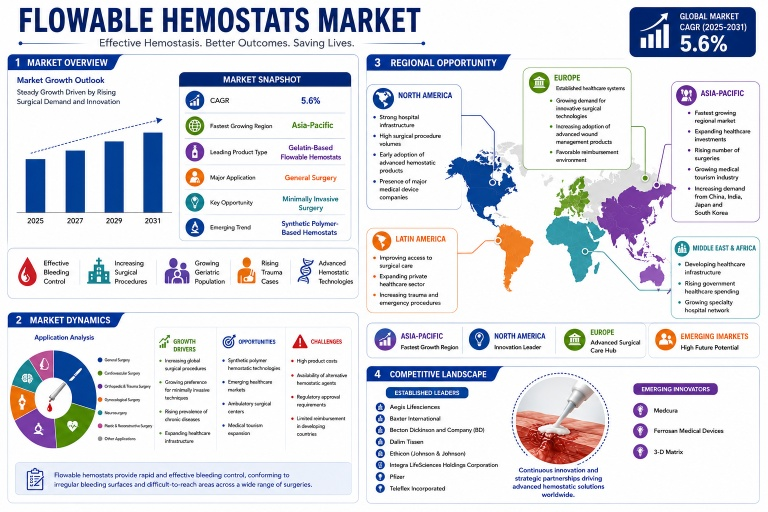
The global flowable hemostats market is witnessing consistent growth, driven by rising surgical volumes, increasing adoption of minimally invasive procedures, and growing demand for advanced intraoperative bleeding management products. Flowable hemostats are widely used across complex surgeries due to their ability to conform to irregular bleeding surfaces and support rapid hemostasis. With hospitals and surgical centers focusing on better patient outcomes and reduced procedure time, the market is expected to register a CAGR of 5.6% during the forecast period.
Key Growth Driver
Increasing surgical complexity and demand for effective bleeding control are strengthening market adoption
Flowable hemostats are gaining strong acceptance in general surgery, cardiovascular surgery, orthopedic procedures, gynecological surgery, neurosurgery, and trauma care. Their ease of application, targeted delivery, and effectiveness in difficult-to-access bleeding sites make them valuable for surgeons. Rising healthcare expenditure, growing geriatric population, and increasing incidence of chronic diseases requiring surgical intervention are further supporting market growth.
Segment Highlight
Product innovation and wider surgical usage continue to expand market potential
Based on product type, Gelatin-Based Flowable Hemostats hold a significant market position due to their broad clinical usage and strong availability across hospital settings. Collagen-Based Flowable Hemostats are gaining demand owing to their biocompatibility and effectiveness in surgical bleeding control. Synthetic Polymer-Based Flowable Hemostats are expected to create new opportunities as manufacturers focus on advanced, consistent, and application-specific hemostatic technologies.
By application, General Surgery remains a major segment due to high procedure volumes globally. Cardiovascular Surgery represents a key growth area because of the critical need for rapid bleeding management. Orthopedic and Trauma Surgery is also witnessing strong adoption, supported by rising accident cases, sports injuries, and joint replacement procedures. Demand is further expanding across gynecological surgery, neurosurgery, plastic and reconstructive surgery, and other applications.
Regional Opportunity
North America maintains a strong market position, while Asia-Pacific is expected to show faster growth
North America continues to lead the market due to high surgical procedure volumes, strong hospital infrastructure, early adoption of advanced surgical products, and presence of major medical device companies. Europe benefits from established healthcare systems, rising demand for advanced wound care solutions, and growing adoption of innovative surgical technologies. Asia-Pacific is emerging as a high-growth region, supported by expanding healthcare access, rising hospital investments, increasing surgical volumes, and growing medical tourism across countries such as China, India, Japan, and South Korea.
Competitive Landscape
Leading companies are focusing on product innovation, surgical efficiency, and wider hospital adoption
The competitive landscape is shaped by continuous product development, clinical performance improvement, partnerships, and expansion into emerging healthcare markets. Companies are investing in advanced hemostatic platforms that offer faster bleeding control, better handling properties, and broader surgical applicability. Market participants are also strengthening distribution networks to increase product availability across hospitals, ambulatory surgical centers, and specialty clinics.
Key companies operating in the market include Aegis Lifesciences, Baxter International, Becton Dickinson and Company (BD), Dalim Tissen, Ethicon (Johnson & Johnson), Ferrosan Medical Devices, Integra LifeSciences Holdings Corporation, Medcura, Pfizer, Teleflex Incorporated, and 3-D Matrix.
Historical & Forecast Period
This study report represents analysis of each segment from 2024 to 2034 considering 2025 as the base year. Compounded Annual Growth Rate (CAGR) for each of the respective segments estimated for the forecast period of 2026 to 2034.
The current report comprises of quantitative market estimations for each micro market for every geographical region and qualitative market analysis such as micro and macro environment analysis, market trends, competitive intelligence, segment analysis, porters five force model, top winning strategies, top investment markets, emerging trends and technological analysis, case studies, strategic conclusions and recommendations and other key market insights.
Research Methodology
The complete research study was conducted in three phases, namely: secondary research, primary research, and expert panel review. key data point that enables the estimation of Flowable Hemostats Market - Growth, Share, Opportunities & Competitive Analysis, 2026 - 2034 market are as follows:
Market forecast was performed through proprietary software that analyzes various qualitative and quantitative factors. Growth rate and CAGR were estimated through intensive secondary and primary research. Data triangulation across various data points provides accuracy across various analyzed market segments in the report. Application of both top down and bottom-up approach for validation of market estimation assures logical, methodical and mathematical consistency of the quantitative data.
| ATTRIBUTE | DETAILS |
|---|---|
| Research Period | 2024-2034 |
| Base Year | 2025 |
| Forecast Period | 2026-2034 |
| Historical Year | 2024 |
| Unit | USD Million |
| Segmentation | |
Product Type
|
|
Application
|
|
End Use
|
|
|
Region Segment (2024-2034; US$ Million)
|
Frequently Asked Questions
Q1. What is driving the growth of the Flowable Hemostats Market?
The market is primarily driven by increasing surgical procedures worldwide, growing adoption of minimally invasive surgeries, rising incidence of chronic diseases, and the need for effective intraoperative bleeding management solutions.
Q2. What is the expected growth rate of the Flowable Hemostats Market?
The global Flowable Hemostats Market is projected to expand at a CAGR of 5.6% during the forecast period.
Q3. Which product type holds a significant share in the market?
Gelatin-based flowable hemostats account for a notable market share due to their widespread clinical acceptance, ease of handling, and proven effectiveness in controlling surgical bleeding.
Q4. Which surgical applications are creating the highest demand for flowable hemostats?
General surgery remains a leading application area, while cardiovascular surgery, orthopedic and trauma surgery, gynecological surgery, and neurosurgery are also contributing significantly to market demand.
Q5. Why are flowable hemostats preferred over conventional hemostatic products?
Flowable hemostats can conform to irregular wound surfaces, reach difficult bleeding sites, and provide rapid and localized bleeding control, making them particularly useful in complex surgical procedures.
Q6. Which region is expected to witness the fastest market growth?
Asia-Pacific is anticipated to experience the fastest growth due to expanding healthcare infrastructure, increasing surgical volumes, rising healthcare expenditure, and growing medical tourism activities.
Q7. What emerging trends are influencing the market?
The market is witnessing increasing interest in synthetic polymer-based hemostats, advanced biocompatible formulations, and products designed specifically for minimally invasive surgical procedures.
Q8. Who are the leading companies operating in the Flowable Hemostats Market?
Major companies operating in the market include Aegis Lifesciences, Baxter International, Becton Dickinson and Company (BD), Dalim Tissen, Ethicon (Johnson & Johnson), Ferrosan Medical Devices, Integra LifeSciences Holdings Corporation, Medcura, Pfizer, Teleflex Incorporated, and 3-D Matrix.
Q9. What challenges could affect market expansion?
Factors such as high product costs, availability of alternative hemostatic agents, stringent regulatory requirements, and reimbursement limitations in certain developing countries may hinder market growth.
Q10. What opportunities are expected to shape the future of the Flowable Hemostats Market?
Growing demand for minimally invasive surgeries, technological advancements in synthetic hemostatic materials, and expanding healthcare investments in emerging economies are expected to create substantial growth opportunities for market participants.


