
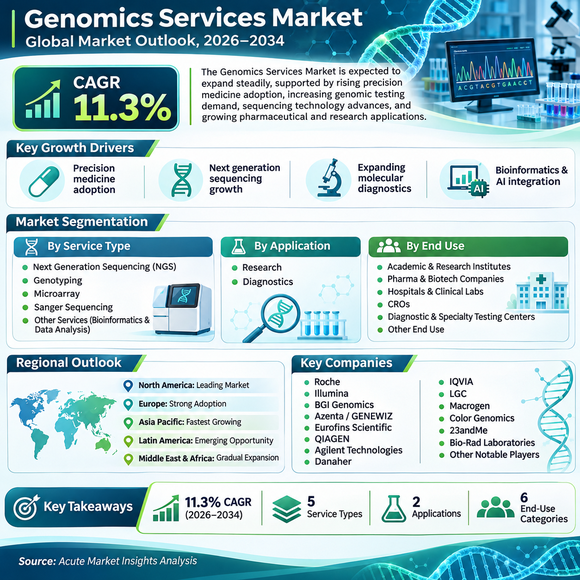
The global genomics services market is expected to register a CAGR of 11.3% during the forecast period from 2026 to 2034, supported by increasing demand for precision medicine, expanding applications of genomic testing, advancements in sequencing technologies, and growing investments in pharmaceutical and biotechnology research. Genomics services include next generation sequencing (NGS), genotyping, microarray analysis, Sanger sequencing, bioinformatics, and genomic data interpretation services used across research and clinical applications. The increasing adoption of genomic technologies for cancer research, rare disease investigation, hereditary disease testing, drug discovery, and biomarker identification is expected to support market expansion. Furthermore, declining sequencing costs, expanding availability of genomic testing services, and growing outsourcing activities among pharmaceutical companies, biotechnology organizations, and research institutions are expected to create significant opportunities for service providers. The integration of artificial intelligence, cloud computing, and advanced bioinformatics tools is also expected to improve genomic data processing and interpretation capabilities, supporting wider applications across healthcare and life sciences.
Genomics Services Market Growth Drivers
Growing Adoption of Precision Medicine and Personalized Healthcare
The increasing adoption of precision medicine and personalized healthcare approaches is expected to remain a major growth driver for the Genomics Services Market. Healthcare providers and pharmaceutical companies are increasingly utilizing genomic information to identify disease-associated genetic variations, support patient stratification, and develop targeted treatment strategies. The growing application of genomic testing in oncology, rare genetic disorders, inherited diseases, and pharmacogenomics is expected to support demand for sequencing and genetic analysis services. Furthermore, increasing investment in molecular diagnostics and the development of targeted therapies are encouraging healthcare organizations to integrate genomic technologies into clinical research and selected diagnostic workflows. These developments are expected to strengthen demand for reliable and accurate genomic testing services during the forecast period.
Increasing Demand for Next Generation Sequencing and Genomic Research
Growing adoption of next generation sequencing technologies across academic research, pharmaceutical development, and clinical laboratories is expected to drive market growth. NGS technologies enable high-throughput analysis of genetic material and support applications including whole genome sequencing, whole exome sequencing, transcriptomics, and targeted gene analysis. Improvements in sequencing throughput, automation, and data processing efficiency are making genomic analysis more accessible to research institutions and commercial organizations. In addition, the expansion of population genomics programs, cancer genomics research, and infectious disease surveillance is expected to increase demand for specialized sequencing services. Growing collaboration between academic institutions, biotechnology companies, and genomics service providers is also expected to support market development.
Genomics Services Market Restraints
High Data Analysis Complexity and Limited Availability of Skilled Professionals
The complexity of genomic data analysis and the limited availability of specialized professionals are expected to restrain the growth of the Genomics Services Market. Genomic testing generates substantial volumes of biological data that require advanced computational infrastructure, specialized software, and trained bioinformatics professionals for accurate interpretation. Laboratories and service providers must invest in data processing systems, quality control procedures, and secure information management platforms to maintain reliable service delivery. Furthermore, the interpretation of genetic variants can be challenging due to incomplete scientific evidence, differences in analytical methodologies, and the complexity of biological pathways. These factors may increase operational costs and limit the adoption of advanced genomic services among smaller laboratories and research organizations.
Genomics Services Market Opportunities
Expansion of Clinical Genomics and AI-Powered Bioinformatics Services
The increasing integration of artificial intelligence, machine learning, and advanced bioinformatics technologies into genomic analysis is expected to create significant growth opportunities in the Genomics Services Market. Genomic service providers are developing computational platforms capable of supporting sequence alignment, variant detection, genomic interpretation, and biological data integration. These technologies can help researchers and laboratories process complex genomic datasets more efficiently and identify relevant genetic patterns. Furthermore, the expansion of clinical genomics applications, including oncology testing, rare disease analysis, reproductive genetics, and pharmacogenomics, is expected to create opportunities for specialized testing and interpretation services. Increasing collaboration between healthcare institutions, software developers, and genomic laboratories is expected to support innovation and expand commercial opportunities.
Genomics Services Market Challenges
Data Privacy, Regulatory Compliance, and Standardization of Genomic Testing
Protecting genetic information and maintaining compliance with evolving regulatory frameworks remain major challenges in the Genomics Services Market. Genomic data contains sensitive information that may have implications for individuals and biological relatives, making secure storage, access control, and responsible data management essential. Service providers must comply with applicable privacy regulations, laboratory quality standards, patient consent requirements, and clinical testing guidelines. In addition, differences in sequencing platforms, analytical pipelines, laboratory procedures, and variant interpretation methods can affect consistency across service providers. Developing standardized workflows, maintaining analytical accuracy, and ensuring responsible handling of genomic information are expected to remain important priorities for companies operating in the market.
Genomics Services Market Trends
Increasing Outsourcing of Genomic Sequencing and Analytical Services
The growing trend of outsourcing genomic sequencing and analytical services is expected to influence the development of the Genomics Services Market. Pharmaceutical companies, biotechnology organizations, academic institutions, and smaller research laboratories are increasingly utilizing specialized genomics service providers to access advanced sequencing equipment, laboratory infrastructure, and bioinformatics expertise. Outsourcing can reduce the need for substantial capital investment in sequencing platforms and enable organizations to access specialized technologies based on project requirements. Furthermore, demand for integrated services covering sample preparation, sequencing, quality control, and data interpretation is expected to support the expansion of contract genomics service providers.
Growing Integration of Artificial Intelligence and Advanced Bioinformatics
Artificial intelligence and advanced bioinformatics are increasingly being incorporated into genomics workflows to support the analysis and interpretation of large genomic datasets. Companies are developing computational tools for variant identification, genetic association studies, genomic annotation, and research data integration. The adoption of automated analytical platforms and cloud-based infrastructure is expected to improve workflow efficiency and support collaboration among research organizations. Furthermore, increasing demand for accurate and scalable data interpretation is expected to encourage investment in specialized bioinformatics services.
Expansion of Multi-Omics Research and Integrated Molecular Analysis
The increasing adoption of multi-omics approaches is emerging as an important trend in the Genomics Services Market. Researchers are combining genomic information with transcriptomics, proteomics, epigenomics, and other molecular datasets to improve understanding of biological processes and disease mechanisms. This approach is being explored across drug discovery, biomarker research, oncology, and translational medicine. Growing demand for integrated molecular analysis is expected to create opportunities for service providers offering sequencing, analytical platforms, and specialized bioinformatics capabilities.
Genomics Services Market Segmentation Analysis
Genomics Services Market by Service Type
Based on service type, the Genomics Services Market is segmented into Next Generation Sequencing (NGS), Genotyping, Microarray, Sanger Sequencing, and Other Services (Bioinformatics & Data Analysis). Next Generation Sequencing (NGS) is expected to remain an important service category due to its extensive applications in whole genome sequencing, cancer genomics, rare disease research, transcriptomics, and molecular diagnostics. The genotyping segment is expected to benefit from increasing applications in genetic variation analysis, population studies, pharmacogenomics, and research programs. Microarray services continue to support gene expression analysis, genotyping, copy number variation studies, and selected cytogenomic applications. Sanger sequencing remains relevant for targeted genetic analysis, sequence verification, and confirmation of selected genetic variants because of its established analytical capabilities. Other Services, including Bioinformatics & Data Analysis, are expected to experience increasing demand as genomic datasets become larger and more complex, requiring specialized computational tools and interpretation services.
Genomics Services Market by Application
Based on application, the Genomics Services Market is categorized into Research and Diagnostics. The research segment includes genomic applications across drug discovery, disease mechanism studies, biomarker identification, population genomics, functional genomics, and biotechnology development. Increasing funding for life sciences research and growing adoption of genomic technologies by pharmaceutical companies and academic institutions are expected to support demand for research-related services. The diagnostics segment includes genomic testing services used in oncology, inherited disease testing, rare disease investigation, reproductive genetics, and other clinically relevant applications. Increasing integration of molecular testing into healthcare systems, advancements in clinical sequencing, and growing interest in precision medicine are expected to support the expansion of diagnostic genomics services. However, diagnostic applications require appropriate clinical validation, regulatory compliance, and quality assurance.
Genomics Services Market by End Use
Based on end use, the Genomics Services Market is segmented into Academic & Research Institutes, Pharma & Biotech Companies, Hospitals & Clinical Labs, CROs, Diagnostic & Specialty Testing Centers, and Other End Use. Academic & Research Institutes represent an important customer group due to their extensive involvement in fundamental genomics research, genetic studies, and molecular biology projects. Pharma & Biotech Companies are expected to generate substantial demand for genomic services through drug discovery, biomarker development, clinical research, and precision medicine programs. Hospitals & Clinical Labs are increasingly incorporating genomic testing into selected diagnostic pathways, particularly in oncology and rare genetic diseases. Contract Research Organizations (CROs) utilize specialized genomics services to support pharmaceutical research, clinical trials, and outsourced laboratory projects. Diagnostic & Specialty Testing Centers are expected to benefit from growing demand for advanced molecular testing, hereditary disease analysis, and specialized genomic interpretation services. Other End Use includes additional organizations utilizing genomic testing and analytical services for applications such as public health research, agricultural biotechnology, and specialized biological investigations.
Genomics Services Market Regional Analysis
North America Genomics Services Market
North America is expected to remain a major regional market for genomics services, supported by established biotechnology industries, advanced healthcare infrastructure, substantial research investment, and the presence of leading genomic technology companies. The United States is an important center for next generation sequencing, precision medicine, clinical genomics, and pharmaceutical research. Increasing utilization of genomic analysis in oncology, rare disease research, and drug development is expected to support regional demand. Furthermore, collaboration between academic institutions, pharmaceutical companies, hospitals, and specialized sequencing service providers is expected to strengthen market development. Canada is also expected to contribute through genomics research programs, biotechnology investment, and expanding molecular diagnostic capabilities.
Europe Genomics Services Market
Europe is expected to maintain a significant position in the global Genomics Services Market, driven by investments in life sciences research, personalized medicine, and molecular diagnostics. Countries such as Germany, the United Kingdom, France, and Switzerland are important centers for pharmaceutical research, biotechnology innovation, and genomic testing. Increasing implementation of national genomics programs and the development of advanced clinical diagnostic infrastructure are expected to support regional market growth. Furthermore, growing demand for genomic data analysis, biomarker discovery, and research outsourcing is expected to encourage investment in specialized service providers. Regulatory requirements related to patient data protection and clinical testing standards are expected to remain important considerations for market participants.
Asia Pacific Genomics Services Market
Asia Pacific is expected to offer significant growth opportunities in the Genomics Services Market, supported by expanding biotechnology industries, increasing healthcare investment, and growing adoption of genomic testing technologies. China, Japan, India, South Korea, and Australia are important markets for genomic research, molecular diagnostics, and sequencing services. The expansion of pharmaceutical research activities, increasing demand for genetic testing, and rising investment in genomic infrastructure are expected to support regional market development. Furthermore, growing availability of sequencing services and the development of bioinformatics capabilities are expected to improve access to genomic analysis across research and clinical applications.
Latin America Genomics Services Market
Latin America is expected to witness gradual growth in the Genomics Services Market, supported by increasing investment in biotechnology research, expanding molecular diagnostic capabilities, and growing interest in precision medicine. Brazil and Mexico are expected to remain important regional markets due to their healthcare infrastructure, research institutions, and pharmaceutical industries. Increasing collaboration with international genomics companies and growing demand for specialized testing services are expected to contribute to regional market development. However, high testing costs, limited reimbursement coverage, and uneven access to advanced laboratory infrastructure may restrain market expansion.
Middle East & Africa Genomics Services Market
The Middle East & Africa Genomics Services Market is expected to develop through increasing investment in healthcare modernization, biotechnology research, and genetic testing infrastructure. Countries such as Saudi Arabia, the United Arab Emirates, and South Africa are expected to offer opportunities for genomic research and clinical diagnostic services. Growing interest in precision medicine, inherited disease research, and population genomics initiatives is expected to support market growth. Furthermore, government-supported healthcare development programs and partnerships with international genomics service providers could strengthen regional capabilities. However, limited access to specialized professionals, high infrastructure costs, and differences in healthcare funding are expected to remain important challenges.
Genomics Services Market Competitive Landscape
The global Genomics Services Market is characterized by the presence of sequencing technology providers, specialized genomic testing companies, laboratory service organizations, molecular diagnostics companies, and contract research service providers. Competition is influenced by sequencing capacity, analytical accuracy, turnaround time, pricing, data interpretation capabilities, regulatory compliance, and global service availability. Market participants are focusing on expanding sequencing services, improving laboratory automation, developing advanced bioinformatics platforms, and strengthening collaborations with pharmaceutical companies, research institutions, and healthcare providers. Increasing demand for integrated genomic testing and interpretation services is expected to encourage investment in end-to-end service platforms. Strategic partnerships, acquisitions, technology development, and expansion of regional laboratory capabilities are expected to remain important competitive strategies.
Key Companies Operating in the Genomics Services Market
Major companies included in the global Genomics Services Market competitive landscape are Roche, Illumina, BGI Genomics, Azenta / GENEWIZ, Eurofins Scientific, QIAGEN, Agilent Technologies, Danaher, IQVIA, LGC, Macrogen, Color Genomics, Bio-Rad Laboratories, and Other Notable Players. These companies represent different areas of the genomics value chain, including sequencing technologies, genotyping, molecular diagnostics, genomic laboratory services, genetic testing, bioinformatics, and pharmaceutical research support. Their competitive positioning depends on service specialization, technology capabilities, laboratory infrastructure, research partnerships, geographical reach, and data analysis expertise. Market share assessment should distinguish direct genomics service revenue from sequencing instrument sales, reagents, software licensing, and other non-service activities.
Historical & Forecast Period
This study report represents analysis of each segment from 2024 to 2034 considering 2025 as the base year. Compounded Annual Growth Rate (CAGR) for each of the respective segments estimated for the forecast period of 2026 to 2034.
The current report comprises of quantitative market estimations for each micro market for every geographical region and qualitative market analysis such as micro and macro environment analysis, market trends, competitive intelligence, segment analysis, porters five force model, top winning strategies, top investment markets, emerging trends and technological analysis, case studies, strategic conclusions and recommendations and other key market insights.
Research Methodology
The complete research study was conducted in three phases, namely: secondary research, primary research, and expert panel review. key data point that enables the estimation of Genomics Services Market - Growth, Share, Opportunities & Competitive Analysis, 2026 - 2034 market are as follows:
Market forecast was performed through proprietary software that analyzes various qualitative and quantitative factors. Growth rate and CAGR were estimated through intensive secondary and primary research. Data triangulation across various data points provides accuracy across various analyzed market segments in the report. Application of both top down and bottom-up approach for validation of market estimation assures logical, methodical and mathematical consistency of the quantitative data.
| ATTRIBUTE | DETAILS |
|---|---|
| Research Period | 2024-2034 |
| Base Year | 2025 |
| Forecast Period | 2026-2034 |
| Historical Year | 2024 |
| Unit | USD Million |
| Segmentation | |
Service Type
|
|
Application
|
|
End Use
|
|
|
Region Segment (2024-2034; US$ Million)
|
Frequently Asked Questions
1. What is the expected growth rate of the global Genomics Services Market?
The global Genomics Services Market is expected to grow at a CAGR of 11.3% from 2026 to 2034, based on the forecast assumption used in this study. Market growth is expected to be supported by increasing demand for next generation sequencing, precision medicine, molecular diagnostics, pharmaceutical research, and advanced bioinformatics services. Growing adoption of genomic testing across research institutions and healthcare organizations is also expected to contribute to industry expansion.
2. What are genomics services and what are their major applications?
Genomics services include laboratory testing, sequencing, genotyping, microarray analysis, and computational interpretation of genetic information. These services are primarily used in research and diagnostics, including cancer genomics, rare disease investigation, inherited disease testing, drug discovery, biomarker identification, and population genetics. The increasing availability of genomic technologies is expected to expand their use across healthcare, pharmaceutical development, and life sciences research.
3. What are the major service types in the Genomics Services Market?
The Genomics Services Market is segmented into Next Generation Sequencing (NGS), Genotyping, Microarray, Sanger Sequencing, and Other Services (Bioinformatics & Data Analysis). NGS supports high-throughput genetic analysis, while genotyping and microarray services are used for genetic variation and molecular profiling studies. Sanger sequencing remains relevant for targeted sequence analysis, and bioinformatics services support the processing and interpretation of genomic data.
4. What factors are driving the growth of the Genomics Services Market?
The major growth drivers include increasing adoption of precision medicine, rising demand for molecular diagnostics, advancements in sequencing technologies, growing pharmaceutical and biotechnology research, and increasing outsourcing of genomic testing services. Improvements in bioinformatics, laboratory automation, and data analysis technologies are also expected to support market development.
5. Which regions are expected to offer significant opportunities in the Genomics Services Market?
North America is expected to remain an important market because of its established biotechnology industry, advanced healthcare infrastructure, and strong genomic research capabilities. Europe is expected to maintain a significant presence through pharmaceutical research and precision medicine initiatives. Asia Pacific is expected to provide substantial growth opportunities, supported by increasing healthcare investment, expanding biotechnology industries, and rising adoption of genomic testing services.
6. Who are the major companies operating in the global Genomics Services Market?
Major companies included in the Genomics Services Market are Roche, Illumina, BGI Genomics, Azenta / GENEWIZ, Eurofins Scientific, QIAGEN, Agilent Technologies, Danaher, IQVIA, LGC, Macrogen, Color Genomics, 23andMe, and Bio-Rad Laboratories, along with other notable players. These organizations participate in different areas of genomic analysis, sequencing technologies, molecular diagnostics, laboratory services, and bioinformatics. Their individual market positions depend on the specific service categories included in the market definition.


