
Growing demand for sustainable agriculture, increasing adoption of controlled environment farming, and rising concerns over food security are driving the growth of the hydroponics market worldwide.
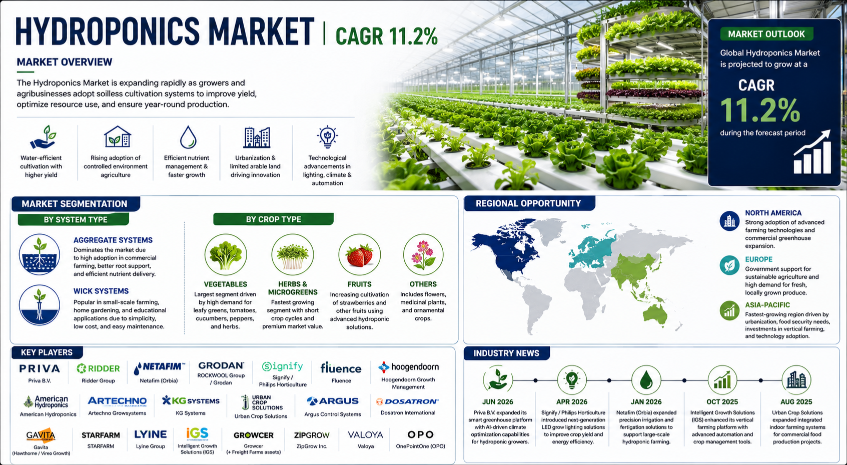
The global hydroponics market is witnessing strong growth as growers increasingly adopt soilless cultivation systems to improve crop yield, optimize water usage, and enable year-round production. Hydroponic farming offers efficient nutrient management, reduced land requirements, and higher productivity compared to conventional agriculture. Rising urbanization, expansion of indoor and vertical farming, increasing investment in precision agriculture, and growing demand for pesticide-free produce are supporting market expansion. Technological advancements in climate control, nutrient delivery systems, LED grow lighting, and automation continue to improve operational efficiency. The market is projected to register a CAGR of 11.2% during the forecast period.
Key Growth Driver
Increasing demand for resource-efficient and high-yield farming solutions is accelerating market growth globally.
Hydroponic cultivation enables growers to produce crops with significantly lower water consumption, better nutrient utilization, and higher productivity in limited spaces. Rising concerns over climate change, declining arable land, growing population, and increasing demand for fresh vegetables and herbs are encouraging investment in hydroponic farming. Smart greenhouse technologies, IoT-enabled monitoring systems, AI-driven crop management, and automation continue to strengthen market adoption.
Segment Highlight
Advanced cultivation systems and expanding commercial farming operations continue to create growth opportunities across crop categories.
Based on system type, Aggregate Systems account for a significant share of the market due to their widespread commercial adoption, superior root support, efficient nutrient management, and compatibility with high-value crop production. Wick Systems continue to witness demand among small-scale growers, educational institutions, and home gardening applications because of their simple design, low maintenance requirements, and cost-effectiveness.
By crop type, Vegetables dominate the market owing to high commercial demand for lettuce, tomatoes, cucumbers, peppers, and leafy greens. Herbs & Microgreens continue to experience rapid adoption due to their short cultivation cycles and premium market value. Fruits are witnessing increasing hydroponic cultivation for strawberries and other specialty crops, while Others include flowers, medicinal plants, and ornamental crops cultivated under controlled environments.
Regional Opportunity
Europe remains a leading market, while Asia-Pacific is emerging as the fastest-growing region for hydroponic farming.
Europe maintains a strong position in the Hydroponics Market due to advanced greenhouse infrastructure, widespread adoption of precision agriculture, government support for sustainable farming, and high demand for fresh produce. North America continues to witness robust growth supported by commercial indoor farming, technological innovation, and increasing investment in controlled environment agriculture. Meanwhile, Asia-Pacific is expected to experience the fastest growth driven by rapid urbanization, declining agricultural land availability, increasing food demand, expanding vertical farming projects, and government initiatives promoting modern agricultural technologies across China, Japan, India, Singapore, South Korea, and Australia.
Competitive Landscape
Market participants are focusing on automation, smart greenhouse technologies, precision irrigation, and integrated crop management solutions to strengthen their competitive position.
Leading companies are investing in advanced climate control systems, AI-powered cultivation platforms, LED horticulture lighting, automated nutrient management, and IoT-enabled monitoring technologies to improve crop productivity and operational efficiency. Strategic partnerships, expansion of commercial greenhouse projects, research into high-yield crop varieties, and investments in sustainable farming technologies continue to shape market competition. Companies are also emphasizing energy-efficient solutions, water conservation, digital farm management, and scalable hydroponic infrastructure to address evolving agricultural requirements.
Key companies operating in the market include Priva B.V., Ridder Group, Netafim (Orbia), ROCKWOOL Group / Grodan, Signify / Philips Horticulture, Fluence, Hoogendoorn Growth Management, American Hydroponics, Artechno Growsystems, KG Systems, Urban Crop Solutions, Argus Control Systems, Dosatron International, Gavita (Hawthorne / Vireo Growth), STARFARM, Lyine Group, Intelligent Growth Solutions (IGS), Growcer (+ Freight Farms assets), ZipGrow Inc., Valoya, and OnePointOne (OPO).
Hydroponics Industry News
Jun 2026: Priva B.V. expanded its smart greenhouse automation platform with enhanced AI-driven climate optimization features for commercial hydroponic growers.
Apr 2026: Signify / Philips Horticulture introduced next-generation LED grow lighting solutions designed to improve crop yield and energy efficiency in controlled environment agriculture.
Jan 2026: Netafim (Orbia) expanded its precision irrigation and fertigation solutions to support large-scale hydroponic farming operations.
Oct 2025: Intelligent Growth Solutions (IGS) strengthened its vertical farming platform with advanced environmental monitoring and automated crop management capabilities.
Aug 2025: Urban Crop Solutions expanded integrated indoor farming systems targeting commercial food production and urban agriculture projects.
Historical & Forecast Period
This study report represents analysis of each segment from 2024 to 2034 considering 2025 as the base year. Compounded Annual Growth Rate (CAGR) for each of the respective segments estimated for the forecast period of 2026 to 2034.
The current report comprises of quantitative market estimations for each micro market for every geographical region and qualitative market analysis such as micro and macro environment analysis, market trends, competitive intelligence, segment analysis, porters five force model, top winning strategies, top investment markets, emerging trends and technological analysis, case studies, strategic conclusions and recommendations and other key market insights.
Research Methodology
The complete research study was conducted in three phases, namely: secondary research, primary research, and expert panel review. key data point that enables the estimation of Hydroponic System Market - Growth, Share, Opportunities & Competitive Analysis, 2026 - 2034 market are as follows:
Market forecast was performed through proprietary software that analyzes various qualitative and quantitative factors. Growth rate and CAGR were estimated through intensive secondary and primary research. Data triangulation across various data points provides accuracy across various analyzed market segments in the report. Application of both top down and bottom-up approach for validation of market estimation assures logical, methodical and mathematical consistency of the quantitative data.
| ATTRIBUTE | DETAILS |
|---|---|
| Research Period | 2024-2034 |
| Base Year | 2025 |
| Forecast Period | 2026-2034 |
| Historical Year | 2024 |
| Unit | USD Million |
| Segmentation | |
System Type
|
|
Crop Type
|
|
Growing Environment
|
|
End User
|
|
|
Region Segment (2024-2034; US$ Million)
|
Frequently Asked Questions
Q1. What is driving the growth of the Hydroponics Market?
The market is primarily driven by increasing demand for sustainable agriculture, water-efficient farming methods, controlled environment agriculture, food security initiatives, and rising adoption of precision farming technologies.
Q2. What is the expected growth rate of the Hydroponics Market?
The global Hydroponics Market is projected to expand at a CAGR of 11.2% during the forecast period.
Q3. Which system type accounts for a significant market share?
Aggregate Systems account for a significant market share due to their high productivity, commercial scalability, efficient nutrient delivery, and suitability for cultivating a wide range of crops.
Q4. Which crop type dominates the Hydroponics Market?
Vegetables dominate the market owing to strong demand for leafy greens, tomatoes, cucumbers, peppers, and other high-value crops produced through controlled environment farming.
Q5. Which region is expected to witness the strongest market growth?
Asia-Pacific is expected to witness the strongest market growth due to increasing investments in vertical farming, rapid urbanization, growing food demand, declining arable land, and expanding adoption of modern agricultural technologies.


