
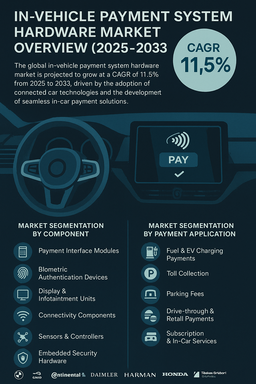
The global in-vehicle payment system hardware market is projected to grow at a CAGR of 11.5% from 2026 to 2034, driven by increasing adoption of connected and autonomous vehicle technologies, integration of digital payment solutions in automotive infotainment systems, and rising consumer demand for seamless in-car transactions. Automakers and payment technology companies are collaborating to develop secure, convenient, and fast payment infrastructures embedded directly into vehicles, transforming the driving experience into a connected ecosystem.
Connected Mobility Driving Cashless Convenience
The evolution of connected cars and smart mobility solutions is accelerating the deployment of in-vehicle payment hardware that enables drivers to make payments for tolls, fuel, parking, and retail purchases without leaving the vehicle. Advancements in biometric authentication, near-field communication (NFC), and embedded security modules are ensuring seamless and secure payment experiences. Furthermore, partnerships between automotive OEMs and fintech leaders are expanding the capabilities of infotainment systems to support digital wallets, contactless cards, and subscription-based vehicle services.
Challenges: Data Privacy and Integration Costs
Despite rapid growth, the market faces challenges such as cybersecurity risks, interoperability issues, and high integration costs of payment modules. Ensuring secure communication between vehicle networks, banks, and payment gateways requires robust encryption and hardware-level security. Additionally, different standards among automakers and financial institutions hinder system compatibility. However, continuous innovation in secure hardware design, biometric verification, and cloud-based payment authentication is addressing these concerns, paving the way for widespread adoption in both premium and mid-range vehicles.
Market Segmentation by Component
By component, the market is segmented into Payment Interface Modules, Biometric Authentication Devices, Display & Infotainment Units, Connectivity Components, Sensors & Controllers, and Embedded Security Hardware. In 2025, Display & Infotainment Units held the largest market share due to their central role in processing and managing payment transactions via integrated touchscreens and voice interfaces. The Biometric Authentication Devices segment is expected to register the highest CAGR, driven by growing demand for facial and fingerprint recognition systems to ensure transaction security. Embedded Security Hardware and Connectivity Components are also gaining prominence as vehicles become increasingly networked and vulnerable to cyberattacks.
Market Segmentation by Payment Application
By payment application, the market is categorized into Fuel & EV Charging Payments, Toll Collection, Parking Fees, Drive-through & Retail Payments, and Subscription & In-Car Services. In 2025, Fuel & EV Charging Payments dominated the market, supported by the rapid expansion of EV charging networks and partnerships between automakers and energy providers. Toll Collection and Parking Fees applications are expected to see significant growth as smart city initiatives and digital toll systems expand globally. Drive-through & Retail Payments are gaining traction in urban regions, while Subscription & In-Car Services such as navigation upgrades, infotainment streaming, and vehicle maintenance plans are emerging as recurring revenue sources for automakers.
Regional Insights
In 2025, North America led the in-vehicle payment system hardware market, owing to early adoption of connected car technologies and collaborations between automakers and financial service providers. Europe followed, driven by advanced automotive electronics integration and stringent data protection frameworks under the GDPR. The Asia Pacific region is expected to record the fastest CAGR during the forecast period, supported by growing EV infrastructure, smart mobility initiatives, and the adoption of digital payment ecosystems in countries like Japan, South Korea, and China. Emerging markets in Latin America and Middle East & Africa (MEA) are gradually integrating connected car payment systems as part of broader smart transportation development.
Competitive Landscape
The market is moderately consolidated, with leading automakers and technology providers focusing on developing secure and interoperable payment platforms. BMW, Daimler, and Hyundai Motor Company are pioneering in-car payment ecosystems through partnerships with financial networks and tech suppliers. Continental and Harman International provide advanced infotainment and connectivity modules integrated with payment functionalities. Thales Group specializes in hardware-level encryption and biometric security, while Mastercard Incorporated collaborates with automakers to facilitate tokenized, real-time vehicle payments. Honda Motor is actively implementing payment-enabled infotainment systems across its new models, focusing on seamless integration with fuel, parking, and retail networks.
Historical & Forecast Period
This study report represents analysis of each segment from 2024 to 2034 considering 2025 as the base year. Compounded Annual Growth Rate (CAGR) for each of the respective segments estimated for the forecast period of 2026 to 2034.
The current report comprises of quantitative market estimations for each micro market for every geographical region and qualitative market analysis such as micro and macro environment analysis, market trends, competitive intelligence, segment analysis, porters five force model, top winning strategies, top investment markets, emerging trends and technological analysis, case studies, strategic conclusions and recommendations and other key market insights.
Research Methodology
The complete research study was conducted in three phases, namely: secondary research, primary research, and expert panel review. key data point that enables the estimation of In-Vehicle Payment System Hardware Market By Component, By Payment Application, By Technology, By End Use - Growth, Share, Opportunities & Competitive Analysis, 2026 - 2034 market are as follows:
Market forecast was performed through proprietary software that analyzes various qualitative and quantitative factors. Growth rate and CAGR were estimated through intensive secondary and primary research. Data triangulation across various data points provides accuracy across various analyzed market segments in the report. Application of both top down and bottom-up approach for validation of market estimation assures logical, methodical and mathematical consistency of the quantitative data.
| ATTRIBUTE | DETAILS |
|---|---|
| Research Period | 2024-2034 |
| Base Year | 2025 |
| Forecast Period | 2026-2034 |
| Historical Year | 2024 |
| Unit | USD Million |
| Segmentation | |
Component
|
|
Payment Application
|
|
Technology
|
|
End Use
|
|
|
Region Segment (2024-2034; US$ Million)
|
Key questions answered in this report


