
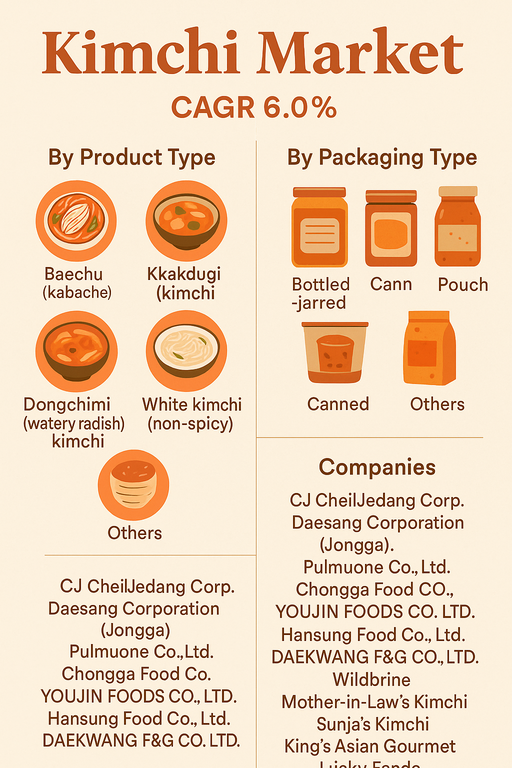
The global kimchi market is expected to grow at a CAGR of 6.0% between 2026 and 2034, fueled by rising global interest in fermented foods, expanding Korean cuisine influence, and increasing awareness of gut health and immunity. Kimchi, a traditional Korean fermented dish, has gained international traction as a superfood rich in probiotics, vitamins, and antioxidants. The demand is rising across North America, Europe, and Asia Pacific, both through traditional retail and modern grocery chains. Additionally, the trend toward clean-label, plant-based, and functional foods is pushing innovation in kimchi packaging, flavor profiles, and ingredient sourcing.
Market Drivers
Growing Consumer Preference for Fermented and Probiotic Foods
With increasing awareness about digestive health and immunity, fermented foods like kimchi are seeing global demand. Rich in Lactobacillus and other beneficial microbes, kimchi supports gut health and is widely recognized for its anti-inflammatory and antioxidant properties. Health-conscious consumers are incorporating kimchi into daily diets not just as a side dish but also as an ingredient in fusion cuisines, beverages, and snacks.
Expansion of Korean Cuisine and Cross-Cultural Appeal
The growing popularity of Korean culture (K-wave or Hallyu), including K-dramas and K-pop, has contributed to a rising interest in Korean food. Kimchi has become a staple item in Asian restaurants, grocery chains, and online platforms worldwide. Increased export activity from South Korea and the introduction of innovative packaging formats are making kimchi more accessible in global markets.
Market Restraint
Short Shelf Life and Cold Chain Challenges
Kimchi’s fermentation process is temperature-sensitive, requiring consistent cold storage and transportation. This presents challenges in regions lacking refrigerated supply chains or where long shipping times may degrade product quality. Inconsistent taste, leakage, or over-fermentation during distribution can hinder acceptance, especially in markets unfamiliar with the product’s strong aroma and spicy flavor.
Market Segmentation by Product Type
The market is segmented into Baechu (cabbage) Kimchi, Kkakdugi (radish) Kimchi, Dongchimi (watery radish) Kimchi, Nabak Kimchi (sliced radish and vegetables), White Kimchi (non-spicy), and Others. In 2025, Baechu kimchi dominated global sales as the most traditional and widely consumed type. Kkakdugi is gaining popularity, particularly in ready-to-eat segments. Dongchimi and Nabak kimchi are favored for their milder, watery characteristics, often consumed during summer. White kimchi is increasingly consumed by health-sensitive and spice-averse consumers in Western markets.
Market Segmentation by Packaging Type
By packaging type, the market is segmented into Bottled/Jarred, Vacuum Packed, Canned, Pouch Packaging, and Others. Vacuum packed kimchi led the market in 2025 due to its efficiency in preserving flavor, minimizing fermentation-related gas build-up, and extending shelf life. Bottled and jarred formats are gaining traction in premium and artisanal segments. Canned and pouch packaging options are growing due to their convenience for export, longer shelf stability, and retail-ready formats.
Geographic Trends
Asia Pacific dominated the kimchi market in 2025, led by South Korea, which is the origin and global hub for premium kimchi production and export. Japan, China, and Vietnam also contribute to regional demand. North America is expected to see the fastest growth between 2026 and 2034, as consumers increasingly seek out probiotic-rich and plant-based foods. Europe is emerging as a health-forward kimchi market, particularly in Germany, the UK, and France, where functional foods are gaining popularity. Latin America and the Middle East & Africa are nascent but growing markets due to increasing Asian diaspora populations and specialty food imports.
Competitive Trends
The global kimchi market is moderately fragmented with a mix of large Korean food manufacturers and niche artisanal brands. CJ CheilJedang Corp. and Daesang Corporation (Jongga) are market leaders, leveraging large-scale production, export networks, and wide product ranges. Pulmuone, Chongga Food, and YOUJIN FOODS are prominent in Asia, offering value-added and premium kimchi variants. In the U.S., companies like Wildbrine, Mother-in-Law's Kimchi, and Sunja’s Kimchi cater to organic, clean-label, and small-batch consumers. King’s Asian Gourmet and Cosmos Food Company focus on Asian specialty distribution. Brands are differentiating through flavor innovation (e.g., garlic-free, mild spice), dietary positioning (vegan, gluten-free), and packaging convenience.
Historical & Forecast Period
This study report represents analysis of each segment from 2024 to 2034 considering 2025 as the base year. Compounded Annual Growth Rate (CAGR) for each of the respective segments estimated for the forecast period of 2026 to 2034.
The current report comprises of quantitative market estimations for each micro market for every geographical region and qualitative market analysis such as micro and macro environment analysis, market trends, competitive intelligence, segment analysis, porters five force model, top winning strategies, top investment markets, emerging trends and technological analysis, case studies, strategic conclusions and recommendations and other key market insights.
Research Methodology
The complete research study was conducted in three phases, namely: secondary research, primary research, and expert panel review. key data point that enables the estimation of Kimchi Market By Product Type, By Packaging Type, By Distribution Channel - Growth, Share, Opportunities & Competitive Analysis, 2026 - 2034 market are as follows:
Market forecast was performed through proprietary software that analyzes various qualitative and quantitative factors. Growth rate and CAGR were estimated through intensive secondary and primary research. Data triangulation across various data points provides accuracy across various analyzed market segments in the report. Application of both top down and bottom-up approach for validation of market estimation assures logical, methodical and mathematical consistency of the quantitative data.
| ATTRIBUTE | DETAILS |
|---|---|
| Research Period | 2024-2034 |
| Base Year | 2025 |
| Forecast Period | 2026-2034 |
| Historical Year | 2024 |
| Unit | USD Million |
| Segmentation | |
Product Type
|
|
Packaging Type
|
|
Distribution Channel
|
|
|
Region Segment (2024-2034; US$ Million)
|
Key questions answered in this report


