
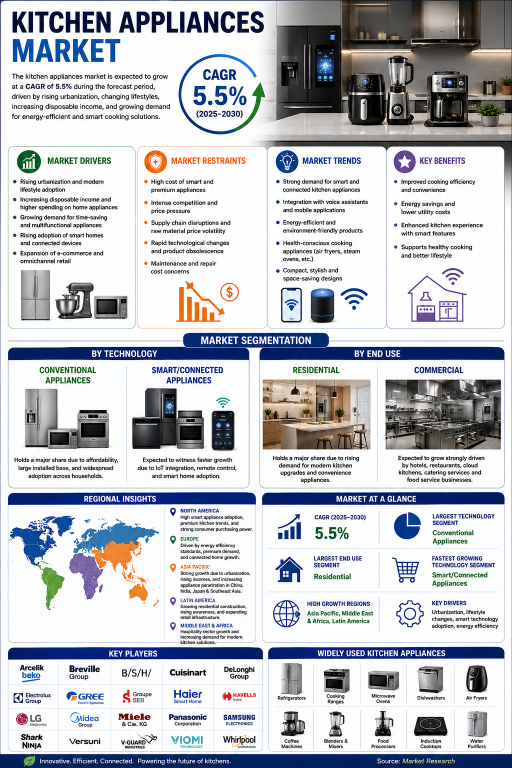
The kitchen appliances market is expected to grow at a CAGR of 5.5% during the forecast period, driven by rising urbanization, changing consumer lifestyles, increasing disposable income, and growing demand for energy-efficient and smart cooking solutions.
Market Drivers
The market is mainly driven by increasing demand for convenient, time-saving, and multifunctional kitchen equipment in residential and commercial settings. Consumers are adopting advanced appliances such as smart ovens, induction cooktops, air fryers, coffee machines, and connected refrigerators to improve cooking efficiency and kitchen management.
Growth in smart homes, modular kitchens, and energy-efficient appliances is also supporting market expansion. Rising demand from restaurants, hotels, cloud kitchens, and food service businesses is increasing commercial appliance adoption.
Market Restraints
The market faces challenges related to high product cost, intense competition, and rapid technology changes. Smart appliances often require higher investment and stable internet connectivity, which may limit adoption in price-sensitive markets.
Supply chain disruptions, raw material price fluctuations, and maintenance concerns may also affect profitability and market penetration.
Kitchen Appliances Market Trends
The market is witnessing strong demand for smart and connected appliances integrated with Wi-Fi, voice assistants, touchscreen interfaces, and mobile applications.
Energy-efficient products, compact appliances, touchless operation, AI-based cooking assistance, and health-focused cooking appliances are emerging trends. Air fryers, smart coffee makers, induction cooking systems, and automated kitchen solutions are witnessing strong demand globally.
Market Segmentation
By Technology
By technology, the market is segmented into conventional appliances and smart/connected appliances. Conventional appliances hold a major share due to affordability, large installed base, and widespread adoption across residential households.
Smart/connected appliances are expected to witness faster growth due to rising smart home adoption, IoT integration, remote monitoring features, and increasing consumer preference for connected ecosystems.
By End Use
By end use, the market is segmented into residential and commercial. Residential holds a major share due to high consumer spending on modern kitchen upgrades, convenience appliances, and home cooking solutions.
Commercial applications are expected to witness strong growth due to expansion of hotels, restaurants, quick-service restaurants, catering services, and cloud kitchens.
Regional Insights
North America holds a significant share of the kitchen appliances market due to high smart appliance adoption, premium kitchen remodeling trends, and strong consumer purchasing power.
Europe is driven by energy efficiency standards, premium appliance demand, and growth in connected homes. Asia Pacific is expected to witness strong growth due to rapid urbanization, rising middle-class population, and increasing appliance penetration in China, India, Japan, and Southeast Asia.
Latin America and the Middle East & Africa are emerging markets supported by residential construction growth, hospitality expansion, and rising consumer awareness.
Competitive Landscape
The kitchen appliances market is highly competitive, with companies focusing on product innovation, smart connectivity, energy efficiency, compact design, and premium features. Competition is based on pricing, technology integration, durability, after-sales service, and brand reputation.
Key companies operating in the market include Arcelik/Beko, Breville Group, BSH Hausgerate GmbH, Cuisinart, De'Longhi Group, Electrolux Group, Gree Electric Appliances, Groupe SEB, Haier Smart Home, Havells India, LG Electronics, Midea Group, Miele & Cie. KG, Panasonic Corporation, Samsung Electronics, SharkNinja, Versuni, V-Guard Industries, Viomi Technology, and Whirlpool Corporation.
Kitchen Appliances Industry News
The industry is witnessing increasing launches of AI-enabled cooking appliances, connected refrigerators, smart ovens, robotic kitchen systems, and energy-efficient products.
Manufacturers are focusing on app-based control, voice assistant compatibility, health-focused cooking technologies, and sustainable product development. Partnerships between smart home ecosystem providers and appliance manufacturers are expected to support market growth.
Historical & Forecast Period
This study report represents analysis of each segment from 2024 to 2034 considering 2025 as the base year. Compounded Annual Growth Rate (CAGR) for each of the respective segments estimated for the forecast period of 2026 to 2034.
The current report comprises of quantitative market estimations for each micro market for every geographical region and qualitative market analysis such as micro and macro environment analysis, market trends, competitive intelligence, segment analysis, porters five force model, top winning strategies, top investment markets, emerging trends and technological analysis, case studies, strategic conclusions and recommendations and other key market insights.
Research Methodology
The complete research study was conducted in three phases, namely: secondary research, primary research, and expert panel review. key data point that enables the estimation of Kitchen Appliances Market - Growth, Share, Opportunities & Competitive Analysis, 2026 - 2034 market are as follows:
Market forecast was performed through proprietary software that analyzes various qualitative and quantitative factors. Growth rate and CAGR were estimated through intensive secondary and primary research. Data triangulation across various data points provides accuracy across various analyzed market segments in the report. Application of both top down and bottom-up approach for validation of market estimation assures logical, methodical and mathematical consistency of the quantitative data.
| ATTRIBUTE | DETAILS |
|---|---|
| Research Period | 2024-2034 |
| Base Year | 2025 |
| Forecast Period | 2026-2034 |
| Historical Year | 2024 |
| Unit | USD Million |
| Segmentation | |
Product Type
|
|
Technology
|
|
End Use
|
|
Distribution Channel
|
|
|
Region Segment (2024-2034; US$ Million)
|
Frequently Asked Questions
What is the growth outlook for the kitchen appliances market?
The market is expected to grow at a CAGR of 5.5% during the forecast period.
Which technology segment holds a major share?
Conventional appliances hold a major share due to affordability and widespread household adoption.
Which end-use segment dominates the market?
Residential dominates due to rising demand for modern kitchen upgrades and convenience appliances.
What are the major challenges?
High smart appliance cost, supply chain disruptions, raw material price fluctuations, and rapid technology changes are major challenges.
Who are the key players?
Major companies include Whirlpool Corporation, Samsung Electronics, LG Electronics, Electrolux Group, Panasonic Corporation, Haier Smart Home, Midea Group, BSH Hausgerate GmbH, Breville Group, and SharkNinja.


