
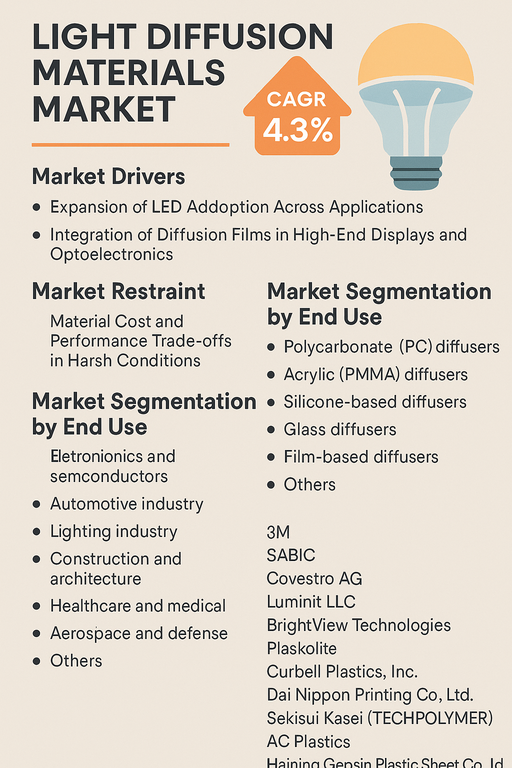
The global light diffusion materials market is projected to grow at a CAGR of 4.3% between 2026 and 2034, supported by increasing demand for uniform and glare-free lighting in a range of industries such as electronics, automotive, construction, and healthcare. Light diffusion materials are used to scatter and soften light emissions from LEDs and other light sources, improving visual comfort, energy efficiency, and aesthetic quality. As LED technology becomes the dominant lighting solution across sectors, manufacturers are prioritizing diffusion materials that optimize luminance control while maintaining high light transmission and thermal stability.
Market Drivers
Expansion of LED Adoption Across Consumer and Industrial Applications
The transition from conventional light sources to LED lighting across commercial, residential, and industrial spaces has significantly expanded the need for efficient light diffusion solutions. LEDs, although energy-efficient, tend to emit concentrated beams of light. Light diffusion materials help spread the illumination evenly while minimizing harsh shadows and direct glare. As smart lighting systems and display technologies gain traction, the demand for advanced diffusers that enhance visual comfort, reduce eye strain, and maintain color rendering accuracy is on the rise.
Integration of Diffusion Films in High-End Displays and Optoelectronics
The increasing use of light diffusion films in electronic devices such as smartphones, tablets, laptops, televisions, and signage displays has become a major growth driver. These diffusers enhance brightness uniformity and viewing angle performance, especially in edge-lit or backlit LCDs. With rising consumer expectations for ultra-slim, high-definition displays and the proliferation of wearable tech, manufacturers are focusing on developing thin, flexible, and highly transparent diffusion materials. Additionally, advancements in optical film technology are improving the durability, light management efficiency, and compatibility of diffusers with newer generation electronics.
Market Restraint
Material Cost and Performance Trade-Offs in Harsh Conditions
Despite their benefits, light diffusion materials face adoption challenges due to material-specific limitations, especially in high-temperature, high-humidity, or chemically aggressive environments. Polycarbonate and acrylic diffusers may degrade or yellow under prolonged UV exposure, while silicone and specialty films can be cost-prohibitive for large-area applications. Balancing optical clarity, diffusion performance, and mechanical resilience often leads to design and cost trade-offs, particularly in automotive, aerospace, and industrial lighting systems where safety and longevity are paramount. These technical barriers can hinder broader adoption or increase the total cost of ownership for diffusion-integrated systems.
Market Segmentation by Material Type
The light diffusion materials market is segmented into Polycarbonate (PC) Diffusers, Acrylic (PMMA) Diffusers, Silicone-based Diffusers, Glass Diffusers, Film-based Diffusers, and Others. In 2025, polycarbonate diffusers held the largest market share due to their high impact resistance, thermal stability, and good light transmission properties, making them suitable for both general lighting and automotive applications. Acrylic diffusers followed, known for their superior optical clarity and cost-effectiveness in commercial and architectural lighting. Film-based diffusers are gaining rapid adoption in display electronics and backlit panels due to their thin profile and precision light control. Silicone-based and glass diffusers are used in niche applications where thermal resistance, optical uniformity, or aesthetic value is critical. From 2026 to 2034, film-based and silicone-based materials are expected to grow at the fastest pace, aligned with expanding electronic and medical device innovations.
Market Segmentation by End Use
The market is segmented by end use into Electronics and Semiconductors, Automotive Industry, Lighting Industry, Construction and Architecture, Healthcare and Medical, Aerospace and Defense, and Others. In 2025, electronics and semiconductors accounted for the highest market share due to the widespread usage of diffusers in consumer electronics displays and LED modules. The lighting industry followed, with increasing implementation in both indoor and outdoor architectural lighting fixtures. Construction and architectural projects are adopting diffusion panels in modern ceilings, facades, and daylighting systems. Healthcare is an emerging end use, driven by demand for soft, glare-free illumination in operating rooms and diagnostic environments. From 2026 to 2034, automotive and aerospace segments are expected to witness notable growth, fueled by advanced dashboard displays, ambient lighting systems, and cockpit instrumentation that require high-performance light diffusers.
Geographic Trends
Asia Pacific led the light diffusion materials market in 2025, driven by robust electronics manufacturing in China, South Korea, Japan, and Taiwan. The region benefits from strong domestic demand, export capabilities, and the presence of major LED and display producers. North America followed, with widespread use in architectural lighting, medical displays, and advanced automotive lighting systems, particularly in the U.S. Europe remains a key market, especially for high-performance materials used in luxury automotive interiors and energy-efficient building projects. Latin America and the Middle East & Africa are gradually expanding markets, with growing adoption of LED infrastructure and smart city initiatives in Brazil, the UAE, and South Africa.
Competitive Trends
In 2025, the light diffusion materials market was characterized by a combination of global chemical and material science companies, optical solution providers, and regional plastic sheet manufacturers. 3M and BrightView Technologies led with high-performance film-based diffusers tailored for electronics and display markets. Covestro AG and SABIC offered advanced PC and PMMA resin solutions for molded and extruded diffusers used across lighting and automotive industries. Luminit LLC and Sekisui Kasei (TECHPOLYMER) provided patented optical diffusion technologies for precision lighting and medical applications. Fujifilm and Dai Nippon Printing leveraged their expertise in imaging films to develop optical-grade diffusers for consumer electronics. AC Plastics, Plaskolite, Haining Gensin, and Ray Chung Acrylic Enterprise focused on sheet and panel-based solutions for lighting and construction. Curbell Plastics supplied customized plastic diffusion components across healthcare and architectural sectors. Strategic priorities across the sector include UV resistance enhancement, ultra-thin flexible film innovation, recyclable diffuser development, and integration with smart lighting and adaptive display technologies.
Historical & Forecast Period
This study report represents analysis of each segment from 2024 to 2034 considering 2025 as the base year. Compounded Annual Growth Rate (CAGR) for each of the respective segments estimated for the forecast period of 2026 to 2034.
The current report comprises of quantitative market estimations for each micro market for every geographical region and qualitative market analysis such as micro and macro environment analysis, market trends, competitive intelligence, segment analysis, porters five force model, top winning strategies, top investment markets, emerging trends and technological analysis, case studies, strategic conclusions and recommendations and other key market insights.
Research Methodology
The complete research study was conducted in three phases, namely: secondary research, primary research, and expert panel review. key data point that enables the estimation of Light Diffusion Materials Market By Material Type, Application, End Use - Growth, Share, Opportunities & Competitive Analysis, 2026 - 2034 market are as follows:
Market forecast was performed through proprietary software that analyzes various qualitative and quantitative factors. Growth rate and CAGR were estimated through intensive secondary and primary research. Data triangulation across various data points provides accuracy across various analyzed market segments in the report. Application of both top down and bottom-up approach for validation of market estimation assures logical, methodical and mathematical consistency of the quantitative data.
| ATTRIBUTE | DETAILS |
|---|---|
| Research Period | 2024-2034 |
| Base Year | 2025 |
| Forecast Period | 2026-2034 |
| Historical Year | 2024 |
| Unit | USD Million |
| Segmentation | |
Material Type
|
|
Application
|
|
End Use
|
|
|
Region Segment (2024-2034; US$ Million)
|
Key questions answered in this report


