
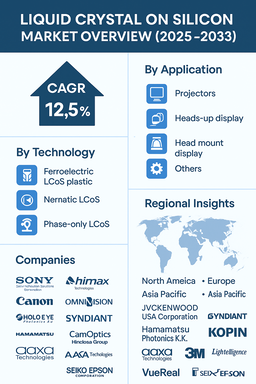
The global liquid crystal on silicon (LCoS) market is projected to grow at a CAGR of 12.5% between 2026 and 2034, driven by rising demand for high-resolution display technologies, rapid growth of augmented and virtual reality applications, and advancements in projection systems. LCoS, a reflective microdisplay technology, is widely adopted for its superior image quality, high contrast ratios, and compatibility with multiple light sources. Its expanding use in consumer electronics, automotive, medical imaging, and defense applications positions it as a key enabler of next-generation immersive display solutions.
Rising Demand for High-Resolution Displays and AR/VR
The increasing need for compact, energy-efficient, and high-quality displays is fueling the adoption of LCoS technology across diverse sectors. Projectors leveraging LCoS deliver superior image resolution for educational, corporate, and entertainment purposes. In automotive, heads-up displays (HUDs) and advanced driver assistance systems (ADAS) are enhancing situational awareness and safety, creating new opportunities for LCoS solutions. The rapid growth of AR/VR head-mounted displays is further propelling demand, as LCoS microdisplays provide immersive visual experiences essential for gaming, training simulations, and industrial applications. The integration of LCoS with AI-driven visualization and next-generation optics is strengthening its adoption in both consumer and professional segments.
Challenges: Cost, Scalability, and Competition
Despite its strong growth trajectory, the LCoS market faces several challenges. High manufacturing costs and complexity associated with LCoS production limit large-scale commercialization, especially in price-sensitive regions. Competing technologies such as OLED, DLP, and LCD also pose challenges by offering cost advantages or simpler integration in certain applications. Scalability remains a concern for AR/VR and wearable devices, where compact form factors and low power consumption are critical. However, ongoing improvements in fabrication techniques, falling component costs, and rising investments in display innovation are expected to mitigate these constraints.
Market Segmentation by Technology
By technology, the market is segmented into ferroelectric LCoS plastic, nematic LCoS metal, and phase-only LCoS. Ferroelectric LCoS is widely used for fast-switching applications and high-speed imaging. Nematic LCoS dominates the commercial segment due to its higher resolution, low cost, and broader adoption in projectors and consumer electronics. Phase-only LCoS technology is expanding in scientific and optical applications, offering advantages in holography, beam shaping, and augmented reality systems.
Market Segmentation by Application
By application, the market is segmented into projectors, heads-up displays (HUDs), head-mounted displays (HMDs), and others. Projectors currently hold the largest share, with strong demand in education, business, and entertainment. HUDs are witnessing rapid growth in automotive, aviation, and military sectors, driven by safety and navigation requirements. HMDs represent the fastest-growing segment, with applications in AR/VR, gaming, training, and medical visualization fueling adoption. Other applications include optical communications, imaging systems, and scientific instrumentation.
Regional Insights
In 2025, North America led the LCoS market, driven by early adoption of AR/VR technologies, strong defense investments, and demand for advanced projection systems. Europe followed, with Germany, the UK, and France leading innovation in automotive HUDs, optical instruments, and immersive consumer electronics. Asia Pacific is projected to be the fastest-growing region, with China, Japan, South Korea, and India driving adoption through expanding electronics manufacturing, high demand for AR/VR, and rising investments in semiconductor fabrication. Latin America and Middle East & Africa (MEA) are emerging markets, with gradual adoption supported by educational technology expansion, digitalization initiatives, and growing healthcare applications.
Competitive Landscape
The competitive landscape in 2025 was characterized by a mix of semiconductor companies, optics specialists, and display innovators. Sony Semiconductor Solutions Corporation, Canon Inc., Himax Technologies, and OMNIVISION are key players leveraging their strengths in semiconductor and display technologies. HOLOEYE Photonics AG, SYNDIANT, and Hamamatsu Photonics K.K. are advancing niche applications in optical and scientific markets. JVCKENWOOD, AAXA Technologies, and MicroVision, Inc. are actively engaged in projection systems, while KOPIN Corporation, Lightelligence, and VueReal are innovating in AR/VR and wearable displays. Seiko Epson Corporation, 3M Company, and Tower Semiconductor continue to expand their presence in manufacturing and integration. Emerging companies such as CamOptics, Hinojosa Group, and Santec Holdings Corporation are strengthening their foothold in specialized imaging and optics applications. Competitive differentiation in the LCoS market is being shaped by miniaturization, energy efficiency, high-resolution performance, and integration into AR/VR ecosystems, ensuring rapid evolution of the industry landscape.
Historical & Forecast Period
This study report represents analysis of each segment from 2024 to 2034 considering 2025 as the base year. Compounded Annual Growth Rate (CAGR) for each of the respective segments estimated for the forecast period of 2026 to 2034.
The current report comprises of quantitative market estimations for each micro market for every geographical region and qualitative market analysis such as micro and macro environment analysis, market trends, competitive intelligence, segment analysis, porters five force model, top winning strategies, top investment markets, emerging trends and technological analysis, case studies, strategic conclusions and recommendations and other key market insights.
Research Methodology
The complete research study was conducted in three phases, namely: secondary research, primary research, and expert panel review. key data point that enables the estimation of Liquid Crystal on Silicon (LCoS) Market By Technology, By Application, By End Use - Growth, Share, Opportunities & Competitive Analysis, 2026 - 2034 market are as follows:
Market forecast was performed through proprietary software that analyzes various qualitative and quantitative factors. Growth rate and CAGR were estimated through intensive secondary and primary research. Data triangulation across various data points provides accuracy across various analyzed market segments in the report. Application of both top down and bottom-up approach for validation of market estimation assures logical, methodical and mathematical consistency of the quantitative data.
| ATTRIBUTE | DETAILS |
|---|---|
| Research Period | 2024-2034 |
| Base Year | 2025 |
| Forecast Period | 2026-2034 |
| Historical Year | 2024 |
| Unit | USD Million |
| Segmentation | |
Technology
|
|
Application
|
|
End Use Industry
|
|
|
Region Segment (2024-2034; US$ Million)
|
Key questions answered in this report


