
Rising global demand for natural gas and increasing investments in LNG export infrastructure are driving growth in the LNG liquefaction train market.
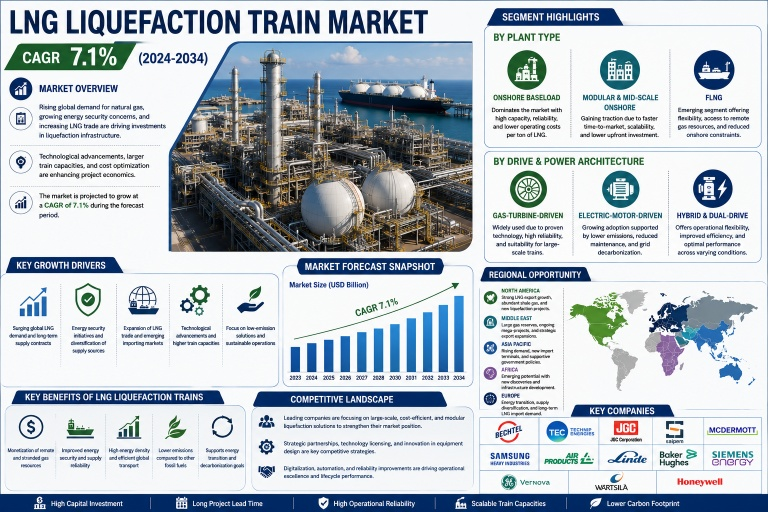
The global LNG liquefaction train market is witnessing strong growth as countries expand liquefaction capacity to support energy security, gas monetization, and international LNG trade. LNG liquefaction trains are critical processing units that cool natural gas into liquefied natural gas for storage and long-distance transportation. Growing demand from power generation, industrial users, and gas-importing economies is encouraging large-scale LNG project development. The market is projected to register a CAGR of 7.1% during the forecast period.
Key Growth Driver
Increasing LNG trade and energy security investments are accelerating market expansion globally.
Governments and energy companies are investing in new LNG liquefaction projects to diversify energy supply, reduce dependence on pipeline gas, and monetize stranded gas reserves. Rising demand for flexible fuel supply, long-term LNG contracts, and lower-emission alternatives to coal and oil is supporting project development. In addition, technological advancements in modular liquefaction, process efficiency, and project execution are improving the economics of LNG liquefaction trains.
Segment Highlight
Large-scale baseload projects and modular LNG solutions are creating opportunities across different project types.
Based on plant type, Onshore Baseload liquefaction trains account for a significant share of the market due to their high production capacity, operational reliability, and suitability for large LNG export projects. Modular & Mid-Scale Onshore plants are gaining traction due to faster deployment, lower upfront investment, and flexibility for regional LNG supply. FLNG is emerging as an important segment because it enables offshore gas monetization, reduces need for onshore infrastructure, and supports projects in remote gas fields.
By drive and power architecture, Gas-Turbine-Driven systems continue to hold a major share due to proven performance, high reliability, and strong adoption in large-scale LNG facilities. Electric-Motor-Driven systems are gaining demand as operators focus on lower emissions, improved efficiency, and integration with cleaner power sources. Hybrid & Dual-Drive architectures are expected to create growth opportunities by offering operational flexibility, improved energy efficiency, and reduced emissions across varying operating conditions.
Regional Opportunity
North America and the Middle East remain major markets, while Asia-Pacific continues to support long-term LNG demand growth.
North America is a key growth region due to large natural gas reserves, expanding LNG export capacity, and strong investment in liquefaction infrastructure. The Middle East continues to maintain a strong position supported by major gas reserves, strategic export projects, and long-term supply agreements. Asia-Pacific remains a major demand center, with countries such as China, Japan, South Korea, and India driving LNG imports for power generation, industrial use, and energy diversification. Africa is also emerging as an opportunity region due to new gas discoveries and planned LNG export projects.
Competitive Landscape
Market participants are focusing on project execution capability, process technology, modular design, and energy-efficient liquefaction solutions.
Leading companies are investing in advanced liquefaction technologies, engineering optimization, digital project management, low-emission power architectures, and modular plant designs to improve project economics and operational performance. Strategic partnerships between engineering contractors, technology licensors, equipment suppliers, and energy companies continue to shape market competition. Companies are also emphasizing reliability, cost control, schedule certainty, and emissions reduction to strengthen their market position in large-scale LNG projects.
Key companies operating in the market include Bechtel, Technip Energies, JGC Corporation, Saipem, McDermott International, Samsung Heavy Industries, Air Products, Linde, Baker Hughes, Siemens Energy, GE Vernova, Wartsila, and Honeywell.
Historical & Forecast Period
This study report represents analysis of each segment from 2024 to 2034 considering 2025 as the base year. Compounded Annual Growth Rate (CAGR) for each of the respective segments estimated for the forecast period of 2026 to 2034.
The current report comprises of quantitative market estimations for each micro market for every geographical region and qualitative market analysis such as micro and macro environment analysis, market trends, competitive intelligence, segment analysis, porters five force model, top winning strategies, top investment markets, emerging trends and technological analysis, case studies, strategic conclusions and recommendations and other key market insights.
Research Methodology
The complete research study was conducted in three phases, namely: secondary research, primary research, and expert panel review. key data point that enables the estimation of LNG Liquefaction Train Market - Growth, Share, Opportunities & Competitive Analysis, 2026 - 2034 market are as follows:
Market forecast was performed through proprietary software that analyzes various qualitative and quantitative factors. Growth rate and CAGR were estimated through intensive secondary and primary research. Data triangulation across various data points provides accuracy across various analyzed market segments in the report. Application of both top down and bottom-up approach for validation of market estimation assures logical, methodical and mathematical consistency of the quantitative data.
| ATTRIBUTE | DETAILS |
|---|---|
| Research Period | 2024-2034 |
| Base Year | 2025 |
| Forecast Period | 2026-2034 |
| Historical Year | 2024 |
| Unit | USD Million |
| Segmentation | |
Plant Type
|
|
Drive & Power Architecture
|
|
Capacity
|
|
Developer
|
|
|
Region Segment (2024-2034; US$ Million)
|
Frequently Asked Questions
Q1. What is driving the growth of the LNG Liquefaction Train Market?
The market is primarily driven by increasing global LNG trade, rising natural gas demand, energy security investments, and expansion of LNG export infrastructure.
Q2. What is the expected growth rate of the LNG Liquefaction Train Market?
The global LNG Liquefaction Train Market is projected to expand at a CAGR of 7.1% during the forecast period.
Q3. What is an LNG liquefaction train?
An LNG liquefaction train is a processing unit that cools natural gas to very low temperatures and converts it into liquefied natural gas for storage and transportation.
Q4. Which plant type accounts for a significant market share?
Onshore Baseload plants account for a significant market share due to their high capacity, reliability, and suitability for large-scale LNG export projects.
Q5. Which drive and power architecture dominates the market?
Gas-Turbine-Driven systems dominate the market due to their proven technology, operational reliability, and broad adoption in large LNG facilities.
Q6. Which region is expected to witness strong market growth?
North America is expected to witness strong growth due to expanding LNG export projects, large natural gas reserves, and rising investments in liquefaction capacity.
Q7. What trends are influencing the LNG Liquefaction Train Market?
Major trends include modular LNG development, FLNG adoption, electric-drive liquefaction systems, emissions reduction, digital plant monitoring, and improved process efficiency.
Q8. What challenges could affect market expansion?
High capital investment, long project development timelines, regulatory approvals, feed gas supply risks, cost overruns, and changing LNG price dynamics may affect market growth.
Q9. Who are the leading companies operating in the LNG Liquefaction Train Market?
Major companies include Bechtel, Technip Energies, JGC Corporation, Saipem, McDermott International, Samsung Heavy Industries, Air Products, Linde, Baker Hughes, Siemens Energy, GE Vernova, Wartsila, and Honeywell.
Q10. What opportunities are expected to shape the future of the LNG Liquefaction Train Market?
Growing demand for LNG exports, development of stranded gas reserves, expansion of modular and mid-scale LNG projects, increasing use of electric-drive systems, and rising focus on lower-emission liquefaction technologies are expected to create substantial growth opportunities during the forecast period.


