
Growing demand from agriculture, healthcare, and industrial applications, increasing fertilizer consumption, and expanding chemical processing activities are driving the growth of the magnesium sulfate market worldwide.
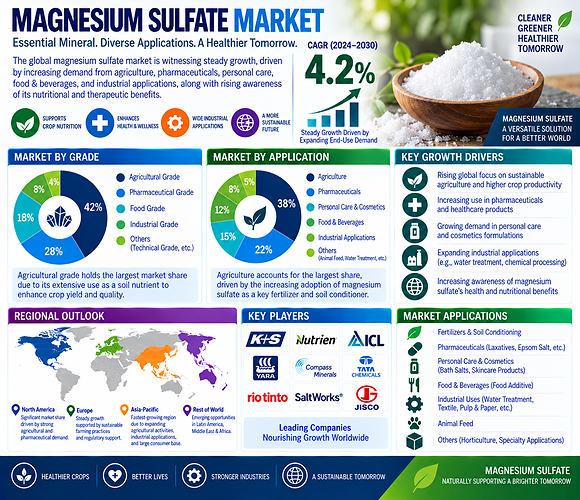
The global magnesium sulfate market is witnessing steady growth as industries increasingly utilize magnesium sulfate for crop nutrition, pharmaceutical formulations, food processing, water treatment, and various industrial applications. Magnesium sulfate is valued for its high magnesium and sulfur content, making it an essential nutrient source for improving crop productivity and soil health. In healthcare, it is widely used in injectable medications, dietary supplements, and therapeutic treatments, while industrial sectors utilize it in pulp and paper, textiles, chemicals, and construction materials. Continuous improvements in production technologies and increasing demand for specialty-grade magnesium sulfate continue to support market expansion. The market is projected to register a CAGR of 4.2% during the forecast period.
Key Growth Driver
Increasing demand for high-efficiency fertilizers and expanding agricultural production is accelerating market growth globally.
Farmers are increasingly adopting magnesium sulfate fertilizers to address magnesium and sulfur deficiencies, improve crop quality, and enhance agricultural productivity. Rising demand for specialty fertilizers, precision agriculture, sustainable farming practices, and balanced crop nutrition continues to strengthen market demand. Growth in pharmaceutical manufacturing and industrial chemical applications further supports market expansion.
Segment Highlight
Heptahydrate products and granular formulations continue to create significant growth opportunities.
Based on product type, Heptahydrate accounts for a significant share of the market owing to its widespread use in agriculture, pharmaceuticals, food processing, and industrial applications. Monohydrate continues to witness growing demand in fertilizer production and specialty chemical applications, while Anhydrous magnesium sulfate is increasingly utilized in industrial processes requiring low moisture content.
By physical form, Granular magnesium sulfate dominates the market due to its ease of handling, efficient field application, uniform nutrient distribution, and extensive use in agricultural fertilizers. Powder and Crystalline forms continue to experience strong demand across pharmaceutical, food, and industrial sectors, while Liquid magnesium sulfate is gaining adoption in fertigation systems and specialized industrial applications.
Regional Opportunity
Asia-Pacific remains the leading market, while Latin America is emerging as a fast-growing region for magnesium sulfate consumption.
Asia-Pacific maintains a dominant position in the Magnesium Sulfate Market due to expanding agricultural production, increasing fertilizer consumption, rapid industrialization, and growing pharmaceutical manufacturing across China, India, and Southeast Asia. North America continues to witness stable growth supported by specialty agriculture, healthcare applications, and industrial chemical demand. Europe maintains significant market share through advanced agricultural practices and pharmaceutical production. Meanwhile, Latin America is expected to experience rapid growth driven by expanding commercial agriculture, increasing crop nutrient management, and growing demand for specialty fertilizers across Brazil, Argentina, and neighboring countries.
Competitive Landscape
Market participants are focusing on production capacity expansion, specialty-grade product development, sustainable manufacturing, and application-specific formulations to strengthen their competitive position.
Leading companies are investing in advanced purification technologies, high-purity pharmaceutical grades, specialty agricultural fertilizers, and environmentally responsible manufacturing processes to improve product quality and operational efficiency. Strategic collaborations with fertilizer manufacturers, pharmaceutical companies, agricultural distributors, and industrial customers continue to support market expansion. Companies are also emphasizing supply chain optimization, product innovation, and sustainable production practices to address evolving global demand.
Key companies operating in the market include K+S Aktiengesellschaft, Giles Chemical Corporation, Laizhou Laiyu Chemical, Weifang Huakang Magnesium, and Haifa Group.
Magnesium Sulfate Industry News
Jun 2026: Haifa Group expanded specialty fertilizer solutions incorporating magnesium nutrients to improve crop productivity and sustainable agriculture.
Apr 2026: K+S Aktiengesellschaft strengthened production capabilities supporting agricultural and industrial magnesium sulfate applications.
Jan 2026: Giles Chemical Corporation enhanced pharmaceutical-grade magnesium sulfate manufacturing to meet increasing healthcare demand.
Oct 2025: Weifang Huakang Magnesium expanded production capacity for high-purity magnesium sulfate serving domestic and international markets.
Aug 2025: Laizhou Laiyu Chemical continued investments in process optimization to improve production efficiency and product quality.
Historical & Forecast Period
This study report represents analysis of each segment from 2024 to 2034 considering 2025 as the base year. Compounded Annual Growth Rate (CAGR) for each of the respective segments estimated for the forecast period of 2026 to 2034.
The current report comprises of quantitative market estimations for each micro market for every geographical region and qualitative market analysis such as micro and macro environment analysis, market trends, competitive intelligence, segment analysis, porters five force model, top winning strategies, top investment markets, emerging trends and technological analysis, case studies, strategic conclusions and recommendations and other key market insights.
Research Methodology
The complete research study was conducted in three phases, namely: secondary research, primary research, and expert panel review. key data point that enables the estimation of Magnesium Sulfate Market - Growth, Share, Opportunities & Competitive Analysis, 2026 - 2034 market are as follows:
Market forecast was performed through proprietary software that analyzes various qualitative and quantitative factors. Growth rate and CAGR were estimated through intensive secondary and primary research. Data triangulation across various data points provides accuracy across various analyzed market segments in the report. Application of both top down and bottom-up approach for validation of market estimation assures logical, methodical and mathematical consistency of the quantitative data.
| ATTRIBUTE | DETAILS |
|---|---|
| Research Period | 2024-2034 |
| Base Year | 2025 |
| Forecast Period | 2026-2034 |
| Historical Year | 2024 |
| Unit | USD Million |
| Segmentation | |
Product Type
|
|
Physical Form
|
|
Grade
|
|
End Use
|
|
|
Region Segment (2024-2034; US$ Million)
|
Frequently Asked Questions
Q1. What is driving the growth of the Magnesium Sulfate Market?
The market is primarily driven by increasing fertilizer demand, expanding agricultural production, growing pharmaceutical applications, rising industrial chemical consumption, and increasing adoption of balanced crop nutrition practices.
Q2. What is the expected growth rate of the Magnesium Sulfate Market?
The global Magnesium Sulfate Market is projected to expand at a CAGR of 4.2% during the forecast period.
Q3. Which product type accounts for a significant market share?
Heptahydrate accounts for a significant market share due to its extensive use across agriculture, pharmaceuticals, food processing, and industrial applications, along with its high solubility and versatility.
Q4. Which physical form dominates the Magnesium Sulfate Market?
Granular magnesium sulfate dominates the market owing to its ease of storage, transportation, field application, and widespread use in fertilizer formulations.
Q5. Which region is expected to witness the strongest market growth?
Latin America is expected to witness the strongest market growth due to expanding commercial agriculture, increasing fertilizer usage, growing focus on crop nutrient management, and rising investment in agricultural productivity, while Asia-Pacific continues to maintain the largest overall market share.


