
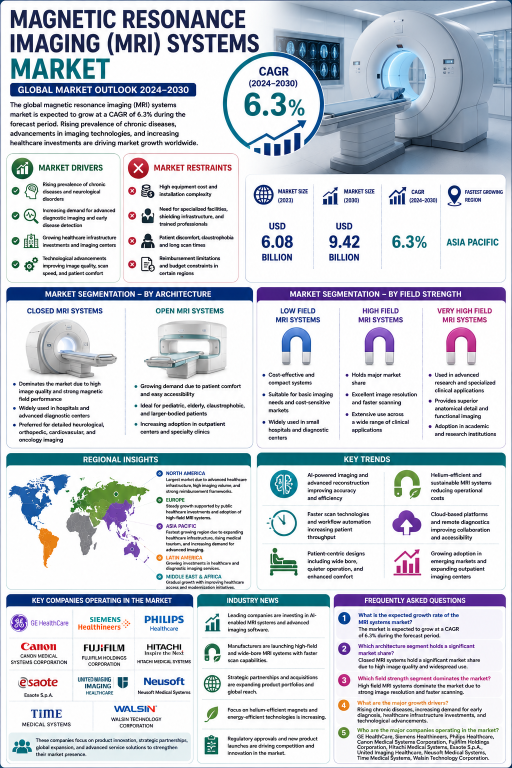
The global magnetic resonance imaging (MRI) systems market is expected to grow at a CAGR of 6.3% during the forecast period. Market growth is driven by rising prevalence of chronic diseases, increasing demand for advanced diagnostic imaging, growing healthcare infrastructure investments, and continuous technological improvements in imaging quality, scan speed, and patient comfort. MRI systems are widely used for neurological, musculoskeletal, cardiovascular, oncology, and abdominal imaging due to their strong soft-tissue contrast and non-ionizing imaging capability. The growing focus on early disease detection and precision diagnosis is further supporting market expansion worldwide.
Market Drivers
Rising Demand for Advanced Diagnostic Imaging and Early Disease Detection
Hospitals, diagnostic centers, and specialty clinics are increasingly adopting MRI systems to improve diagnosis of neurological disorders, cancer, orthopedic conditions, cardiovascular diseases, and soft-tissue injuries. Rising aging populations and increasing chronic disease burden are creating strong demand for accurate and non-invasive imaging technologies. Growing investments in healthcare infrastructure, imaging centers, and advanced radiology services are significantly driving demand for MRI systems across developed and emerging economies.
Market Restraints
High Equipment Cost and Installation Complexity
MRI systems require high capital investment, specialized facility design, shielding infrastructure, trained operators, and regular maintenance. These cost factors can limit adoption in smaller hospitals and cost-sensitive healthcare markets. Long scan times, patient discomfort, claustrophobia concerns, and limited access in rural areas may also restrict market growth. Reimbursement limitations and budget constraints in certain healthcare systems can further affect purchasing decisions.
Magnetic Resonance Imaging (MRI) Systems Market Trends
The market is witnessing increasing adoption of high-field MRI systems, AI-assisted imaging workflows, faster scanning protocols, and patient-friendly system designs. Manufacturers are focusing on improved image resolution, noise reduction, wide-bore designs, lower helium usage, and workflow automation. Open MRI systems are gaining demand among pediatric, obese, and claustrophobic patients, while very high field MRI systems are supporting advanced research and specialized clinical applications. Cloud-based imaging platforms, remote diagnostics, and AI-enabled image reconstruction are also becoming key trends in the MRI systems market.
Market Segmentation
By Architecture
Based on architecture, the market is segmented into Closed MRI Systems and Open MRI Systems. Closed MRI systems account for a significant market share due to their high image quality, strong magnetic field performance, and widespread use in hospitals and advanced diagnostic centers. These systems are preferred for detailed neurological, orthopedic, cardiovascular, and oncology imaging. Open MRI systems are witnessing steady demand due to improved patient comfort, easier access, and suitability for claustrophobic, pediatric, elderly, and larger-bodied patients.
By Field Strength
Based on field strength, the market is segmented into Low Field MRI Systems, High Field MRI Systems, and Very High Field MRI Systems. High field MRI systems hold a major market share owing to their strong image resolution, faster scan capability, and broad clinical application base. Low field MRI systems remain important in cost-sensitive markets and facilities requiring compact, lower-cost imaging solutions. Very high field MRI systems are gaining traction in research institutions, advanced hospitals, and specialized diagnostic applications requiring superior anatomical detail and advanced imaging performance.
Regional Insights
North America represents a major market for MRI systems due to advanced healthcare infrastructure, high diagnostic imaging volume, strong reimbursement frameworks, and early adoption of advanced imaging technologies. The United States continues to lead regional demand due to large hospital networks, strong chronic disease screening activity, and high investment in radiology services. Europe is witnessing steady growth supported by public healthcare investments, increasing adoption of high-field imaging systems, and rising demand for early diagnosis. Asia Pacific is expected to record the fastest growth during the forecast period due to expanding healthcare infrastructure, increasing hospital investments, rising medical tourism, and growing demand for advanced diagnostic imaging across China, India, Japan, South Korea, and Southeast Asia. Latin America and the Middle East & Africa are also experiencing growing demand as healthcare modernization and diagnostic imaging access continue to improve.
Competitive Landscape
The MRI systems market is highly competitive, with leading companies focusing on image quality, scan speed, patient comfort, AI-enabled workflow, and system efficiency. Manufacturers are investing in wide-bore systems, helium-efficient magnets, AI-powered reconstruction, remote imaging support, and advanced software platforms to strengthen their market positions. Strategic partnerships with hospitals, diagnostic chains, research institutions, and healthcare providers remain important growth strategies. Competitive differentiation increasingly depends on clinical performance, total cost of ownership, service reliability, system uptime, software integration, and after-sales support.
Key Companies Operating in the Market Include
Key companies operating in the magnetic resonance imaging (MRI) systems market include GE HealthCare, Siemens Healthineers, Philips Healthcare, Canon Medical Systems Corporation, Fujifilm Holdings Corporation, Hitachi Medical Systems, Esaote S.p.A., United Imaging Healthcare, Neusoft Medical Systems, and Time Medical Systems. These companies are focusing on high-field MRI platforms, AI-enabled imaging software, patient-friendly designs, faster scan protocols, compact systems, and improved service support to strengthen their market positions. Continuous investments in product innovation, clinical workflow automation, and healthcare partnerships are helping these companies address rising demand for advanced diagnostic imaging worldwide.
Magnetic Resonance Imaging (MRI) Systems Industry News
The industry is witnessing increasing investments in AI-assisted imaging, faster scan technologies, helium-efficient MRI systems, and compact imaging platforms. Manufacturers are introducing MRI systems with improved patient comfort, enhanced image quality, reduced noise, and automated workflow features. Hospitals and diagnostic centers are upgrading existing imaging infrastructure to improve diagnostic accuracy and patient throughput. Growing demand for early disease detection, precision medicine, and advanced radiology services is expected to remain a major driver of innovation and market growth during the forecast period.
Historical & Forecast Period
This study report represents analysis of each segment from 2024 to 2034 considering 2025 as the base year. Compounded Annual Growth Rate (CAGR) for each of the respective segments estimated for the forecast period of 2026 to 2034.
The current report comprises of quantitative market estimations for each micro market for every geographical region and qualitative market analysis such as micro and macro environment analysis, market trends, competitive intelligence, segment analysis, porters five force model, top winning strategies, top investment markets, emerging trends and technological analysis, case studies, strategic conclusions and recommendations and other key market insights.
Research Methodology
The complete research study was conducted in three phases, namely: secondary research, primary research, and expert panel review. key data point that enables the estimation of Magnetic Resonance Imaging Systems Market - Growth, Share, Opportunities & Competitive Analysis, 2026 - 2034 market are as follows:
Market forecast was performed through proprietary software that analyzes various qualitative and quantitative factors. Growth rate and CAGR were estimated through intensive secondary and primary research. Data triangulation across various data points provides accuracy across various analyzed market segments in the report. Application of both top down and bottom-up approach for validation of market estimation assures logical, methodical and mathematical consistency of the quantitative data.
| ATTRIBUTE | DETAILS |
|---|---|
| Research Period | 2024-2034 |
| Base Year | 2025 |
| Forecast Period | 2026-2034 |
| Historical Year | 2024 |
| Unit | USD Million |
| Segmentation | |
Architecture
|
|
Field Strength
|
|
Design
|
|
Application
|
|
End use
|
|
|
Region Segment (2024-2034; US$ Million)
|
Frequently Asked Questions
What is the expected growth rate of the magnetic resonance imaging (MRI) systems market?
The magnetic resonance imaging (MRI) systems market is expected to grow at a CAGR of 6.3% during the forecast period.
Which architecture segment holds a significant market share?
Closed MRI systems hold a significant market share due to their high image quality, strong magnetic field performance, and widespread use in hospitals and diagnostic centers.
Which field strength segment dominates the market?
High field MRI systems dominate the market owing to their strong image resolution, faster scan capability, and broad clinical application base.
What are the major growth drivers?
Major growth drivers include rising chronic disease burden, increasing demand for early diagnosis, expanding healthcare infrastructure, technological advancements in MRI systems, and growing adoption of advanced diagnostic imaging.
Who are the major companies operating in the market?
Major companies include GE HealthCare, Siemens Healthineers, Philips Healthcare, Canon Medical Systems Corporation, Fujifilm Holdings Corporation, Hitachi Medical Systems, Esaote S.p.A., United Imaging Healthcare, Neusoft Medical Systems, and Time Medical Systems.


