
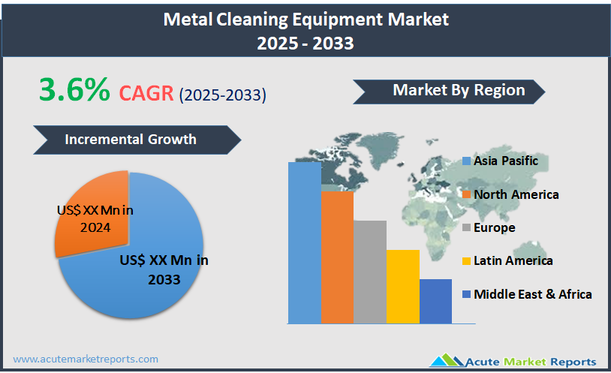
The metal cleaning equipment market comprises systems and solutions used for the degreasing, cleaning, and surface treatment of metallic components. These equipment are essential in various industries, including automotive, aerospace, manufacturing, and metal fabrication, to ensure that metal parts are free of contaminants before undergoing processes like painting, coating, or assembly. Metal cleaning equipment uses a range of technologies including solvent-based cleaners, aqueous cleaners, and ultrasonic cleaners, tailored to meet specific industry standards and cleaning requirements. The metal cleaning equipment market is projected to grow at a Compound Annual Growth Rate (CAGR) of 3.6% over the forecast period.
Growing Manufacturing Sector
The expansion of the manufacturing sector globally acts as a significant driver for the metal cleaning equipment market. As industrial activities increase, particularly in emerging economies such as China, India, and Brazil, there is a heightened demand for precision in manufacturing processes, where the cleanliness of metal parts is crucial to ensure the quality and durability of the final products. For instance, in automotive and aerospace industries, the requirement for parts to be free from contaminants before painting or coating is stringent. The push towards maintaining high-quality standards necessitates the adoption of advanced metal cleaning equipment. Moreover, as manufacturers aim to enhance production efficiency and product quality, the reliance on effective cleaning systems becomes inevitable, driving continuous demand for innovative cleaning technologies.
Technological Advancements in Cleaning Solutions
Technological advancements present a significant opportunity in the metal cleaning equipment market. The development of more sophisticated, environmentally friendly cleaning technologies, such as aqueous cleaning systems and ultrasonic cleaners, meets the industry's need for sustainability and efficiency. These technologies offer superior cleaning effectiveness with reduced environmental impact, appealing to industries seeking to comply with strict environmental regulations. Furthermore, the integration of automation and IoT technologies in metal cleaning equipment allows for more precise and controlled cleaning processes, significantly reducing labor costs and enhancing overall efficiency. This trend is expected to accelerate the adoption of advanced metal cleaning solutions, providing ample opportunities for market growth.
Environmental Regulations
Stringent environmental regulations serve as a major restraint in the metal cleaning equipment market. The use of certain chemicals in metal cleaning processes, particularly solvent-based cleaning systems, is heavily regulated due to their potential environmental and health hazards. These regulations force manufacturers to seek alternative, often more expensive, cleaning solutions or to invest in additional treatment and disposal methods to comply with environmental standards. This transition not only increases operational costs but also poses a challenge in maintaining cleaning efficiency and effectiveness with greener alternatives, which can be less potent than traditional solvents.
Compliance with Evolving Standards
Adapting to rapidly evolving industry standards and regulations presents a significant challenge for the metal cleaning equipment market. As both environmental and safety regulations continue to tighten, equipment manufacturers must continually innovate and upgrade their offerings to comply with new standards. This necessity for constant development and testing can strain research and development budgets and extend the time to market for new technologies. Additionally, the varying standards across different regions complicate the global distribution of metal cleaning equipment, requiring manufacturers to customize their solutions according to the regulatory environment of each market. This scenario demands a flexible, informed approach to product development and marketing strategies, challenging companies to stay ahead in a competitive and regulatory-intensive market.
Market Segmentation by Operational Mode
In the metal cleaning equipment market, segmentation by operational mode includes Manual, Semi-automatic, and Fully-automatic systems. Fully-automatic systems account for the highest revenue within this segment due to their increasing adoption in large-scale manufacturing sectors where efficiency, precision, and minimal human intervention are prioritized. These systems reduce labor costs and enhance the consistency of cleaning processes, making them particularly attractive in industries such as automotive and aerospace manufacturing. On the other hand, Semi-automatic metal cleaning equipment is expected to exhibit the highest Compound Annual Growth Rate (CAGR). The growing demand for these systems is driven by medium-sized enterprises that are transitioning from manual to automated processes but are not fully equipped or do not require fully automatic systems. Semi-automatic equipment offers a balance of control, cost-efficiency, and automation, making it a suitable choice for businesses looking to gradually enhance their operational efficiency without substantial upfront investments.
Market Segmentation by Chemical Type
The market for metal cleaning equipment is also segmented by chemical type, specifically into Solvent and Aqueous-based cleaning systems. Solvent-based systems have traditionally dominated the market in terms of revenue due to their effectiveness in dissolving tough residues and contaminants. These systems are particularly valued in applications requiring deep cleaning of metals before critical processes like electroplating or painting. However, Aqueous-based cleaning systems are anticipated to have the highest CAGR moving forward. This shift is attributed to increasing environmental regulations and health concerns related to solvent emissions and disposal. Aqueous cleaners, which are primarily water-based and less hazardous, are gaining preference as they meet stricter environmental standards and improve workplace safety. Their rising popularity is further bolstered by technological improvements that enhance their cleaning efficiency, making them more comparable to solvent-based alternatives in performance.
Geographic Segment
In the metal cleaning equipment market, Europe historically generated the highest revenue in 2025, supported by a robust manufacturing sector, particularly in Germany and Italy, where high standards for precision and cleanliness in manufacturing processes are typical. Additionally, stringent environmental regulations in this region have driven the adoption of advanced cleaning technologies that comply with these standards. Moving forward from 2026 to 2034, the Asia Pacific region is expected to exhibit the highest Compound Annual Growth Rate (CAGR). This growth is anticipated due to the rapid industrialization in countries like China and India, coupled with increasing investments in manufacturing capabilities and rising standards for product quality and environmental compliance. The expansion of automotive, electronics, and aerospace industries in this region further supports the demand for sophisticated metal cleaning solutions.
Competitive Trends and Key Strategies
Key players in the metal cleaning equipment market include Cemastir Lavametalli srl, SBS Ecoclean Group, Hockh Metall-Reinigungsanlagen GmbH, Karl Roll GmbH & Co. KG, MecWash Systems Ltd., Metalwash Limited, Metalas Cleaning Systems, Rippert Anlagentechnik GmbH & Co. KG, Rösler Oberflächentechnik GmbH, and Pero Corporation. In 2025, these companies focused on technological innovations, specifically the development of environmentally friendly and energy-efficient cleaning systems, in response to growing environmental concerns and regulatory pressures. They also concentrated on expanding their global reach through strategic alliances, acquisitions, and strengthening their distribution networks to better serve emerging markets. From 2026 to 2034, these players are expected to increase their investments in research and development to further enhance the efficiency and sustainability of their cleaning technologies. The integration of automation and IoT features into cleaning equipment is anticipated to be a key strategy, aiming to improve operational efficiencies and offer predictive maintenance features, thereby reducing downtime and operational costs. This approach will likely help them stay competitive in a market that is increasingly demanding more intelligent and environmentally sound industrial solutions.
Historical & Forecast Period
This study report represents analysis of each segment from 2024 to 2034 considering 2025 as the base year. Compounded Annual Growth Rate (CAGR) for each of the respective segments estimated for the forecast period of 2026 to 2034.
The current report comprises of quantitative market estimations for each micro market for every geographical region and qualitative market analysis such as micro and macro environment analysis, market trends, competitive intelligence, segment analysis, porters five force model, top winning strategies, top investment markets, emerging trends and technological analysis, case studies, strategic conclusions and recommendations and other key market insights.
Research Methodology
The complete research study was conducted in three phases, namely: secondary research, primary research, and expert panel review. key data point that enables the estimation of Metal Cleaning Equipment Market By Operational Mode, By Chemical Type, By Technology, By Washing Type, By Application - Growth, Share, Opportunities & Competitive Analysis, 2026 - 2034 market are as follows:
Market forecast was performed through proprietary software that analyzes various qualitative and quantitative factors. Growth rate and CAGR were estimated through intensive secondary and primary research. Data triangulation across various data points provides accuracy across various analyzed market segments in the report. Application of both top down and bottom-up approach for validation of market estimation assures logical, methodical and mathematical consistency of the quantitative data.
| ATTRIBUTE | DETAILS |
|---|---|
| Research Period | 2024-2034 |
| Base Year | 2025 |
| Forecast Period | 2026-2034 |
| Historical Year | 2024 |
| Unit | USD Million |
| Segmentation | |
Operational Mode
|
|
Chemical Type
|
|
Technology
|
|
Washing Type
|
|
Application
|
|
|
Region Segment (2024-2034; US$ Million)
|
Key questions answered in this report


