
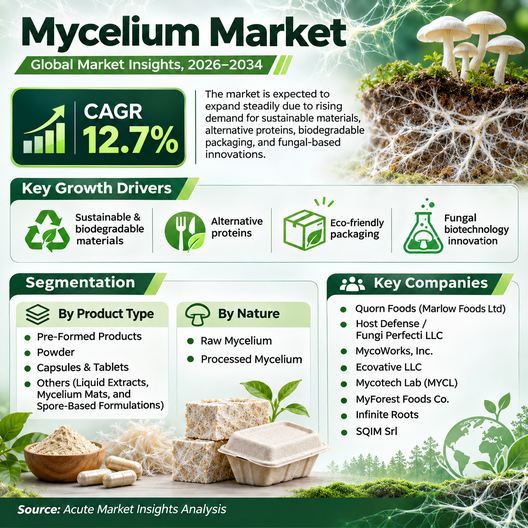
The global mycelium market is expected to register a CAGR of 12.7% during the forecast period from 2026 to 2034, driven by increasing demand for sustainable materials, alternative proteins, biodegradable packaging, and fungal-based products. Mycelium, a network of fungal filaments, is gaining commercial importance across food and beverages, dietary supplements, packaging, textiles, construction, and biotechnology applications. Growing environmental concerns, increasing adoption of bio-based alternatives, and advancements in fungal cultivation and fermentation technologies are expected to support market expansion. Furthermore, manufacturers are focusing on improving production efficiency, product performance, and commercial scalability to address growing demand from various end-use industries.
Mycelium Market Growth Drivers
Increasing Demand for Sustainable and Biodegradable Materials
Growing demand for sustainable and biodegradable alternatives to conventional plastics, synthetic leather, and petroleum-based materials is expected to drive the Mycelium Market. Industries are increasingly exploring renewable raw materials to reduce environmental impact and support circular economy initiatives. Mycelium-based materials can be manufactured using agricultural residues and controlled fungal cultivation processes, making them suitable for applications such as protective packaging, insulation, textiles, and specialty composites. Increasing investment in sustainable manufacturing technologies and growing interest from packaging and consumer goods companies are expected to support market growth.
Growing Adoption of Alternative Proteins and Functional Food Products
Increasing demand for alternative proteins and functional food ingredients is expected to contribute significantly to the growth of the Mycelium Market. Mycelium-derived ingredients are being explored for their nutritional characteristics, versatility, and potential use in meat alternatives and specialty food formulations. Growing consumer interest in plant-based and fermentation-derived foods is encouraging manufacturers to develop innovative mycelium-based products. Furthermore, advancements in fermentation technology and increasing investment in alternative protein production are expected to create additional opportunities for market participants.
Mycelium Market Restraints
High Production Costs and Limited Commercial Manufacturing Capacity
High production costs and limited commercial manufacturing capacity are expected to restrain the growth of the Mycelium Market. Producing mycelium-based products often requires controlled cultivation environments, specialized equipment, substrate preparation, and continuous quality monitoring. These requirements can increase operating expenses compared with conventional materials and established food ingredients. Additionally, challenges related to large-scale production, product consistency, and processing efficiency may limit commercial adoption, particularly among price-sensitive manufacturers and end users.
Mycelium Market Opportunities
Expanding Applications in Packaging, Textiles, and Construction Materials
Increasing applications of mycelium-based materials across packaging, textiles, furniture, and construction industries are expected to create growth opportunities for the market. Manufacturers are developing innovative products such as biodegradable packaging, leather alternatives, acoustic panels, insulation materials, and lightweight composites. Growing interest in replacing conventional materials with renewable alternatives is encouraging collaboration between biotechnology companies and industrial manufacturers. Improvements in cultivation methods, product durability, and processing technologies are expected to support the commercialization of mycelium-based materials across additional applications.
Mycelium Market Challenges
Maintaining Product Quality, Durability, and Large-Scale Production Efficiency
Maintaining consistent product quality and improving large-scale production efficiency remain major challenges in the Mycelium Market. Variations in fungal strains, cultivation substrates, environmental conditions, and processing methods can influence the properties of finished products. Manufacturers must also address industry-specific requirements related to material durability, moisture resistance, storage stability, and safety. Developing standardized production processes while maintaining competitive manufacturing costs is expected to remain essential for wider market adoption.
Mycelium Market Trends
Increasing Development of Mycelium-Based Leather Alternatives and Biomaterials
The development of mycelium-based leather alternatives and biofabricated materials is emerging as an important trend in the global Mycelium Market. Manufacturers are increasingly exploring fungal-based materials for applications in fashion, footwear, accessories, furniture, and automotive interiors. Advancements in biofabrication technologies are enabling companies to develop materials with improved flexibility, appearance, and performance characteristics. Growing demand for alternatives to animal-derived and petroleum-based materials is expected to encourage continued product development and commercial investment.
Advancements in Fermentation and Fungal Cultivation Technologies
Technological advancements in fermentation and fungal cultivation are expected to influence the future development of the Mycelium Market. Companies are focusing on optimizing fungal strains, cultivation substrates, environmental conditions, and processing technologies to improve productivity and product consistency. The adoption of controlled fermentation systems is also expected to support the development of specialized mycelium ingredients and biomaterials. Continuous innovation in manufacturing processes is expected to help companies address production costs and scalability challenges.
Mycelium Market Segmentation Analysis
Mycelium Market by Product Type
The Mycelium Market is segmented by product type into Pre-Formed Products, Powder, Capsules & Tablets, and Others (Liquid Extracts, Mycelium Mats, and Spore-Based Formulations). Pre-formed products are expected to experience increasing demand from packaging, textiles, and industrial material applications, supported by the development of molded structures and ready-to-use biofabricated materials. Powder products are widely applicable in nutritional supplements, functional food ingredients, and specialty formulations due to their versatility and ease of incorporation into different products. Capsules and tablets are expected to benefit from demand for convenient mycelium-based dietary supplements. The others category, including liquid extracts, mycelium mats, and applicable spore-based formulations, is expected to provide additional opportunities across biotechnology, specialized materials, and nutritional applications.
Mycelium Market by Nature
Based on nature, the Mycelium Market is categorized into Raw Mycelium and Processed Mycelium. Raw mycelium is primarily associated with fungal cultivation, biotechnology research, fermentation processes, and further manufacturing activities. Demand for raw mycelium is expected to be supported by increasing research and commercial development of fungal-based products. Processed mycelium includes materials that undergo drying, extraction, molding, compression, or other processing techniques to meet commercial application requirements. Processed mycelium is expected to benefit from growing demand for finished food ingredients, nutritional supplements, sustainable packaging, leather alternatives, and industrial biomaterials.
Mycelium Market Regional Analysis
North America Mycelium Market
North America is expected to remain an important market for mycelium-based products, supported by biotechnology innovation, growing demand for alternative proteins, and increasing commercialization of sustainable materials. The United States is a key center for companies developing mycelium-based packaging, food ingredients, nutritional products, and leather alternatives. Rising investment in fermentation technologies, collaboration between biotechnology developers and consumer brands, and increasing interest in environmentally sustainable products are expected to support regional market growth. Furthermore, research activities and advancements in biofabrication technologies are expected to strengthen the regional industry.
Europe Mycelium Market
Europe is expected to maintain a strong presence in the global Mycelium Market, supported by increasing emphasis on environmental sustainability, circular economy initiatives, and development of renewable materials. Countries such as Germany, Italy, the Netherlands, and the United Kingdom are important markets for fungal biotechnology, alternative proteins, and mycelium-based industrial products. Increasing interest in reducing dependence on conventional plastics and animal-derived materials is expected to encourage commercial adoption. Furthermore, investment in biotechnology research and sustainable manufacturing processes is expected to create opportunities for regional companies.
Asia Pacific Mycelium Market
Asia Pacific is expected to offer significant growth opportunities in the Mycelium Market, driven by expanding food processing industries, increasing biotechnology investment, and growing interest in sustainable materials. China, Japan, India, and South Korea are expected to contribute to regional demand through applications in nutritional products, functional foods, packaging, and biomaterials. Availability of agricultural residues and growing research into fungal cultivation technologies could support regional manufacturing development. Furthermore, increasing awareness of alternative protein sources and bio-based products is expected to support market expansion.
Latin America Mycelium Market
Latin America is expected to witness growing interest in mycelium-based products, supported by opportunities in agricultural residue utilization, sustainable packaging, and biotechnology applications. Brazil and Mexico are expected to present commercial opportunities due to their agricultural resources and established food processing industries. Increasing interest in renewable materials and alternative food ingredients is expected to encourage research and product development. However, limited manufacturing infrastructure and production costs may restrict near-term commercialization.
Middle East & Africa Mycelium Market
The Middle East & Africa Mycelium Market is expected to develop gradually, supported by increasing interest in sustainable manufacturing, food innovation, and biotechnology. Investment in food security, resource-efficient production systems, and alternative protein technologies could encourage demand for fungal-based products. Growing attention to environmental sustainability and innovative materials is also expected to create opportunities in packaging and specialized industrial applications. However, limited production infrastructure and relatively high manufacturing costs may challenge wider market penetration.
Mycelium Market Competitive Landscape
The global Mycelium Market is characterized by the presence of established food manufacturers, biotechnology companies, and specialized developers of mycelium-based materials. Market participants are focusing on product innovation, manufacturing efficiency, commercial partnerships, and technological advancements to strengthen their competitive positions. Companies are increasingly investing in fungal fermentation technologies, alternative protein development, sustainable packaging, and biofabricated materials to address demand from different end-use industries. Strategic partnerships, production capacity development, and product diversification are expected to remain important competitive strategies.
Key Companies Operating in the Mycelium Market
Major companies operating in the global Mycelium Market include Quorn Foods (Marlow Foods Ltd), Host Defense / Fungi Perfecti LLC, MycoWorks, Inc., Ecovative LLC, Mycotech Lab (MYCL), MyForest Foods Co., Infinite Roots, and SQIM Srl, along with other notable players. These companies are involved in different areas of the mycelium industry, including alternative protein foods, dietary supplements, sustainable packaging, leather alternatives, and specialized biomaterials. Their competitive strategies focus on technological development, product quality, manufacturing scalability, and commercial partnerships.
Historical & Forecast Period
This study report represents analysis of each segment from 2024 to 2034 considering 2025 as the base year. Compounded Annual Growth Rate (CAGR) for each of the respective segments estimated for the forecast period of 2026 to 2034.
The current report comprises of quantitative market estimations for each micro market for every geographical region and qualitative market analysis such as micro and macro environment analysis, market trends, competitive intelligence, segment analysis, porters five force model, top winning strategies, top investment markets, emerging trends and technological analysis, case studies, strategic conclusions and recommendations and other key market insights.
Research Methodology
The complete research study was conducted in three phases, namely: secondary research, primary research, and expert panel review. key data point that enables the estimation of Mycelium Market - Growth, Share, Opportunities & Competitive Analysis, 2026 - 2034 market are as follows:
Market forecast was performed through proprietary software that analyzes various qualitative and quantitative factors. Growth rate and CAGR were estimated through intensive secondary and primary research. Data triangulation across various data points provides accuracy across various analyzed market segments in the report. Application of both top down and bottom-up approach for validation of market estimation assures logical, methodical and mathematical consistency of the quantitative data.
| ATTRIBUTE | DETAILS |
|---|---|
| Research Period | 2024-2034 |
| Base Year | 2025 |
| Forecast Period | 2026-2034 |
| Historical Year | 2024 |
| Unit | USD Million |
| Segmentation | |
Product Type
|
|
Nature
|
|
Application
|
|
|
Region Segment (2024-2034; US$ Million)
|
Frequently Asked Questions
1. What is the expected growth rate of the global Mycelium Market?
The global Mycelium Market is expected to grow at a CAGR of 12.7% from 2026 to 2034, based on the forecast assumption used in this study. Increasing demand for sustainable materials, alternative proteins, biodegradable packaging, and fungal-based products is expected to support market expansion. Advancements in fermentation technology and commercial manufacturing processes are also expected to contribute to industry growth.
2. What are the major factors driving the growth of the Mycelium Market?
The major factors driving the Mycelium Market include increasing demand for sustainable and biodegradable materials, growing adoption of alternative protein products, advancements in fungal cultivation technologies, and expanding applications across packaging, textiles, and construction industries. Rising investment in biotechnology and interest in renewable manufacturing inputs are also expected to support market development.
3. What are the major product types in the Mycelium Market?
The Mycelium Market is segmented into Pre-Formed Products, Powder, Capsules & Tablets, and Others, including Liquid Extracts, Mycelium Mats, and Spore-Based Formulations. Pre-formed products are used in packaging and biofabricated materials, while powders, capsules, and tablets serve nutritional and functional ingredient applications. Other specialized formulations support biotechnology and material development applications.
4. What is the difference between raw mycelium and processed mycelium?
Raw mycelium refers to fungal biomass that has not undergone substantial processing into a finished commercial product and is primarily associated with cultivation, research, and further manufacturing. Processed mycelium undergoes techniques such as drying, extraction, molding, or compression to produce materials and ingredients suitable for commercial applications, including dietary supplements, packaging, food products, and leather alternatives.
5. Which regions are expected to offer significant growth opportunities in the Mycelium Market?
North America and Europe are important markets for mycelium-based products due to established biotechnology industries, investment in alternative proteins, and increasing demand for sustainable materials. Asia Pacific is expected to offer significant growth opportunities, supported by expanding food processing activities, biotechnology research, and interest in renewable materials. Latin America and the Middle East & Africa are also expected to present emerging commercial opportunities.
6. Who are the leading companies operating in the global Mycelium Market?
Major companies operating in the global Mycelium Market include Quorn Foods (Marlow Foods Ltd), Host Defense / Fungi Perfecti LLC, MycoWorks, Inc., Ecovative LLC, Mycotech Lab (MYCL), MyForest Foods Co., Infinite Roots, and SQIM Srl. These companies focus on alternative proteins, nutritional products, sustainable packaging, biofabricated leather alternatives, and other fungal-based materials through product development, technology innovation, and commercial partnerships.


