
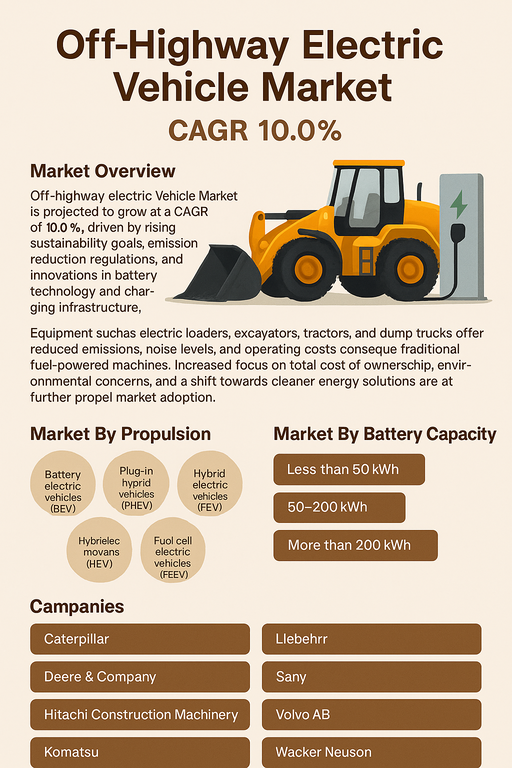
The off-Highway electric vehicle market is projected to grow at a CAGR of 10% during the forecast period 2026 to 2034, driven by increasing sustainability regulations, rising fuel costs, and growing interest in zero-emission technologies across construction, mining, agriculture, and other off-road industries. Off-highway electric vehicles spanning loaders, dump trucks, excavators, tractors, and material-handling equipment offer reduced operating expenses, lower noise levels, and fewer emissions compared to traditional diesel-powered machines. Ongoing advancements in electric drivetrain technologies and enhanced battery energy density further support market growth as companies and operators recognize the long-term advantages of electrification, especially in noise-sensitive urban environments and enclosed mining operations.
Market Drivers
Sustainability and Emissions Reduction Mandates
Stringent regulations on carbon emissions and pollution are forcing equipment owners and manufacturers to embrace electrified solutions for off-highway applications. Electric off-road machines contribute to sustainability targets while helping companies reduce their overall environmental footprint and improve their ESG (Environmental, Social, and Governance) profile.
Total Cost of Ownership and Operational Efficiency
Electric off-highway vehicles require less maintenance due to fewer moving parts and offer lower fuel consumption and operating expenses. Improved energy efficiency and fast-charging solutions allow operators to achieve increased uptime and better productivity per shift. These economic advantages continue to encourage companies to scale up their electric fleets and plan long-term investments into more sustainable equipment.
Advances in Battery and Charging Infrastructure
Developments in high-capacity batteries with extended cycle life, rapid-charging stations, and renewable-energy-powered charging depots make off-highway EVs more practical across diverse use cases. These innovations increase vehicle range, reduce downtime, and enhance feasibility for heavy-duty, off-road operations, creating a strong incentive for adoption.
Market Restraint
High Upfront Investment and Energy Infrastructure Gaps
Despite long-term savings, off-highway electric equipment requires higher upfront investment. This, coupled with the need for specialized charging or battery-swapping infrastructure especially in remote construction or mining sites can pose adoption barriers. Operators face logistical hurdles for charging and grid access, especially in underdeveloped regions, limiting rapid deployment.
Market Segmentation by Propulsion
The Propulsion segment includes Battery Electric Vehicles (BEV), Plug-in Hybrid Electric Vehicles (PHEV), Hybrid Electric Vehicles (HEV), and Fuel Cell Electric Vehicles (FCEV). In 2025, Battery Electric Vehicles held the largest market share, driven by declining battery costs, improved performance, and increasing availability of models for heavy-duty off-road use. Plug-in hybrid and traditional hybrid electric machines continue to gain attention as transitional options that reduce emissions without range anxiety. Fuel Cell Electric Vehicles, though still in an early commercialization phase, show long-term potential for heavy equipment owing to fast refueling and long operation periods without recharging.
Market Segmentation by Battery Capacity
By Battery Capacity, the market is segmented into Less than 50 kWh, 50–200 kWh, and More than 200 kWh. Equipment with 50–200 kWh batteries led the market in 2025 due to their versatility across medium-sized machines like loaders, excavators, and haulers, which require sufficient energy density for continuous operation without excessive weight. The segment for batteries greater than 200 kWh is projected to register the highest CAGR through 2034 as large machines and specialty equipment demand longer runtimes, driving innovations in energy storage and thermal management. Smaller-capacity machines under 50 kWh remain important in compact utility and agriculture equipment due to their lower capital cost and ease of charging.
Geographic Trends
Europe accounted for a significant share of the market in 2025, supported by strict environmental policies, green public procurement programs, and well-developed electric charging networks. Countries like Germany, Sweden, and Norway are at the forefront of pilot programs to electrify their off-highway equipment fleets. North America also showed strong demand, driven by increased interest from major construction, agricultural, and mining companies looking to optimize fuel consumption and comply with new emissions standards. Asia Pacific is expected to witness the fastest growth during the forecast period due to rapid industrialization and the increasing emphasis on reducing pollution in megacities across China, Japan, India, and South Korea. Latin America and the Middle East & Africa present emerging opportunities as major players invest in commercial demonstration projects and encourage mining and agricultural companies to trial electric models as part of sustainability strategies.
Competitive Trends
The competitive landscape is dynamic, with leading companies investing in research and partnerships to scale their electric model offerings and leverage new battery technologies. Major players in the off-highway electric vehicle market include Caterpillar, Deere & Company, Hitachi Construction Machinery, Komatsu, Kubota, Liebherr, Sany, Volvo AB, Wacker Neuson, and XCMG. These companies focus on expanding product portfolios and investing in modular, high-performance electric drivetrains to differentiate their machines across diverse geographies and industries. Strategic moves such as collaborations with battery suppliers, launching electric pilot programs with key customers, and leveraging automation for enhanced safety and productivity will continue to shape the market landscape. Companies that successfully navigate the high development costs, improve energy densities, and optimize charging solutions will likely gain a competitive edge in this rapidly expanding and technology-driven segment.
Historical & Forecast Period
This study report represents analysis of each segment from 2024 to 2034 considering 2025 as the base year. Compounded Annual Growth Rate (CAGR) for each of the respective segments estimated for the forecast period of 2026 to 2034.
The current report comprises of quantitative market estimations for each micro market for every geographical region and qualitative market analysis such as micro and macro environment analysis, market trends, competitive intelligence, segment analysis, porters five force model, top winning strategies, top investment markets, emerging trends and technological analysis, case studies, strategic conclusions and recommendations and other key market insights.
Research Methodology
The complete research study was conducted in three phases, namely: secondary research, primary research, and expert panel review. key data point that enables the estimation of Off-highway Electric Vehicle Market By Vehicle, By Propulsion, By Battery Capacity, By Power Output, By Application - Growth, Share, Opportunities & Competitive Analysis, 2026 - 2034 market are as follows:
Market forecast was performed through proprietary software that analyzes various qualitative and quantitative factors. Growth rate and CAGR were estimated through intensive secondary and primary research. Data triangulation across various data points provides accuracy across various analyzed market segments in the report. Application of both top down and bottom-up approach for validation of market estimation assures logical, methodical and mathematical consistency of the quantitative data.
| ATTRIBUTE | DETAILS |
|---|---|
| Research Period | 2024-2034 |
| Base Year | 2025 |
| Forecast Period | 2026-2034 |
| Historical Year | 2024 |
| Unit | USD Million |
| Segmentation | |
Vehicle
|
|
Propulsion
|
|
Battery Capacity
|
|
Power Output
|
|
Application
|
|
|
Region Segment (2024-2034; US$ Million)
|
Key questions answered in this report


