
Growing demand for sustainable crop protection solutions, increasing restrictions on conventional chemical pesticides, and rising adoption of environmentally friendly agricultural technologies are driving the growth of the photodynamic pesticides market worldwide.
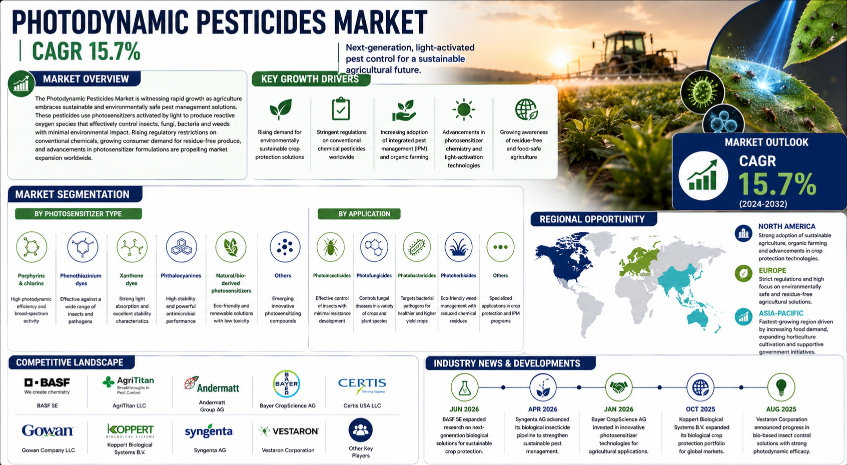
The global photodynamic pesticides market is witnessing rapid growth as agriculture increasingly shifts toward safer and more sustainable pest management practices. Photodynamic pesticides utilize light-activated photosensitizers to generate reactive oxygen species that effectively control insects, fungi, bacteria, and weeds while minimizing environmental impact. These next-generation crop protection solutions offer lower toxicity, reduced chemical residues, and a lower risk of resistance development compared to conventional pesticides. Increasing investment in biological crop protection, precision agriculture, integrated pest management (IPM), and sustainable farming practices continues to support market expansion. The market is projected to register a CAGR of 15.7% during the forecast period.
Key Growth Driver
Increasing demand for environmentally sustainable crop protection technologies is accelerating market growth globally.
Farmers, agricultural companies, and regulators are increasingly adopting eco-friendly pest management solutions to reduce environmental contamination and comply with stricter pesticide regulations. Photodynamic pesticides provide targeted pest control while reducing harmful residues in food and soil. Advances in photosensitizer chemistry, nanotechnology-based formulations, precision spraying technologies, and integrated biological control strategies continue to strengthen market adoption.
Segment Highlight
Advanced photosensitizer technologies and expanding biological crop protection applications continue to create significant growth opportunities.
Based on photosensitizer type, Porphyrins & Chlorins account for a significant share of the market due to their high photodynamic efficiency, strong reactive oxygen generation capability, and broad-spectrum antimicrobial activity. Natural/Bio-derived Photosensitizers continue to gain rapid adoption owing to increasing demand for sustainable agricultural inputs and environmentally compatible crop protection solutions. Phenothiazinium Dyes, Xanthene Dyes, and Phthalocyanines are also witnessing growing research and commercial interest for specialized agricultural applications.
By application, Photoinsecticides dominate the market owing to increasing demand for environmentally friendly insect control across commercial agriculture. Photofungicides continue to witness strong growth for disease management in fruits, vegetables, and high-value crops. Photobactericides are gaining importance for bacterial disease control, while Photoherbicides are emerging as sustainable alternatives for weed management. Others include specialized applications targeting crop-specific pests and integrated pest management programs.
Regional Opportunity
Europe remains the leading market, while Asia-Pacific is emerging as the fastest-growing region for photodynamic pesticides.
Europe maintains a dominant position in the Photodynamic Pesticides Market due to stringent environmental regulations, widespread adoption of sustainable agriculture, strong government support for biological crop protection, and increasing restrictions on synthetic pesticides. North America continues to witness significant growth supported by precision agriculture, organic farming expansion, and innovation in biological crop protection technologies. Meanwhile, Asia-Pacific is expected to experience the fastest growth driven by rising food production requirements, increasing adoption of integrated pest management, expanding horticulture cultivation, government support for sustainable farming, and growing awareness of environmentally friendly pesticides across China, India, Japan, South Korea, and Southeast Asia.
Competitive Landscape
Market participants are focusing on biological crop protection, advanced photosensitizer formulations, precision agriculture integration, and sustainable pest management technologies to strengthen their competitive position.
Leading companies are investing in research and development of next-generation photosensitizers, nano-enabled delivery systems, precision application technologies, and integrated biological pest management solutions to improve crop protection efficiency and environmental safety. Strategic collaborations with agricultural research institutions, expansion of biological product portfolios, regulatory approvals, and investments in sustainable farming technologies continue to shape market competition. Companies are also emphasizing residue-free crop protection, resistance management, and compatibility with organic farming systems to address evolving agricultural requirements.
Key companies operating in the market include BASF SE, AgriTitan LLC, Andermatt Group AG, Bayer CropScience AG, Certis USA LLC, Gowan Company LLC, Koppert Biological Systems B.V., Syngenta AG, and Vestaron Corporation.
Photodynamic Pesticides Industry News
Jun 2026: BASF SE expanded research initiatives focused on sustainable crop protection technologies and next-generation biological agricultural solutions.
Apr 2026: Syngenta AG strengthened its biological crop protection portfolio through continued investment in environmentally friendly pest management technologies.
Jan 2026: Bayer CropScience AG advanced research programs supporting sustainable crop protection solutions for integrated pest management applications.
Oct 2025: Koppert Biological Systems B.V. expanded biological crop protection offerings to improve environmentally responsible pest management across commercial agriculture.
Aug 2025: Vestaron Corporation continued expanding bio-based insect control technologies designed to reduce dependence on conventional chemical pesticides.
Historical & Forecast Period
This study report represents analysis of each segment from 2024 to 2034 considering 2025 as the base year. Compounded Annual Growth Rate (CAGR) for each of the respective segments estimated for the forecast period of 2026 to 2034.
The current report comprises of quantitative market estimations for each micro market for every geographical region and qualitative market analysis such as micro and macro environment analysis, market trends, competitive intelligence, segment analysis, porters five force model, top winning strategies, top investment markets, emerging trends and technological analysis, case studies, strategic conclusions and recommendations and other key market insights.
Research Methodology
The complete research study was conducted in three phases, namely: secondary research, primary research, and expert panel review. key data point that enables the estimation of Photodynamic Pesticides Market - Growth, Share, Opportunities & Competitive Analysis, 2026 - 2034 market are as follows:
Market forecast was performed through proprietary software that analyzes various qualitative and quantitative factors. Growth rate and CAGR were estimated through intensive secondary and primary research. Data triangulation across various data points provides accuracy across various analyzed market segments in the report. Application of both top down and bottom-up approach for validation of market estimation assures logical, methodical and mathematical consistency of the quantitative data.
| ATTRIBUTE | DETAILS |
|---|---|
| Research Period | 2024-2034 |
| Base Year | 2025 |
| Forecast Period | 2026-2034 |
| Historical Year | 2024 |
| Unit | USD Million |
| Segmentation | |
Photosensitizer Type
|
|
Application
|
|
End-User
|
|
|
Region Segment (2024-2034; US$ Million)
|
Frequently Asked Questions
Q1. What is driving the growth of the Photodynamic Pesticides Market?
The market is primarily driven by increasing demand for sustainable agriculture, stricter regulations on chemical pesticides, growing adoption of biological crop protection, and rising investment in environmentally friendly farming technologies.
Q2. What is the expected growth rate of the Photodynamic Pesticides Market?
The global Photodynamic Pesticides Market is projected to expand at a CAGR of 15.7% during the forecast period.
Q3. Which photosensitizer type accounts for a significant market share?
Porphyrins & Chlorins account for a significant market share due to their high photodynamic efficiency, strong antimicrobial activity, and broad applicability in environmentally sustainable crop protection.
Q4. Which application dominates the Photodynamic Pesticides Market?
Photoinsecticides dominate the market owing to increasing demand for eco-friendly insect control solutions that support integrated pest management and sustainable agricultural practices.
Q5. Which region is expected to witness the strongest market growth?
Asia-Pacific is expected to witness the strongest market growth due to expanding agricultural production, increasing adoption of sustainable farming practices, growing horticulture cultivation, and rising government support for environmentally responsible crop protection technologies.


