
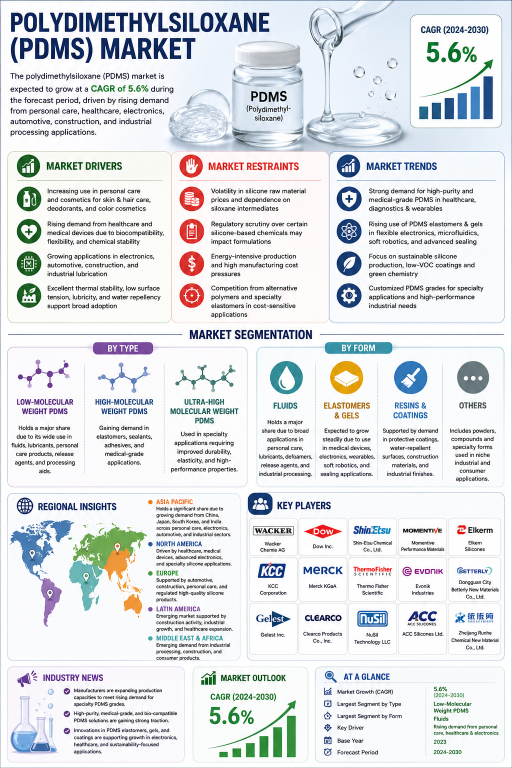
The polydimethylsiloxane (PDMS) market is expected to grow at a CAGR of 5.6% during the forecast period, driven by rising demand from personal care, healthcare, electronics, automotive, construction, and industrial processing applications. PDMS is widely used due to its thermal stability, flexibility, low surface tension, chemical resistance, lubricity, and biocompatibility.
Market Drivers
The market is mainly driven by increasing use of PDMS in personal care and cosmetics. It is widely used in skin care, hair care, deodorants, and cosmetic formulations due to its smooth texture, spreadability, and conditioning properties.
Another key driver is rising demand from medical devices, pharmaceuticals, and healthcare applications. PDMS is used in tubing, implants, drug delivery systems, wound care products, and diagnostic devices due to its biocompatibility and flexibility.
Growth in electronics, automotive, construction, and industrial lubrication applications is also supporting market expansion.
Market Restraints
The market faces challenges related to volatility in silicone raw material prices. Dependence on siloxane intermediates and energy-intensive production can affect manufacturing costs.
Regulatory scrutiny over certain silicone-based chemicals may also impact formulation choices in personal care and consumer products.
In addition, competition from alternative polymers and specialty elastomers can limit growth in cost-sensitive applications.
PDMS Market Trends
The market is witnessing strong demand for high-purity and medical-grade PDMS in healthcare, diagnostics, and wearable devices.
PDMS elastomers and gels are gaining traction in flexible electronics, microfluidics, soft robotics, and advanced sealing applications.
Sustainable silicone production, low-VOC coatings, specialty surface treatments, and customized PDMS grades are also becoming important trends across industrial and consumer applications.
Market Segmentation
By Type
By type, the market is segmented into low-molecular weight PDMS, high-molecular weight PDMS, and ultra-high molecular weight PDMS. Low-molecular weight PDMS holds a major share due to its wide use in fluids, lubricants, personal care products, release agents, and processing aids.
High-molecular weight PDMS is gaining demand in elastomers, sealants, adhesives, and medical-grade applications due to better mechanical strength and flexibility. Ultra-high molecular weight PDMS is used in specialty applications requiring improved durability, elasticity, and high-performance surface properties.
By Form
By form, the market is segmented into fluids, elastomers & gels, resins & coatings, and others. Fluids hold a major share due to broad usage in personal care, lubricants, defoamers, release agents, and industrial processing.
Elastomers & gels are expected to grow steadily due to use in medical devices, electronics, wearable products, soft robotics, and sealing applications. Resins & coatings are supported by demand in protective coatings, water-repellent surfaces, construction materials, and specialty industrial finishes.
Regional Insights
Asia Pacific holds a significant share of the PDMS market due to strong demand from China, Japan, South Korea, and India across personal care, electronics, automotive, and industrial manufacturing.
North America is driven by healthcare, medical devices, advanced electronics, and specialty silicone applications. Europe is supported by demand from automotive, construction, personal care, and regulated high-quality silicone products.
Latin America and the Middle East & Africa are emerging markets, supported by construction activity, industrial growth, healthcare expansion, and rising demand for personal care products.
Competitive Landscape
The PDMS market is competitive, with companies focusing on product purity, viscosity range, molecular weight control, application-specific grades, pricing, and global supply capability. Competition is based on technical performance, regulatory compliance, customer support, and end-use customization.
Strategic initiatives include expansion of silicone capacity, development of medical-grade PDMS, launch of specialty elastomers and coatings, and partnerships with personal care, healthcare, electronics, and industrial customers.
Key companies operating in the market include Wacker Chemie AG, Dow Inc., Shin-Etsu Chemical Co., Ltd., Momentive Performance Materials, Elkem Silicones, KCC Corporation, Merck KGaA, Thermo Fisher Scientific, Evonik Industries, Dongguan City Betterly New Materials Co., Ltd., Gelest Inc., Clearco Products Co., Inc., NuSil Technology LLC, ACC Silicones Ltd., and Zhejiang Runhe Chemical New Material Co., Ltd.
PDMS Industry News
The industry is witnessing increasing demand for high-purity PDMS grades for medical, electronics, and personal care applications. Manufacturers are focusing on advanced elastomers, flexible gels, specialty coatings, and low-viscosity fluids.
Silicone producers are investing in capacity expansion, sustainable production, and product customization to meet demand from healthcare, electronics, and industrial markets.
Historical & Forecast Period
This study report represents analysis of each segment from 2024 to 2034 considering 2025 as the base year. Compounded Annual Growth Rate (CAGR) for each of the respective segments estimated for the forecast period of 2026 to 2034.
The current report comprises of quantitative market estimations for each micro market for every geographical region and qualitative market analysis such as micro and macro environment analysis, market trends, competitive intelligence, segment analysis, porters five force model, top winning strategies, top investment markets, emerging trends and technological analysis, case studies, strategic conclusions and recommendations and other key market insights.
Research Methodology
The complete research study was conducted in three phases, namely: secondary research, primary research, and expert panel review. key data point that enables the estimation of Polydimethylsiloxane (PDMS) Market - Growth, Share, Opportunities & Competitive Analysis, 2026 - 2034 market are as follows:
Market forecast was performed through proprietary software that analyzes various qualitative and quantitative factors. Growth rate and CAGR were estimated through intensive secondary and primary research. Data triangulation across various data points provides accuracy across various analyzed market segments in the report. Application of both top down and bottom-up approach for validation of market estimation assures logical, methodical and mathematical consistency of the quantitative data.
| ATTRIBUTE | DETAILS |
|---|---|
| Research Period | 2024-2034 |
| Base Year | 2025 |
| Forecast Period | 2026-2034 |
| Historical Year | 2024 |
| Unit | USD Million |
| Segmentation | |
Type
|
|
Form
|
|
Application
|
|
|
Region Segment (2024-2034; US$ Million)
|
Frequently Asked Questions
What is the growth outlook for the PDMS market?
The market is expected to grow at a CAGR of 5.6% during the forecast period.
Which type holds a major share?
Low-molecular weight PDMS holds a major share due to wide use in fluids, lubricants, personal care products, and processing aids.
Which form dominates the market?
Fluids dominate due to broad use in personal care, lubricants, defoamers, release agents, and industrial processing.
What are the major challenges?
Raw material price volatility, regulatory scrutiny, production cost pressure, and competition from alternative polymers are major challenges.
Who are the key players?
Major companies include Wacker Chemie AG, Dow Inc., Shin-Etsu Chemical, Momentive Performance Materials, Elkem Silicones, KCC Corporation, Merck KGaA, Thermo Fisher Scientific, Evonik Industries, Gelest Inc., Clearco Products, NuSil Technology, ACC Silicones, and Zhejiang Runhe Chemical New Material.


