
The robotic combat vehicles market is projected to grow at a CAGR of 7% during the forecast period 2026 to 2034, driven by increasing military modernization programs, defense automation initiatives, and the evolving nature of battlefield threats. Robotic combat vehicles (RCVs) leverage advanced sensors, AI-driven guidance systems, and autonomous mobility to enhance troop safety, improve mission success rates, and reduce human exposure to direct fire. These unmanned systems are equipped for surveillance, logistics, reconnaissance, and fire support operations, offering a force multiplier to armed forces globally. Ongoing investments in next-generation ground robotics and modernization of armored fleets continue to boost the demand for robotic combat platforms across the world’s major defense establishments.
Market Drivers
Emphasis on Force Multiplication and Reducing Personnel Risk
Armed forces worldwide are focused on leveraging autonomous and remote-controlled vehicles to enhance operational capability and reduce soldier casualties. Robotic combat vehicles support missions across hazardous environments, such as urban warfare and counterinsurgency operations, improving situational awareness and unit protection without putting personnel at risk.
Rapid Advancements in AI, Autonomy, and Sensor Fusion
Significant progress in machine learning, computer vision, and sensor-fusion technologies is making autonomous mobility and threat-detection features more efficient. These technological advances enhance the effectiveness of robotic combat systems and support their rapid adoption across defense forces, driving global market growth.
Growing Demand for Modular, Scalable Platforms
Modern militaries require robotic solutions that are modular, scalable, and adaptable across different tactical scenarios. Robotic combat vehicles meet this demand through easily configurable weapon stations, sensor suites, and communication links, allowing militaries to deploy them in diverse missions — from reconnaissance and perimeter defense to urban combat and anti-IED operations.
Market Restraint
High Development and Procurement Costs
Despite their benefits, robotic combat vehicles face adoption constraints due to their high acquisition and maintenance costs. Defense budgets often prioritize established platforms and modernization of existing assets, and long developmental timelines can also impact deployment. Issues around interoperability and cyber resilience pose additional challenges that must be addressed to gain trust and approval across all defense organizations.
Market Segmentation by Mode of Operation
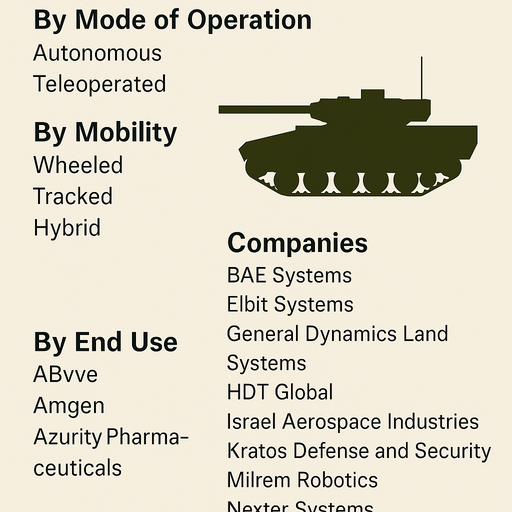
The Mode of Operation segment is divided into Autonomous and Teleoperated. Autonomous robotic combat vehicles are projected to register the highest CAGR during 2026 to 2034 as AI-driven capabilities improve target recognition, pathfinding, and decision-making in complex environments. Teleoperated systems continue to hold significant market share, especially where remote control is needed for specialized or highly contested missions that require direct human oversight to navigate unpredictable terrains or manage lethal force decisions.
Market Segmentation by Mobility
By Mobility, the segment comprises Wheeled, Tracked, and Hybrid robotic platforms. In 2025, tracked robotic combat vehicles led the market owing to their superior off-road mobility and traction across rough terrains common in combat zones. Wheeled vehicles offer advantages in terms of speed and lower maintenance and are expected to grow steadily in urban and light-terrain applications. Hybrid designs, incorporating both wheels and tracks for multi-environment flexibility, are projected to see strong growth through 2034 due to their increasing popularity for specialized missions that require swift mobility adaptation to different theaters of operation.
Geographic Trends
North America accounted for the largest revenue share in 2025 due to substantial investments by the U.S. Department of Defense and robust R&D partnerships with major defense contractors. Europe followed closely, supported by NATO modernization initiatives and joint development programs across Germany, the UK, and France. The Asia Pacific region is projected to witness the fastest CAGR through 2034 as countries like China, India, South Korea, and Japan expand indigenous robotic and unmanned military capabilities to bolster border defense and maritime security. Latin America and the Middle East & Africa also present emerging opportunities driven by counterterrorism operations and investments in force-protection equipment for diverse defense and security agencies.
Competitive Trends
The robotic combat vehicles market is highly competitive, featuring established defense leaders and specialized robotics firms pursuing innovation and system integration. Leading companies include BAE Systems, Elbit Systems, General Dynamics Land Systems, HDT Global, Israel Aerospace Industries, Kratos Defense and Security Solutions, Milrem Robotics, Nexter Systems, Oshkosh Defense, Qinetiq, Rheinmetall, Teledyne FLIR, and Textron Systems. These companies are investing in AI-driven autonomy, lightweight and modular designs, and advanced weapons integration to gain market share. Recent competitive strategies have involved teaming with national armies for field trials, leveraging public-private partnerships to co-develop future-ready autonomous platforms, and scaling up production capacity to support long-term procurement and modernization programs. Sustained emphasis on interoperability, cybersecurity features, and local assembly to satisfy regional requirements is expected to drive market differentiation and ongoing leadership in the evolving robotic combat vehicle landscape.
Historical & Forecast Period
This study report represents analysis of each segment from 2024 to 2034 considering 2025 as the base year. Compounded Annual Growth Rate (CAGR) for each of the respective segments estimated for the forecast period of 2026 to 2034.
The current report comprises of quantitative market estimations for each micro market for every geographical region and qualitative market analysis such as micro and macro environment analysis, market trends, competitive intelligence, segment analysis, porters five force model, top winning strategies, top investment markets, emerging trends and technological analysis, case studies, strategic conclusions and recommendations and other key market insights.
Research Methodology
The complete research study was conducted in three phases, namely: secondary research, primary research, and expert panel review. key data point that enables the estimation of Robotic Combat Vehicles Market By Mode of Operation, By Mobility, and By Application - Growth, Share, Opportunities & Competitive Analysis, 2026 - 2034 market are as follows:
Market forecast was performed through proprietary software that analyzes various qualitative and quantitative factors. Growth rate and CAGR were estimated through intensive secondary and primary research. Data triangulation across various data points provides accuracy across various analyzed market segments in the report. Application of both top down and bottom-up approach for validation of market estimation assures logical, methodical and mathematical consistency of the quantitative data.
| ATTRIBUTE | DETAILS |
|---|---|
| Research Period | 2024-2034 |
| Base Year | 2025 |
| Forecast Period | 2026-2034 |
| Historical Year | 2024 |
| Unit | USD Million |
| Segmentation | |
Mode of Operation
|
|
Mobility
|
|
Application
|
|
|
Region Segment (2024-2034; US$ Million)
|
Key questions answered in this report


