
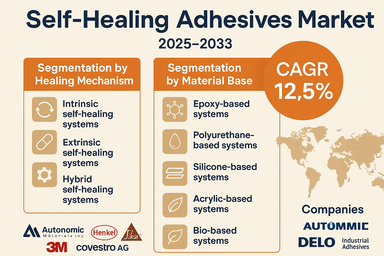
The global self-healing adhesives market is projected to grow at a CAGR of 12.5% from 2026 to 2034, driven by the increasing demand for advanced materials that extend product life, reduce maintenance costs, and enhance reliability in critical applications. Self-healing adhesives are engineered to autonomously repair damage such as microcracks, delamination, or mechanical stress, ensuring long-term performance in industries like automotive, aerospace, electronics, and construction.
Innovation in Polymer Chemistry and Sustainable Solutions
The shift toward next-generation materials is fueling innovation in self-healing adhesive systems. Intrinsic and extrinsic mechanisms—based on reversible chemical bonds or encapsulated healing agents—allow adhesives to recover their strength after damage. Hybrid formulations that combine both systems are gaining traction for applications requiring dynamic stress recovery and high thermal stability. Moreover, bio-based self-healing adhesives are emerging as eco-friendly alternatives to conventional petrochemical-based products, supporting circular economy goals and green manufacturing standards. Industries are also adopting these systems in smart coatings and flexible electronics where durability and adaptive functionality are critical.
Challenges: Cost and Commercial Scalability
Despite promising performance, the market faces challenges such as high formulation costs, complex production processes, and limited large-scale manufacturing capabilities. Maintaining consistent healing performance under varying environmental conditions remains another concern. However, growing collaboration between material science research institutions and industrial adhesive manufacturers is improving scalability, making these systems increasingly viable for mainstream adoption in consumer and industrial sectors.
Market Segmentation by Healing Mechanism
By healing mechanism, the market is segmented into Intrinsic Self-Healing Systems, Extrinsic Self-Healing Systems, and Hybrid Self-Healing Systems. In 2025, Intrinsic self-healing systems held the largest share, favored for their reversible chemical bonding and ability to self-repair without external intervention. These are widely used in electronics and coatings applications. Extrinsic systems, which use embedded capsules or vascular networks containing healing agents, are preferred in structural applications due to their mechanical robustness. The Hybrid self-healing systems segment is expected to record the highest CAGR, combining the autonomous properties of intrinsic systems with the strength of extrinsic mechanisms, making them ideal for automotive and aerospace use.
Market Segmentation by Material Base
By material base, the market is divided into Epoxy-based, Polyurethane-based, Silicone-based, Acrylic-based, and Bio-based systems. The Epoxy-based systems segment dominated in 2025, driven by their superior adhesion strength, thermal stability, and resistance to environmental degradation. Polyurethane-based systems are expanding rapidly due to their flexibility and compatibility with diverse substrates. Silicone-based adhesives are gaining traction in electronics and aerospace for their elasticity and temperature resistance, while Acrylic-based systems are popular in fast-curing industrial applications. The Bio-based adhesives segment is projected to register the fastest growth, supported by rising environmental regulations and increasing demand for sustainable material innovation.
Regional Insights
In 2025, Europe led the global self-healing adhesives market, driven by strong R&D investment, sustainability regulations, and innovation in automotive and aerospace materials. North America follows closely, with increasing adoption in electronics, medical devices, and high-performance industrial applications. The Asia Pacific region is anticipated to witness the highest CAGR through 2034, supported by growing manufacturing activities in China, Japan, and South Korea, alongside rising government initiatives promoting sustainable materials. Latin America and Middle East & Africa (MEA) are emerging markets, with growth driven by construction and automotive expansion.
Competitive Landscape
The self-healing adhesives market is moderately consolidated, with global players focusing on R&D collaboration, polymer innovation, and commercialization of scalable formulations. Autonomic Materials Inc. leads in encapsulated microcapsule-based systems, enabling high-performance industrial coatings and adhesives. Henkel AG & Co. KGaA and 3M Company are pioneers in commercializing self-repairing adhesive products integrated with advanced bonding and thermal properties. Sika and Covestro AG are investing in hybrid polymer systems for construction and automotive applications. DELO Industrial Adhesives continues to innovate in high-strength bonding solutions for electronics and optical applications. Strategic initiatives such as sustainable material development, smart polymer integration, and cross-industry partnerships are expected to drive competitiveness, positioning self-healing adhesives as a cornerstone of future material engineering and industrial durability.
Historical & Forecast Period
This study report represents analysis of each segment from 2024 to 2034 considering 2025 as the base year. Compounded Annual Growth Rate (CAGR) for each of the respective segments estimated for the forecast period of 2026 to 2034.
The current report comprises of quantitative market estimations for each micro market for every geographical region and qualitative market analysis such as micro and macro environment analysis, market trends, competitive intelligence, segment analysis, porters five force model, top winning strategies, top investment markets, emerging trends and technological analysis, case studies, strategic conclusions and recommendations and other key market insights.
Research Methodology
The complete research study was conducted in three phases, namely: secondary research, primary research, and expert panel review. key data point that enables the estimation of Self-healing Adhesives Market By Healing Mechanism, By Application, By Material Base Analysis - Growth, Share, Opportunities & Competitive Analysis, 2026 - 2034 market are as follows:
Market forecast was performed through proprietary software that analyzes various qualitative and quantitative factors. Growth rate and CAGR were estimated through intensive secondary and primary research. Data triangulation across various data points provides accuracy across various analyzed market segments in the report. Application of both top down and bottom-up approach for validation of market estimation assures logical, methodical and mathematical consistency of the quantitative data.
| ATTRIBUTE | DETAILS |
|---|---|
| Research Period | 2024-2034 |
| Base Year | 2025 |
| Forecast Period | 2026-2034 |
| Historical Year | 2024 |
| Unit | USD Million |
| Segmentation | |
Healing Mechanism
|
|
Application
|
|
Material Base
|
|
|
Region Segment (2024-2034; US$ Million)
|
Key questions answered in this report


