
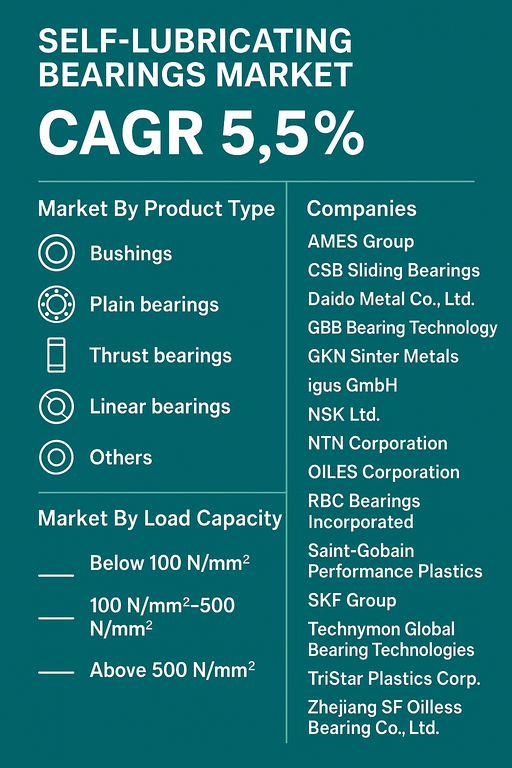
The self-lubricating bearings market is projected to grow at a CAGR of 5.5% from 2026 to 2034, driven by increasing demand for maintenance-free bearing solutions, rising industrial automation, and a global shift toward cost-effective, durable components in high-load and high-friction applications. Self-lubricating bearings offer advantages such as reduced friction, extended service life, corrosion resistance, and elimination of external lubrication, making them ideal for applications across automotive, aerospace, industrial machinery, and construction equipment sectors.
Market Drivers
Growth in Maintenance-Free and Clean Operation Requirements
Industries are increasingly seeking components that reduce downtime and operational costs. Self-lubricating bearings require no additional lubrication and can operate under harsh environments, including high temperature, heavy load, and dirty or wet conditions making them particularly valuable in remote or continuous-process applications where maintenance is difficult.
Rise in Industrial Automation and Equipment Efficiency
As industrial equipment becomes more advanced and automated, demand for components that improve system efficiency and reliability continues to grow. Self-lubricating bearings offer consistent performance, low noise, and high wear resistance characteristics that align with the performance demands of automated conveyors, robotic arms, pumps, and actuators.
Expanding Adoption Across Diverse End-Use Sectors
Self-lubricating bearings are being adopted across industries including automotive (e.g., door hinges, throttle systems), aerospace (e.g., actuators), agricultural equipment (e.g., tillers, harvesters), and renewable energy systems (e.g., wind turbines). Their ability to operate without external lubrication while providing long-term stability makes them suitable for both lightweight and high-load applications.
Market Restraint
Material Limitations and Load Constraints in Certain Applications
Despite their versatility, self-lubricating bearings made from plastic or sintered metals may have lower load-bearing capacity or limited thermal tolerance compared to traditional lubricated metal bearings. In high-speed or high-shock environments, their performance may be suboptimal, leading to potential restrictions in usage across heavy-duty or aerospace-grade applications without advanced customization.
Market Segmentation by Product Type
The product segment includes Bushings, Plain Bearings, Thrust Bearings, Linear Bearings, and Others. In 2025, bushings held the largest market share due to their widespread use in rotating and oscillating motion applications across machinery and vehicles. Plain bearings followed closely, being favored for their simplicity and cost-efficiency in automotive and general engineering applications. Thrust bearings and linear bearings are expected to grow steadily, driven by demand in precise motion applications such as CNC machines, medical devices, and factory automation systems. The Others segment includes spherical and flanged bearings used in custom industrial configurations.
Market Segmentation by Load Capacity
By load capacity, the market is categorized into Below 100 N/mm², 100–500 N/mm², and Above 500 N/mm². In 2025, the 100–500 N/mm² segment led the market due to its applicability in standard industrial operations requiring moderate load handling with durability. The Below 100 N/mm² segment serves low-load applications such as office automation, domestic appliances, and lightweight machinery. The Above 500 N/mm² segment is expected to witness the highest CAGR as industries like mining, heavy construction, and defense invest in robust, high-load bearing components capable of performing under extreme pressure and wear conditions.
Geographic Trends
In 2025, Asia Pacific dominated the global market, led by rapid industrialization in China, India, and Southeast Asia, along with strong manufacturing output and growing adoption of automation in machinery. The region is expected to maintain the highest CAGR through 2034. North America follows with significant use in automotive, defense, and aerospace sectors, particularly in the U.S. Europe remains a key market, particularly in Germany, France, and the UK, due to strong industrial equipment and robotics sectors. Latin America and Middle East & Africa are emerging regions, supported by infrastructure development and investments in agriculture and construction equipment.
Competitive Trends
In 2025, the self-lubricating bearings market was competitive, with global players focusing on material innovation, custom solutions, and expansion into high-growth regions. GGB Bearing Technology, igus GmbH, SKF Group, and NSK Ltd. led the market with extensive product portfolios covering high-performance polymer, composite, and metal-polymer bearings. NTN Corporation, NTN OILES, and Daido Metal Co., Ltd. offered sintered metal bearings tailored for automotive and industrial applications. GKN Sinter Metals, AMES Group, and TriStar Plastics Corp. focused on cost-effective sintered and plastic designs for mid-load segments. Companies like Saint-Gobain Performance Plastics, Technymon Global Bearing Technologies, and Zhejiang SF Oilless Bearing Co., Ltd. invested in R&D to enhance load capacity, reduce wear, and develop custom geometries. Strategic trends include adoption of nanocomposite materials, improved thermal resistance, and partnerships with OEMs for long-term supply contracts in industrial automation and EV component manufacturing.
Historical & Forecast Period
This study report represents analysis of each segment from 2024 to 2034 considering 2025 as the base year. Compounded Annual Growth Rate (CAGR) for each of the respective segments estimated for the forecast period of 2026 to 2034.
The current report comprises of quantitative market estimations for each micro market for every geographical region and qualitative market analysis such as micro and macro environment analysis, market trends, competitive intelligence, segment analysis, porters five force model, top winning strategies, top investment markets, emerging trends and technological analysis, case studies, strategic conclusions and recommendations and other key market insights.
Research Methodology
The complete research study was conducted in three phases, namely: secondary research, primary research, and expert panel review. key data point that enables the estimation of Self-Lubricating Bearings Market By Product type, By Material, By Load Capacity, By Friction, By Durability, By End-User - Growth, Share, Opportunities & Competitive Analysis, 2026 - 2034 market are as follows:
Market forecast was performed through proprietary software that analyzes various qualitative and quantitative factors. Growth rate and CAGR were estimated through intensive secondary and primary research. Data triangulation across various data points provides accuracy across various analyzed market segments in the report. Application of both top down and bottom-up approach for validation of market estimation assures logical, methodical and mathematical consistency of the quantitative data.
| ATTRIBUTE | DETAILS |
|---|---|
| Research Period | 2024-2034 |
| Base Year | 2025 |
| Forecast Period | 2026-2034 |
| Historical Year | 2024 |
| Unit | USD Million |
| Segmentation | |
Product Type
|
|
Material
|
|
Load Capacity
|
|
Friction
|
|
Durability
|
|
End Use
|
|
|
Region Segment (2024-2034; US$ Million)
|
Key questions answered in this report


