
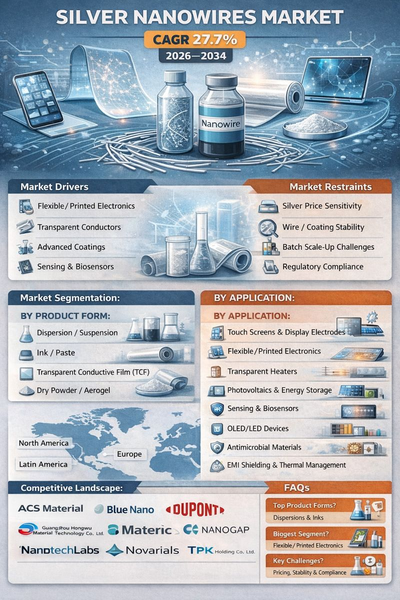
The silver nanowires market is expected to grow at a CAGR of 27.7% during 2026–2034, driven by rising demand for transparent conductive materials and rapid growth in flexible and printed electronics. Silver nanowires are widely used to enable high conductivity with optical transparency, supporting next-generation touch interfaces, display electrodes, transparent heaters, and flexible device architectures. Growth is also supported by increasing adoption of lightweight, bendable electronic designs, broader use of advanced coatings and functional inks, and ongoing R&D in sensing, biosensors, and antimicrobial materials where nanoscale performance benefits are important.
Market Drivers
Market growth is driven by expanding demand for touch screens and display electrodes, where silver nanowires are used as transparent conductive alternatives in selected designs that prioritize flexibility and low-temperature processing. Growth in flexible and printed electronics is a major driver, supported by wearable devices, flexible sensors, smart packaging, and printed circuits that require solution-processable conductive networks. Demand for transparent heaters is increasing in automotive, building, and consumer applications where defogging/deicing and uniform heating performance are required. In energy-related applications, adoption is supported by R&D and selective commercialization in photovoltaics and energy storage, where conductive networks can improve performance in certain architectures. Additional demand is supported by sensing and biosensors where signal stability and surface functionalization options matter, and by EMI shielding and thermal management where conductive networks can support lightweight shielding solutions. In antimicrobial materials, interest is supported by coatings and composites where silver-based functionality is used, although adoption depends on regulatory positioning and cost.
Market Restraints
The market faces restraints from silver price sensitivity and cost pressures compared to alternative conductive materials, especially in high-volume consumer electronics. Product performance can vary by wire length, diameter, coating chemistry, dispersion stability, and network uniformity, which increases qualification time for customers and requires tight QC. Reliability challenges such as oxidation, moisture sensitivity, and long-term adhesion can require encapsulation and protective coatings, increasing total system cost. Manufacturing scale-up and consistent supply of high-quality nanowires remain important constraints, particularly for customers needing uniform batches and stable long-term contracts. Regulatory and EHS considerations around nanomaterials handling, worker safety, and waste management can also raise compliance requirements, especially for powders and dry formats.
Market Segmentation
By Product Form
By product form, the market is segmented into dispersion/suspension, ink/paste, transparent conductive film (TCF), and dry powder/aerogel. Dispersion/suspension holds strong demand because it supports coating and printing processes and enables integration into multiple end-use formulations with controlled rheology and film formation. Ink/paste is a key segment for printed electronics and patterned deposition, where viscosity, printability, and conductivity are core purchase criteria. Transparent conductive film (TCF) represents a higher-value segment used in applications requiring ready-to-integrate conductive layers with consistent optical and electrical performance, supporting faster adoption for device makers. Dry powder/aerogel serves specific applications and R&D needs where downstream customers prefer to formulate internally, but it requires stronger handling controls and process expertise.
By Application
By application, the market is segmented into touch screens & display electrodes, flexible/printed electronics, transparent heaters, photovoltaics & energy storage, sensing & biosensors, OLED/LED devices, antimicrobial materials, and EMI shielding & thermal management. Touch screens & display electrodes remain a key demand driver due to ongoing device upgrades and need for high-performance transparent conductors in selected formats. Flexible/printed electronics is a high-growth segment supported by wearables, flexible sensors, and printed functional layers. Transparent heaters are growing steadily due to demand in automotive and architectural glass applications where uniform heating is required. OLED/LED devices are a selective opportunity where thin, transparent conductive networks can be valuable depending on device architecture and reliability needs. Sensing & biosensors is expanding through R&D and niche commercialization, especially in high-value detection platforms. Photovoltaics & energy storage remains more selective and project-driven, influenced by qualification cycles and cost-performance comparisons. Antimicrobial materials demand depends on regulatory positioning and end-user requirements for coatings and composites. EMI shielding & thermal management is growing where lightweight conductive layers and flexible shielding materials are needed.
Regional Insights
Asia Pacific represents a major demand base due to strong electronics manufacturing capacity, high production of touch-enabled devices, and rapid development of flexible electronics supply chains in selected countries. North America shows strong growth supported by R&D intensity, advanced materials commercialization, and demand from specialized electronics, sensing, and defense-related applications where performance can justify cost. Europe is supported by advanced materials research, automotive and industrial applications for transparent heaters and functional coatings, and increasing focus on sustainable electronics manufacturing, though qualification and compliance requirements can be strict. Latin America shows developing demand, mainly through import-led supply for electronics and industrial applications, with growth dependent on downstream manufacturing expansion. The Middle East & Africa shows selective growth linked to high-value projects, research activity, and adoption of advanced functional materials through distribution networks.
Competitive Landscape
The market is competitive and technology-driven, with suppliers differentiating through nanowire quality (length/diameter control), dispersion stability, optical transmission versus sheet resistance performance, coating compatibility, and long-term reliability. Vendors compete by offering application-optimized formulations for printing and coating, along with technical support for customer qualification, process tuning, and performance validation. Partnerships with electronics component manufacturers and integrators are important to secure design wins, especially in touch and flexible electronics. Key strategies include expanding scalable manufacturing, improving protective coating and encapsulation solutions to address reliability, offering multiple product forms (dispersion, ink, TCF), and strengthening IP and customer-specific formulation development. Key companies operating in the market include ACS Material, LLC, Blue Nano, Inc., DuPont de Nemours, Inc., Guangzhou Hongwu Material Technology Co., Ltd., Materic LLC, Nanogap Sub-nm Powder S.A., NanoTechLabs, Inc., Novarials Corporation, Suzhou Cold Stone Nano Material Technology Co., Ltd., and TPK Holding Co., Ltd.
Historical & Forecast Period
This study report represents analysis of each segment from 2024 to 2034 considering 2025 as the base year. Compounded Annual Growth Rate (CAGR) for each of the respective segments estimated for the forecast period of 2026 to 2034.
The current report comprises of quantitative market estimations for each micro market for every geographical region and qualitative market analysis such as micro and macro environment analysis, market trends, competitive intelligence, segment analysis, porters five force model, top winning strategies, top investment markets, emerging trends and technological analysis, case studies, strategic conclusions and recommendations and other key market insights.
Research Methodology
The complete research study was conducted in three phases, namely: secondary research, primary research, and expert panel review. key data point that enables the estimation of Silver Nanowires Market By Product Form, By Application, By End Use - Growth, Share, Opportunities & Competitive Analysis, 2026 - 2034 market are as follows:
Market forecast was performed through proprietary software that analyzes various qualitative and quantitative factors. Growth rate and CAGR were estimated through intensive secondary and primary research. Data triangulation across various data points provides accuracy across various analyzed market segments in the report. Application of both top down and bottom-up approach for validation of market estimation assures logical, methodical and mathematical consistency of the quantitative data.
| ATTRIBUTE | DETAILS |
|---|---|
| Research Period | 2024-2034 |
| Base Year | 2025 |
| Forecast Period | 2026-2034 |
| Historical Year | 2024 |
| Unit | USD Million |
| Segmentation | |
Product Form
|
|
Application
|
|
End Use
|
|
|
Region Segment (2024-2034; US$ Million)
|
Frequently Asked Questions
What is the growth outlook for the silver nanowires market?
The market is expected to grow at a CAGR of 27.7% during 2026–2034, supported by rapid expansion in transparent conductors and flexible/printed electronics.
Which product form is widely used for industrial integration?
Dispersions/suspensions and inks/pastes are widely used because they support coating and printing processes and enable easier integration into manufacturing lines.
Which application segment is driving strong growth?
Flexible/printed electronics and touch screens & display electrodes are major growth drivers, with additional demand from transparent heaters and EMI shielding in selected use cases.
What are the key challenges in this market?
Key challenges include silver price sensitivity, batch consistency, stability and oxidation control, long qualification cycles, and EHS compliance for nanomaterial handling.
Who are the key players in this market?
Key participants include DuPont, ACS Material, Blue Nano, TPK Holding, NanoTechLabs, Nanogap, and other specialized advanced materials suppliers.


