
Growing concerns over food fraud, increasing regulatory requirements for product traceability, and rising demand for authentication of premium food products are driving the growth of the stable isotope analysis for food origin verification market worldwide.
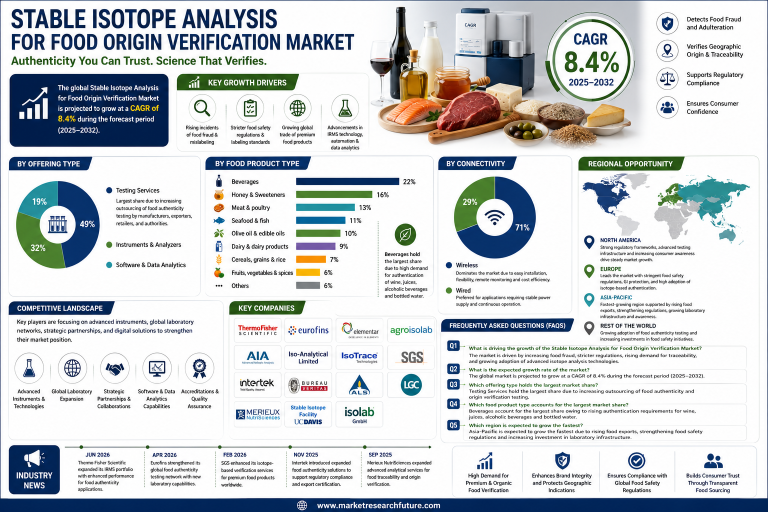
The global stable isotope analysis for food origin verification market is witnessing strong growth as governments, food manufacturers, retailers, and certification bodies increasingly adopt scientific authentication techniques to verify the geographical origin, production methods, and authenticity of food products. Stable isotope analysis helps detect adulteration, mislabeling, and counterfeit products by measuring naturally occurring isotopic signatures in food samples. Increasing global trade, stricter food safety regulations, and rising consumer demand for transparent food sourcing are expected to support market expansion. The market is projected to register a CAGR of 8.4% during the forecast period.
Key Growth Driver
Increasing focus on food authenticity, traceability, and anti-food fraud initiatives is accelerating market growth globally.
Food producers and regulatory authorities are increasingly utilizing stable isotope analysis to authenticate premium agricultural products, protect geographical indications, and ensure compliance with international food labeling standards. Rising incidents of food adulteration, growing export requirements, and technological advancements in isotope ratio mass spectrometry (IRMS), laboratory automation, and analytical software continue to strengthen market demand.
Segment Highlight
Scientific authentication technologies and advanced laboratory services continue to create opportunities across food verification applications.
Based on offering type, Testing Services account for a significant share of the market due to increasing outsourcing of food authenticity testing by manufacturers, exporters, retailers, and regulatory agencies. Instruments & Analyzers continue to witness strong demand from research laboratories, food testing facilities, and government institutions, while Software & Data Analytics are gaining importance through automated interpretation, data management, and origin verification modeling.
By food product type, Beverages account for a significant market share owing to increasing verification requirements for wine, fruit juices, alcoholic beverages, and bottled water. Honey & Sweeteners, Meat & Poultry, Seafood & Fish, Olive Oil & Edible Oils, Dairy & Dairy Products, Cereals, Grains & Rice, and Fruits, Vegetables & Spices continue to experience growing adoption as manufacturers seek to prevent fraud and strengthen supply chain transparency.
Regional Opportunity
Europe remains the leading market, while Asia-Pacific is emerging as a high-growth region for food authenticity testing.
Europe maintains a dominant position in the Stable Isotope Analysis for Food Origin Verification Market due to stringent food safety regulations, widespread adoption of geographical indication (GI) protection, advanced laboratory infrastructure, and strong regulatory enforcement. North America continues to witness significant demand supported by increasing food quality regulations and expanding testing capabilities. Meanwhile, Asia-Pacific is expected to experience the fastest growth driven by rising food exports, strengthening food safety regulations, expanding laboratory infrastructure, and increasing consumer demand for authentic and traceable food products across China, India, Japan, Australia, and Southeast Asia.
Competitive Landscape
Market participants are focusing on advanced isotope ratio mass spectrometry technologies, laboratory automation, comprehensive testing services, and AI-enabled analytical software to strengthen their competitive position.
Leading companies are investing in high-precision analytical instruments, global laboratory expansion, digital data management platforms, reference isotope databases, and automated interpretation software to improve testing accuracy and operational efficiency. Strategic acquisitions, laboratory accreditations, collaborations with regulatory agencies, and expansion of food authenticity testing services continue to influence market competition. Companies are also emphasizing rapid turnaround times, standardized testing protocols, and regulatory compliance to meet evolving industry requirements.
Key companies operating in the market include Thermo Fisher Scientific Inc., Eurofins Scientific SE, Elementar Analysensysteme GmbH, Agroisolab GmbH, Advanced Isotopic Analysis (AIA), Iso-Analytical Limited, IsoTrace Technologies, SGS SA, Intertek Group plc, Bureau Veritas, ALS Limited, LGC Group, Merieux NutriSciences, Stable Isotope Facility (UC Davis), and Isolab GmbH.
Stable Isotope Analysis for Food Origin Verification Industry News
Jun 2026: Thermo Fisher Scientific Inc. expanded its isotope ratio mass spectrometry portfolio with enhanced analytical capabilities supporting food authenticity and traceability testing laboratories.
Apr 2026: Eurofins Scientific SE strengthened its global food authenticity testing network through expanded laboratory capabilities focused on origin verification and anti-food fraud services.
Feb 2026: SGS SA enhanced its food testing portfolio by expanding isotope-based verification services for premium agricultural and processed food products.
Nov 2025: Intertek Group plc introduced expanded food authenticity testing solutions supporting regulatory compliance, geographical origin verification, and export certification requirements.
Sep 2025: Merieux NutriSciences expanded advanced analytical laboratory services for food traceability, authenticity testing, and isotope-based origin verification across international food supply chains.
Historical & Forecast Period
This study report represents analysis of each segment from 2024 to 2034 considering 2025 as the base year. Compounded Annual Growth Rate (CAGR) for each of the respective segments estimated for the forecast period of 2026 to 2034.
The current report comprises of quantitative market estimations for each micro market for every geographical region and qualitative market analysis such as micro and macro environment analysis, market trends, competitive intelligence, segment analysis, porters five force model, top winning strategies, top investment markets, emerging trends and technological analysis, case studies, strategic conclusions and recommendations and other key market insights.
Research Methodology
The complete research study was conducted in three phases, namely: secondary research, primary research, and expert panel review. key data point that enables the estimation of Stable Isotope Analysis for Food Origin Verification Market - Growth, Share, Opportunities & Competitive Analysis, 2026 - 2034 market are as follows:
Market forecast was performed through proprietary software that analyzes various qualitative and quantitative factors. Growth rate and CAGR were estimated through intensive secondary and primary research. Data triangulation across various data points provides accuracy across various analyzed market segments in the report. Application of both top down and bottom-up approach for validation of market estimation assures logical, methodical and mathematical consistency of the quantitative data.
| ATTRIBUTE | DETAILS |
|---|---|
| Research Period | 2024-2034 |
| Base Year | 2025 |
| Forecast Period | 2026-2034 |
| Historical Year | 2024 |
| Unit | USD Million |
| Segmentation | |
Offering Type
|
|
Food Product Type
|
|
End User
|
|
|
Region Segment (2024-2034; US$ Million)
|
Frequently Asked Questions
Q1. What is driving the growth of the Stable Isotope Analysis for Food Origin Verification Market?
The market is primarily driven by increasing food fraud prevention efforts, stricter food safety regulations, growing demand for product traceability, and rising adoption of scientific food authentication technologies.
Q2. What is the expected growth rate of the Stable Isotope Analysis for Food Origin Verification Market?
The global Stable Isotope Analysis for Food Origin Verification Market is projected to expand at a CAGR of 8.4% during the forecast period.
Q3. Which offering type accounts for a significant market share?
Testing Services account for a significant market share due to increasing outsourcing of food authenticity, origin verification, and regulatory compliance testing by food manufacturers and government agencies.
Q4. Which food product type accounts for a significant market share?
Beverages account for a significant market share owing to increasing authentication requirements for wine, fruit juices, alcoholic beverages, bottled water, and other premium beverage products.
Q5. Which region is expected to witness the strongest market growth?
Asia-Pacific is expected to witness the strongest market growth due to expanding food exports, strengthening food safety regulations, increasing laboratory infrastructure, and growing consumer demand for authentic and traceable food products.


