
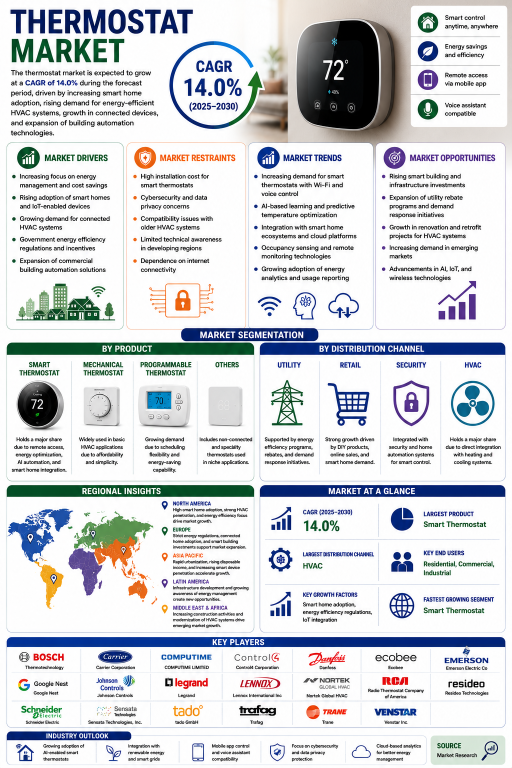
The thermostat market is expected to grow at a CAGR of 14.0% during the forecast period, driven by increasing smart home adoption, rising demand for energy-efficient HVAC systems, growth in connected devices, and expansion of building automation technologies.
Market Drivers
The market is mainly driven by increasing focus on energy management, indoor comfort, and reduction in electricity consumption. Thermostats help optimize heating and cooling systems by improving temperature control and operational efficiency.
Growing adoption of smart homes, IoT-enabled devices, and connected HVAC systems is supporting market growth. Rising investments in commercial building automation and government energy efficiency regulations are also increasing thermostat adoption globally.
Market Restraints
The market faces challenges related to high installation cost for smart systems, cybersecurity concerns, and compatibility limitations with older HVAC infrastructure.
Limited technical awareness in developing regions, dependence on internet connectivity, and integration complexity may also affect adoption among residential consumers.
Thermostat Market Trends
The market is witnessing strong demand for smart thermostats integrated with Wi-Fi, voice assistants, AI-based learning systems, and mobile applications.
Manufacturers are focusing on occupancy sensing, remote monitoring, predictive temperature control, and energy analytics. Integration with smart home ecosystems and cloud-based automation platforms is becoming a major trend in the market.
Market Segmentation
By Product
By product, the market is segmented into smart thermostat, mechanical thermostat, programmable thermostat, and others.
Smart thermostats hold a major share due to remote accessibility, energy optimization, AI-enabled automation, and increasing smart home adoption. Programmable thermostats are also witnessing strong demand due to improved scheduling flexibility and energy-saving capability.
Mechanical thermostats remain relevant in low-cost and basic HVAC applications due to affordability and operational simplicity.
By Distribution Channel
By distribution channel, the market is segmented into utility, retail, security, and HVAC. HVAC holds a major share due to direct integration with heating and cooling systems during residential and commercial installation projects. Retail channels are also witnessing strong growth due to increasing consumer preference for DIY smart home products and online purchasing platforms.
Utility channels are supporting adoption through energy-saving rebate programs and demand-response initiatives.
Regional Insights
North America holds a significant share of the thermostat market due to high smart home adoption, strong HVAC penetration, and increasing demand for energy-efficient buildings.
Europe is driven by strict energy efficiency regulations, connected home adoption, and smart building investments. Asia Pacific is expected to witness strong growth due to rapid urbanization, rising middle-class income, expanding construction activities, and increasing smart device penetration in China, Japan, South Korea, and India.
Latin America and the Middle East & Africa are emerging markets supported by infrastructure modernization, commercial construction growth, and rising awareness regarding energy management.
Competitive Landscape
The thermostat market is highly competitive, with companies focusing on smart connectivity, energy optimization, AI integration, mobile app control, and compatibility with broader smart home ecosystems. Competition is based on product reliability, user interface, interoperability, energy-saving performance, and pricing.
Key companies operating in the market include Bosch Thermotechnology Corp., Carrier Corporation, COMPUTIME LIMITED, Control4 Corporation, Danfoss, Ecobee, Emerson Electric Co, Google Nest, Johnson Controls, Legrand, Lennox International Inc, Nortek Global HVAC, Radio Thermostat Company of America, Resideo Technologies, Schneider Electric, Sensata Technologies, Inc, tado GmbH, Trafag, Trane, and Venstar Inc.
Thermostat Industry News
The industry is witnessing increasing launches of AI-enabled smart thermostats, cloud-connected HVAC controls, and voice-controlled temperature management systems.
Manufacturers are focusing on predictive energy optimization, occupancy-based automation, smart grid integration, and compatibility with home automation ecosystems. Partnerships between HVAC companies, utility providers, and smart home platform companies are expected to support market growth.
Historical & Forecast Period
This study report represents analysis of each segment from 2024 to 2034 considering 2025 as the base year. Compounded Annual Growth Rate (CAGR) for each of the respective segments estimated for the forecast period of 2026 to 2034.
The current report comprises of quantitative market estimations for each micro market for every geographical region and qualitative market analysis such as micro and macro environment analysis, market trends, competitive intelligence, segment analysis, porters five force model, top winning strategies, top investment markets, emerging trends and technological analysis, case studies, strategic conclusions and recommendations and other key market insights.
Research Methodology
The complete research study was conducted in three phases, namely: secondary research, primary research, and expert panel review. key data point that enables the estimation of Thermostat Market - Growth, Share, Opportunities & Competitive Analysis, 2026 - 2034 market are as follows:
Market forecast was performed through proprietary software that analyzes various qualitative and quantitative factors. Growth rate and CAGR were estimated through intensive secondary and primary research. Data triangulation across various data points provides accuracy across various analyzed market segments in the report. Application of both top down and bottom-up approach for validation of market estimation assures logical, methodical and mathematical consistency of the quantitative data.
| ATTRIBUTE | DETAILS |
|---|---|
| Research Period | 2024-2034 |
| Base Year | 2025 |
| Forecast Period | 2026-2034 |
| Historical Year | 2024 |
| Unit | USD Million |
| Segmentation | |
Product
|
|
Distribution Channel
|
|
Mode of Operation
|
|
Application
|
|
|
Region Segment (2024-2034; US$ Million)
|
Frequently Asked Questions
What is the growth outlook for the thermostat market?
The market is expected to grow at a CAGR of 14.0% during the forecast period.
Which product segment holds a major share?
Smart thermostats hold a major share due to connected features, remote monitoring, and energy optimization capabilities.
Which distribution channel dominates the market?
HVAC dominates due to strong integration with residential and commercial heating and cooling systems.
What are the major challenges?
High installation cost, cybersecurity concerns, HVAC compatibility limitations, and integration complexity are major challenges.
Who are the key players?
Major companies include Google Nest, Ecobee, Johnson Controls, Schneider Electric, Danfoss, Carrier Corporation, Bosch Thermotechnology, Resideo Technologies, Trane, and Emerson Electric Co.


