
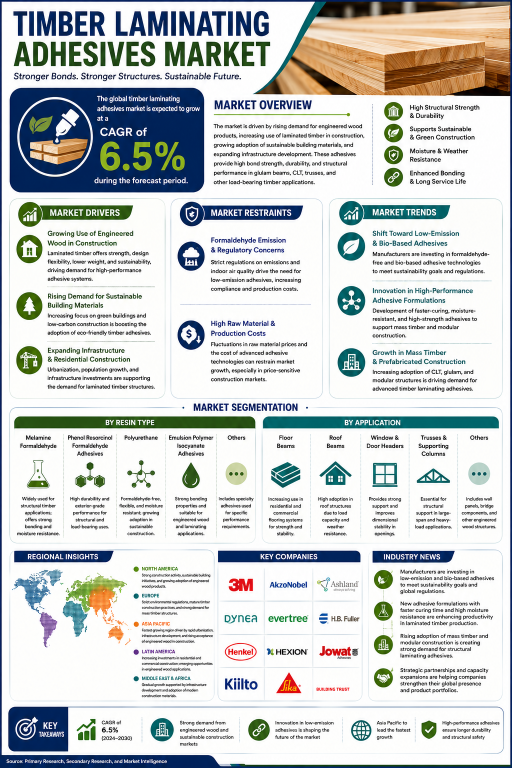
The global timber laminating adhesives market is expected to grow at a CAGR of 6.5% during the forecast period. Market growth is driven by rising demand for engineered wood products, increasing use of laminated timber in construction, growing adoption of sustainable building materials, and expanding residential and commercial infrastructure development. Timber laminating adhesives are widely used in glulam beams, cross-laminated timber, structural columns, roof beams, floor beams, headers, and trusses to improve bonding strength, durability, and structural performance.
Market Drivers
Growing Use of Engineered Wood in Construction
The increasing adoption of engineered wood products in modern construction is a major factor supporting market growth. Laminated timber offers strength, design flexibility, lower weight, and improved sustainability compared to conventional building materials. Rising demand for green buildings, prefabricated construction, and low-carbon structural materials is increasing the use of high-performance adhesives in timber lamination applications.
Market Restraints
Formaldehyde Emission and Regulatory Concerns
Some resin-based adhesives, especially formaldehyde-containing systems, face scrutiny due to emission-related concerns and strict indoor air quality regulations. Manufacturers must invest in low-emission formulations and compliance testing, which can increase production costs. Price sensitivity in construction markets may also limit adoption of premium adhesive technologies.
Timber Laminating Adhesives Market Trends
The market is witnessing growing demand for low-emission, high-strength, and moisture-resistant adhesive systems. Manufacturers are focusing on formaldehyde-free adhesives, bio-based resin technologies, and faster-curing formulations to support sustainable timber construction. Increasing use of mass timber, modular construction, and prefabricated structural components is also creating demand for adhesives that offer strong bonding, long service life, and compliance with structural safety standards.
Market Segmentation
By Resin Type
Based on resin type, the market is segmented into Melamine Formaldehyde, Phenol Resorcinol Formaldehyde Adhesives, Polyurethane, Emulsion Polymer Isocyanate Adhesives, and Others. Melamine formaldehyde adhesives hold a significant market share due to their strong bonding performance, moisture resistance, and wide use in structural timber applications. Phenol resorcinol formaldehyde adhesives are widely used where high durability and exterior-grade performance are required. Polyurethane adhesives are expected to witness strong growth due to their formaldehyde-free profile, flexibility, and increasing use in sustainable construction applications. Emulsion polymer isocyanate adhesives are gaining traction due to strong bonding properties and suitability for engineered wood products.
By Application
Based on application, the market is segmented into Floor Beams, Roof Beams, Window and Door Headers, Trusses and Supporting Columns, and Others. Roof beams account for a significant market share due to increasing use of laminated timber in residential, commercial, and institutional building structures. Floor beams also represent strong demand as engineered wood gains adoption in mid-rise and prefabricated construction. Trusses and supporting columns are expected to grow steadily due to increasing use of glulam and mass timber in structural framing applications. Window and door headers continue to generate stable demand in housing and renovation projects.
Regional Insights
North America represents a major market due to increasing adoption of engineered wood, strong residential construction activity, and rising demand for sustainable building materials. Europe continues to witness steady growth supported by strict sustainability regulations, mature timber construction practices, and strong adoption of mass timber structures. Asia Pacific is expected to record the fastest growth during the forecast period due to rapid urbanization, expanding construction activity, rising infrastructure development, and increasing acceptance of engineered wood products across China, Japan, India, South Korea, and Southeast Asia. Latin America and the Middle East & Africa are gradually emerging as construction industries adopt more efficient and sustainable building materials.
Competitive Landscape
The timber laminating adhesives market is competitive, with companies focusing on product innovation, low-emission adhesive systems, sustainability, bonding performance, and compliance with structural building standards. Manufacturers are investing in polyurethane, bio-based, and formaldehyde-reduced adhesive technologies to meet growing demand from engineered wood and mass timber producers. Strategic partnerships with timber product manufacturers, construction material suppliers, and prefabrication companies remain important for market expansion.
Key companies operating in the market include 3M Company, Akzo Nobel N.V., Ashland Global Holdings, Dynea AS, Evertree, H.B. Fuller Company, Henkel AG & Co. KGaA, Hexion Inc., Jowat SE, Kiilto Oy, and Sika AG.
Timber Laminating Adhesives Industry News
The industry is witnessing increased investment in low-emission and bio-based adhesive formulations for engineered wood applications. Manufacturers are developing advanced bonding solutions that support mass timber construction, prefabricated building systems, and structural laminated wood products. Demand for adhesives with faster curing time, high moisture resistance, and long-term durability is expected to increase as laminated timber becomes more common in sustainable construction projects.
Historical & Forecast Period
This study report represents analysis of each segment from 2024 to 2034 considering 2025 as the base year. Compounded Annual Growth Rate (CAGR) for each of the respective segments estimated for the forecast period of 2026 to 2034.
The current report comprises of quantitative market estimations for each micro market for every geographical region and qualitative market analysis such as micro and macro environment analysis, market trends, competitive intelligence, segment analysis, porters five force model, top winning strategies, top investment markets, emerging trends and technological analysis, case studies, strategic conclusions and recommendations and other key market insights.
Research Methodology
The complete research study was conducted in three phases, namely: secondary research, primary research, and expert panel review. key data point that enables the estimation of Timber Laminating Adhesives Market - Growth, Share, Opportunities & Competitive Analysis, 2026 - 2034 market are as follows:
Market forecast was performed through proprietary software that analyzes various qualitative and quantitative factors. Growth rate and CAGR were estimated through intensive secondary and primary research. Data triangulation across various data points provides accuracy across various analyzed market segments in the report. Application of both top down and bottom-up approach for validation of market estimation assures logical, methodical and mathematical consistency of the quantitative data.
| ATTRIBUTE | DETAILS |
|---|---|
| Research Period | 2024-2034 |
| Base Year | 2025 |
| Forecast Period | 2026-2034 |
| Historical Year | 2024 |
| Unit | USD Million |
| Segmentation | |
Resin Type
|
|
Technology
|
|
|
Region Segment (2024-2034; US$ Million)
|
Frequently Asked Questions
What is the expected growth rate of the timber laminating adhesives market?
The timber laminating adhesives market is expected to grow at a CAGR of 6.5% during the forecast period.
Which resin type segment holds a significant market share?
Melamine formaldehyde adhesives hold a significant market share due to strong bonding performance and wide use in structural timber applications.
Which application segment dominates the market?
Roof beams account for a significant market share due to increasing use of laminated timber in structural construction.
What are the major growth drivers?
Major growth drivers include rising use of engineered wood, growing adoption of mass timber construction, increasing demand for sustainable building materials, and expansion of residential and commercial construction.
Who are the major companies operating in the market?
Major companies include 3M Company, Akzo Nobel N.V., Ashland Global Holdings, Dynea AS, Evertree, H.B. Fuller Company, Henkel AG & Co. KGaA, Hexion Inc., Jowat SE, Kiilto Oy, and Sika AG.


