
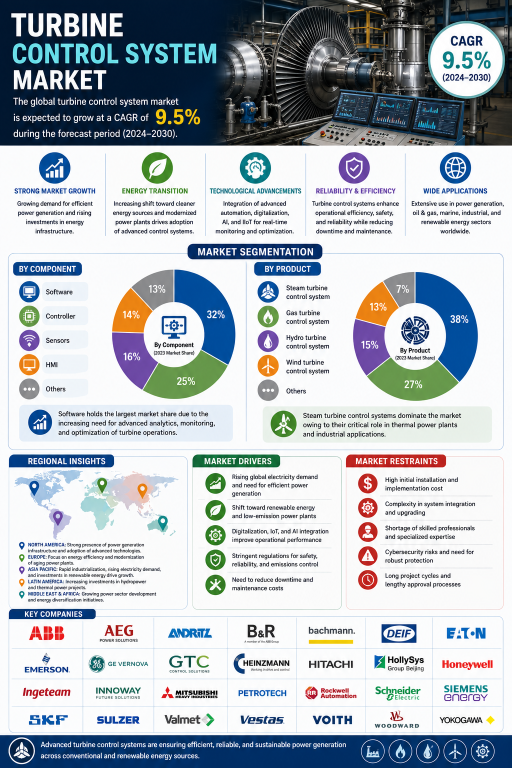
The global turbine control system market is expected to grow at a CAGR of 9.5% during the forecast period. Market growth is being driven by increasing investments in power generation infrastructure, rising adoption of renewable energy, growing demand for operational efficiency, and ongoing modernization of aging power plants. Turbine control systems play a critical role in monitoring, controlling, protecting, and optimizing turbine performance across steam, gas, hydro, and wind power applications. The integration of digital technologies, industrial automation, artificial intelligence, and predictive maintenance capabilities is further supporting market expansion.
Market Drivers
Growing Demand for Efficient and Reliable Power Generation
Rapid growth in electricity demand, coupled with the need for improved plant efficiency and operational reliability, is driving the adoption of advanced turbine control systems. Utilities and industrial operators are increasingly investing in automation platforms that enable real-time monitoring, fault detection, load balancing, and performance optimization. The expansion of renewable energy projects and modernization of conventional power plants are also creating strong demand for turbine control technologies.
Market Restraints
High Installation and Integration Costs
Implementation of advanced turbine control systems often requires significant capital investment, system integration, software customization, and workforce training. Retrofitting existing power generation assets with modern control platforms can be costly and technically complex. Cybersecurity concerns and compatibility issues with legacy infrastructure may also pose challenges for market growth.
Turbine Control System Market Trends
The market is witnessing increasing adoption of digital control platforms integrated with Industrial Internet of Things (IIoT), cloud-based analytics, artificial intelligence, and predictive maintenance technologies. Manufacturers are focusing on developing intelligent turbine control solutions capable of optimizing efficiency, reducing downtime, and improving operational safety. Demand for remote monitoring, condition-based maintenance, and advanced HMI platforms is also increasing across power generation facilities worldwide.
Market Segmentation
By Component
Based on component, the market is segmented into Software, Controller, Sensors, HMI, and Others. Software accounts for a significant market share due to increasing adoption of advanced analytics, performance optimization, asset management, and predictive maintenance applications. Controllers remain essential for real-time turbine operation and protection functions. Sensors continue to witness strong demand as operators focus on accurate monitoring of temperature, pressure, vibration, speed, and performance parameters. HMI solutions are increasingly deployed to improve operational visibility and decision-making capabilities.
By Product
Based on product, the market is segmented into Steam Turbine Control System, Gas Turbine Control System, Hydro Turbine Control System, Wind Turbine Control System, and Others. Steam turbine control systems hold a major market share due to widespread deployment across thermal power plants and industrial facilities. Gas turbine control systems continue to experience strong demand driven by increasing investments in gas-fired power generation. Wind turbine control systems are expected to witness the fastest growth due to accelerating renewable energy deployment and expansion of wind power projects globally. Hydro turbine control systems remain important for grid stability and renewable power generation.
Regional Insights
North America represents a significant market due to modernization of power generation infrastructure, high adoption of automation technologies, and increasing renewable energy investments. Europe continues to witness strong demand driven by energy transition initiatives, decarbonization goals, and upgrades of aging power assets. Asia Pacific is expected to record the fastest growth owing to expanding electricity demand, rapid industrialization, and substantial investments in thermal, hydro, gas, and renewable power generation projects across China, India, Japan, and Southeast Asia. Latin America and the Middle East & Africa are experiencing steady growth supported by infrastructure development and rising power generation capacity additions.
Competitive Landscape
The turbine control system market is highly competitive, with leading companies focusing on digitalization, automation, cybersecurity, predictive maintenance, and intelligent control technologies. Strategic partnerships, software innovation, power plant modernization projects, and renewable energy integration remain key competitive strategies. Companies are investing heavily in advanced analytics, AI-driven monitoring platforms, and cloud-enabled control architectures to strengthen their market positions.
Key companies operating in the market include ABB, AEG Power Solutions, ANDRITZ, B&R, Bachmann, DEIF, Eaton, Emerson Electric, GE Vernova, GTC Control Solutions, Heinzmann, Hitachi, HollySys Group Beijing, Honeywell International, Ingeteam, Innoway Future Solutions, Mitsubishi Heavy Industries, Petrotech, Rockwell Automation, Schneider Electric, Siemens Energy, SKF, Sulzer, Valmet, Vestas, Voith, Woodward, and Yokogawa Electric.
Turbine Control System Industry News
The industry is witnessing increasing deployment of AI-enabled turbine monitoring systems, advanced digital twins, and predictive maintenance platforms aimed at improving plant efficiency and reducing operational costs. Manufacturers are introducing next-generation control systems that support renewable energy integration, remote asset management, and enhanced cybersecurity protection. Utilities and industrial operators are also investing in modernization projects to improve turbine reliability, performance, and grid flexibility.
Historical & Forecast Period
This study report represents analysis of each segment from 2024 to 2034 considering 2025 as the base year. Compounded Annual Growth Rate (CAGR) for each of the respective segments estimated for the forecast period of 2026 to 2034.
The current report comprises of quantitative market estimations for each micro market for every geographical region and qualitative market analysis such as micro and macro environment analysis, market trends, competitive intelligence, segment analysis, porters five force model, top winning strategies, top investment markets, emerging trends and technological analysis, case studies, strategic conclusions and recommendations and other key market insights.
Research Methodology
The complete research study was conducted in three phases, namely: secondary research, primary research, and expert panel review. key data point that enables the estimation of Turbine Control System Market - Growth, Share, Opportunities & Competitive Analysis, 2026 - 2034 market are as follows:
Market forecast was performed through proprietary software that analyzes various qualitative and quantitative factors. Growth rate and CAGR were estimated through intensive secondary and primary research. Data triangulation across various data points provides accuracy across various analyzed market segments in the report. Application of both top down and bottom-up approach for validation of market estimation assures logical, methodical and mathematical consistency of the quantitative data.
| ATTRIBUTE | DETAILS |
|---|---|
| Research Period | 2024-2034 |
| Base Year | 2025 |
| Forecast Period | 2026-2034 |
| Historical Year | 2024 |
| Unit | USD Million |
| Segmentation | |
Component
|
|
Product
|
|
Function
|
|
|
Region Segment (2024-2034; US$ Million)
|
Frequently Asked Questions
What is the expected growth rate of the turbine control system market?
The market is expected to grow at a CAGR of 9.5% during the forecast period.
Which component segment holds a significant market share?
Software holds a significant share due to increasing demand for analytics, monitoring, optimization, and predictive maintenance solutions.
Which product segment dominates the market?
Steam turbine control systems account for a major market share due to extensive deployment in thermal power generation and industrial facilities.
What are the major growth drivers?
Key growth drivers include rising electricity demand, power plant modernization, renewable energy expansion, digitalization, and increasing focus on operational efficiency.
Who are the major companies operating in the market?
Major companies include ABB, Emerson Electric, GE Vernova, Honeywell International, Siemens Energy, Schneider Electric, Rockwell Automation, Yokogawa Electric, Mitsubishi Heavy Industries, ANDRITZ, Woodward, and Hitachi.


