
Growing demand for controlled medicinal cannabis production, increasing legalization across regulated healthcare markets, and rising investment in indoor cultivation technologies are driving the vertical farming for medicinal cannabis market.
The global vertical farming for medicinal cannabis market is witnessing rapid growth as licensed cultivators and pharmaceutical cannabis producers invest in controlled-environment agriculture to improve crop consistency, cannabinoid quality, production output, and regulatory compliance. Vertical farming enables multiple cultivation layers within a limited facility footprint while providing precise control over lighting, temperature, humidity, nutrients, carbon dioxide, and irrigation.
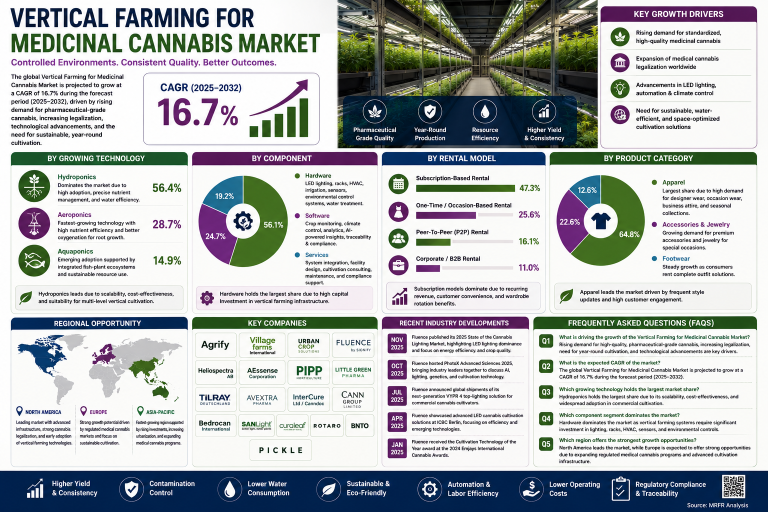
The model is particularly suitable for medicinal cannabis, where standardized crop quality, contamination control, traceability, and repeatable chemical profiles are important. Advancements in LED horticultural lighting, cultivation software, sensors, automation, and environmental control systems are further supporting market expansion. Commercial cannabis cultivators are increasingly prioritizing lighting efficiency, crop quality, and controllable production environments. The market is projected to register a CAGR of 16.7% during the forecast period.
Key Growth Driver
Increasing demand for standardized, high-quality medicinal cannabis is accelerating market growth globally.
Medicinal cannabis producers require consistent cannabinoid concentration, crop quality, and production conditions to meet pharmaceutical and regulatory requirements. Vertical farming systems allow cultivators to maintain controlled growing environments throughout the year, reduce exposure to outdoor contaminants, and optimize cultivation cycles.
The increasing use of energy-efficient LED lighting, automated nutrient delivery, environmental sensors, and crop management software is improving operational control. Nearly 80% of surveyed indoor and greenhouse cannabis cultivators reported using LED lighting as their primary lighting solution in 2025, reflecting the sector’s shift toward efficient and controllable cultivation technology.
Segment Highlight
Hydroponic cultivation and integrated hardware systems continue to create major opportunities across medicinal cannabis facilities.
Based on growing technology, Hydroponics accounts for a significant share of the market due to its established commercial adoption, precise nutrient management, water efficiency, and suitability for multi-layer indoor cultivation. The technology allows cannabis plants to grow without soil through controlled nutrient solutions, enabling cultivators to monitor plant nutrition and production conditions more closely.
Aeroponics is expected to witness strong growth because it delivers nutrients directly to exposed plant roots through a fine mist, supporting efficient water and nutrient usage. However, the technology requires advanced system monitoring and operational expertise. Aquaponics remains an emerging segment that combines plant cultivation with aquatic systems, although its complexity can limit large-scale medicinal cannabis adoption.
By component, Hardware dominates the market due to the high initial investment required for LED grow lights, vertical racks, irrigation equipment, HVAC systems, sensors, environmental controls, and water treatment systems. Software is gaining importance through crop monitoring, environmental automation, data analytics, and production planning. Services include facility design, system installation, cultivation consulting, maintenance, compliance support, and operational optimization.
Regional Opportunity
North America remains the leading market, while Europe is expected to create strong opportunities through regulated medicinal cannabis expansion.
North America maintains a major position in the Vertical Farming for Medicinal Cannabis Market due to its established controlled-environment cultivation infrastructure, presence of technology providers, and continued investment in commercial cannabis production. Advanced lighting, automation, environmental controls, and multi-tier growing systems are widely adopted across licensed cultivation facilities.
Europe is expected to witness strong growth as regulated medicinal cannabis programs expand and pharmaceutical-grade cultivation requirements encourage investment in controlled production facilities. Germany and other European markets are creating opportunities for cultivators, pharmaceutical cannabis suppliers, equipment manufacturers, and cultivation technology providers.
Asia-Pacific presents emerging opportunities supported by selected medicinal cannabis programs, research activities, and controlled cultivation investments in Australia and other regulated markets. The Middle East and Latin America are also attracting interest where medical cannabis regulations and export-focused cultivation projects are developing.
Competitive Landscape
Market participants are focusing on energy-efficient lighting, modular vertical cultivation systems, automated crop management, pharmaceutical-grade production, and facility optimization to strengthen their competitive position.
Technology suppliers are investing in advanced LED lighting, multi-tier cultivation racks, automated irrigation, environmental sensing, data analytics, and centralized control platforms. In July 2025, Fluence announced global shipments of its VYPR 4 lighting solution for commercial cannabis cultivators, while its 2025 industry activities emphasized lighting efficiency, artificial intelligence, genetics, and cultivation technology.
Cannabis producers are focusing on production consistency, Good Manufacturing Practice requirements, genetics, quality testing, and expansion across regulated medical markets. Village Farms reports operating more than seven million square feet of advanced greenhouse infrastructure across North America and Europe, supporting its participation in regulated cannabis markets.
Key companies operating in the market include Agrify Corporation, Village Farms International, Inc., Urban Crop Solutions, Fluence (Signify), Heliospectra AB, AEssense Corporation, Pipp Horticulture, Little Green Pharma Ltd, Tilray Deutschland GmbH, Avextra Pharma GmbH, InterCure Ltd / Canndoc, Cann Group Limited, Bedrocan International, Sanlight GmbH, and Curaleaf International.
Vertical Farming for Medicinal Cannabis Industry Developments
Nov 2025: Fluence published findings from the 2025 State of the Cannabis Lighting Market, reporting that LED lighting had become the primary lighting system for nearly 80% of surveyed indoor and greenhouse cultivators. Energy efficiency and crop quality remained leading purchasing priorities.
Oct 2025: Fluence hosted the PhotoX Advanced Sciences conference in Austin, bringing together specialists in cannabis genetics, artificial intelligence, lighting, cultivation technology, efficiency, and crop quality.
Jul 2025: Fluence announced that its next-generation VYPR 4 top-lighting system was shipping to commercial cannabis cultivators, supporting higher lighting output and improved operating efficiency.
Apr 2025: Fluence presented advanced LED cannabis cultivation solutions at ICBC Berlin and participated in discussions covering energy storage, efficient lighting, and emerging cultivation technologies.
Jan 2025: Fluence received the Cultivation Technology of the Year award at the 2024 Emjays International Cannabis Awards, reflecting continued industry focus on cultivation equipment and lighting innovation.
Historical & Forecast Period
This study report represents analysis of each segment from 2024 to 2034 considering 2025 as the base year. Compounded Annual Growth Rate (CAGR) for each of the respective segments estimated for the forecast period of 2026 to 2034.
The current report comprises of quantitative market estimations for each micro market for every geographical region and qualitative market analysis such as micro and macro environment analysis, market trends, competitive intelligence, segment analysis, porters five force model, top winning strategies, top investment markets, emerging trends and technological analysis, case studies, strategic conclusions and recommendations and other key market insights.
Research Methodology
The complete research study was conducted in three phases, namely: secondary research, primary research, and expert panel review. key data point that enables the estimation of Vertical Farming for Medicinal Cannabis Market - Growth, Share, Opportunities & Competitive Analysis, 2026 - 2034 market are as follows:
Market forecast was performed through proprietary software that analyzes various qualitative and quantitative factors. Growth rate and CAGR were estimated through intensive secondary and primary research. Data triangulation across various data points provides accuracy across various analyzed market segments in the report. Application of both top down and bottom-up approach for validation of market estimation assures logical, methodical and mathematical consistency of the quantitative data.
| ATTRIBUTE | DETAILS |
|---|---|
| Research Period | 2024-2034 |
| Base Year | 2025 |
| Forecast Period | 2026-2034 |
| Historical Year | 2024 |
| Unit | USD Million |
| Segmentation | |
Growing Technology
|
|
Component
|
|
Facility Structure
|
|
End-User Type
|
|
|
Region Segment (2024-2034; US$ Million)
|
Frequently Asked Questions
Q1. What is driving the growth of the Vertical Farming for Medicinal Cannabis Market?
The market is primarily driven by increasing demand for standardized medicinal cannabis, expansion of regulated medical cannabis markets, limited availability of cultivation space, and growing adoption of controlled-environment farming technology.
Q2. What is the expected growth rate of the market?
The global Vertical Farming for Medicinal Cannabis Market is projected to expand at a CAGR of 16.7% during the forecast period.
Q3. Which growing technology accounts for a significant market share?
Hydroponics accounts for a significant market share due to its commercial maturity, precise nutrient delivery, water efficiency, and suitability for multi-level indoor cannabis cultivation.
Q4. Which component dominates the market?
Hardware dominates the market because vertical cannabis facilities require substantial investment in lighting, cultivation racks, HVAC systems, sensors, irrigation systems, environmental controls, and water management equipment.
Q5. Which region offers strong market opportunities?
North America remains a leading market due to its established cannabis cultivation infrastructure and technology ecosystem, while Europe is expected to create strong opportunities through the expansion of regulated medicinal cannabis production.


