
Growing consumer awareness of environmental sustainability, increasing demand for plastic-free products, and the adoption of circular packaging solutions are driving the growth of the zero waste personal care market worldwide.
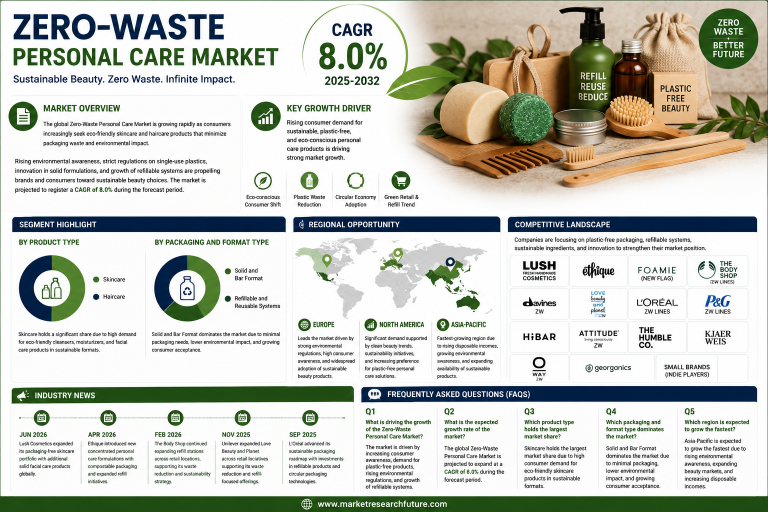
The global zero waste personal care market is experiencing robust growth as consumers increasingly seek eco-friendly skincare and haircare products that minimize packaging waste and environmental impact. Brands are introducing solid formulations, refillable packaging, reusable containers, and biodegradable materials to reduce single-use plastic consumption while meeting evolving consumer preferences. Rising environmental regulations, corporate sustainability commitments, and growing awareness of responsible consumption are further supporting market expansion. The market is projected to register a CAGR of 8.0% during the forecast period.
Key Growth Driver
Increasing consumer preference for sustainable personal care products is accelerating market growth globally.
Consumers are actively shifting toward zero-waste beauty and personal care products that offer environmentally responsible alternatives without compromising product performance. Expansion of refill stations, plastic-free packaging innovations, solid product formats, and sustainability-focused brand initiatives are strengthening market demand. In addition, retailers and manufacturers are investing in circular economy models and environmentally friendly supply chains to support long-term growth.
Segment Highlight
Sustainable product innovation and reusable packaging solutions continue to create opportunities across personal care applications.
Based on product type, Skincare accounts for a significant share of the market due to increasing consumer demand for eco-friendly cleansers, moisturizers, facial bars, and other sustainable skincare products. Haircare continues to witness strong growth as consumers increasingly adopt shampoo bars, conditioner bars, and waterless formulations that reduce packaging waste and transportation emissions.
By packaging and format type, Solid and Bar Format dominates the market owing to its minimal packaging requirements, longer product lifespan, and reduced environmental footprint. Refillable and Reusable Systems are rapidly gaining popularity as premium beauty brands and retailers expand refill stations, reusable containers, and closed-loop packaging initiatives to promote circular consumption.
Regional Opportunity
Europe remains the leading market, while Asia-Pacific is emerging as a high-growth region for sustainable personal care products.
Europe maintains a dominant position in the Zero-Waste Personal Care Market due to strong environmental regulations, high consumer awareness, established sustainability initiatives, and widespread adoption of eco-friendly beauty products. North America continues to witness significant demand supported by increasing consumer preference for clean beauty and sustainable packaging. Meanwhile, Asia-Pacific is expected to experience the fastest growth driven by rising disposable incomes, expanding premium personal care markets, growing environmental awareness, and increasing availability of sustainable beauty products across China, Japan, India, South Korea, and Southeast Asia.
Competitive Landscape
Market participants are focusing on plastic-free packaging, refillable product systems, biodegradable materials, and sustainable ingredient sourcing to strengthen their competitive position.
Leading companies are investing in innovative solid formulations, recyclable packaging, refill infrastructure, carbon footprint reduction, and ethical sourcing practices to enhance brand value and customer loyalty. Strategic collaborations with retailers, expansion of direct-to-consumer channels, and increasing investment in environmentally responsible product development continue to influence market competition. Companies are also emphasizing cruelty-free certifications, vegan formulations, and transparent sustainability reporting to meet evolving consumer expectations.
Key companies operating in the market include Lush Cosmetics, Ethique, Foamie (New Flag), The Body Shop (ZW lines), Davines ZW, Unilever (Love Beauty and Planet ZW), L'Oreal ZW Lines, P&G ZW Lines, HiBAR, ATTITUDE Living ZW, The Humble Co., Kjaer Weis, Oway ZW, Georganics, and Small Brands (Indie Players).
Zero-Waste Personal Care Industry News
Jun 2026: Lush Cosmetics expanded its packaging-free skincare portfolio with additional solid facial care products aimed at reducing plastic waste across global retail stores.
Apr 2026: Ethique introduced new concentrated personal care formulations featuring compostable packaging and expanded refill initiatives to support circular beauty practices.
Feb 2026: The Body Shop continued expanding refill stations across selected retail locations, supporting its broader sustainability and waste reduction strategy.
Nov 2025: Unilever expanded its Love Beauty and Planet sustainability initiatives with additional low-waste packaging innovations and refill-focused product offerings in selected markets.
Sep 2025: L'Oreal advanced its sustainable packaging roadmap through continued investment in refillable beauty products, recyclable materials, and circular packaging technologies across multiple personal care brands.
Historical & Forecast Period
This study report represents analysis of each segment from 2024 to 2034 considering 2025 as the base year. Compounded Annual Growth Rate (CAGR) for each of the respective segments estimated for the forecast period of 2026 to 2034.
The current report comprises of quantitative market estimations for each micro market for every geographical region and qualitative market analysis such as micro and macro environment analysis, market trends, competitive intelligence, segment analysis, porters five force model, top winning strategies, top investment markets, emerging trends and technological analysis, case studies, strategic conclusions and recommendations and other key market insights.
Research Methodology
The complete research study was conducted in three phases, namely: secondary research, primary research, and expert panel review. key data point that enables the estimation of Zero-Waste Personal Care Market - Growth, Share, Opportunities & Competitive Analysis, 2026 - 2034 market are as follows:
Market forecast was performed through proprietary software that analyzes various qualitative and quantitative factors. Growth rate and CAGR were estimated through intensive secondary and primary research. Data triangulation across various data points provides accuracy across various analyzed market segments in the report. Application of both top down and bottom-up approach for validation of market estimation assures logical, methodical and mathematical consistency of the quantitative data.
| ATTRIBUTE | DETAILS |
|---|---|
| Research Period | 2024-2034 |
| Base Year | 2025 |
| Forecast Period | 2026-2034 |
| Historical Year | 2024 |
| Unit | USD Million |
| Segmentation | |
Product Type
|
|
Packaging and Format Type
|
|
Distribution Channel
|
|
|
Region Segment (2024-2034; US$ Million)
|
Frequently Asked Questions
Q1. What is driving the growth of the Zero-Waste Personal Care Market?
The market is primarily driven by increasing consumer awareness of sustainability, growing demand for plastic-free products, expanding refillable packaging solutions, and rising environmental regulations.
Q2. What is the expected growth rate of the Zero-Waste Personal Care Market?
The global Zero-Waste Personal Care Market is projected to expand at a CAGR of 8.0% during the forecast period.
Q3. Which product type accounts for a significant market share?
Skincare accounts for a significant market share due to increasing demand for eco-friendly facial cleansers, moisturizers, soaps, and other sustainable skincare products.
Q4. Which packaging and format type dominates the Zero-Waste Personal Care Market?
Solid and Bar Format dominates the market owing to its reduced packaging requirements, lower environmental impact, ease of transportation, and growing consumer acceptance.
Q5. Which region is expected to witness the strongest market growth?
Asia-Pacific is expected to witness the strongest market growth due to rising environmental awareness, expanding beauty and personal care markets, increasing disposable incomes, and growing availability of sustainable consumer products.


