
Growing prevalence of severe maxillary bone loss, increasing demand for graft-free full-arch rehabilitation, and continuous advancements in implant design and digital treatment planning are driving the growth of the zygomatic and pterygoid implants market worldwide.
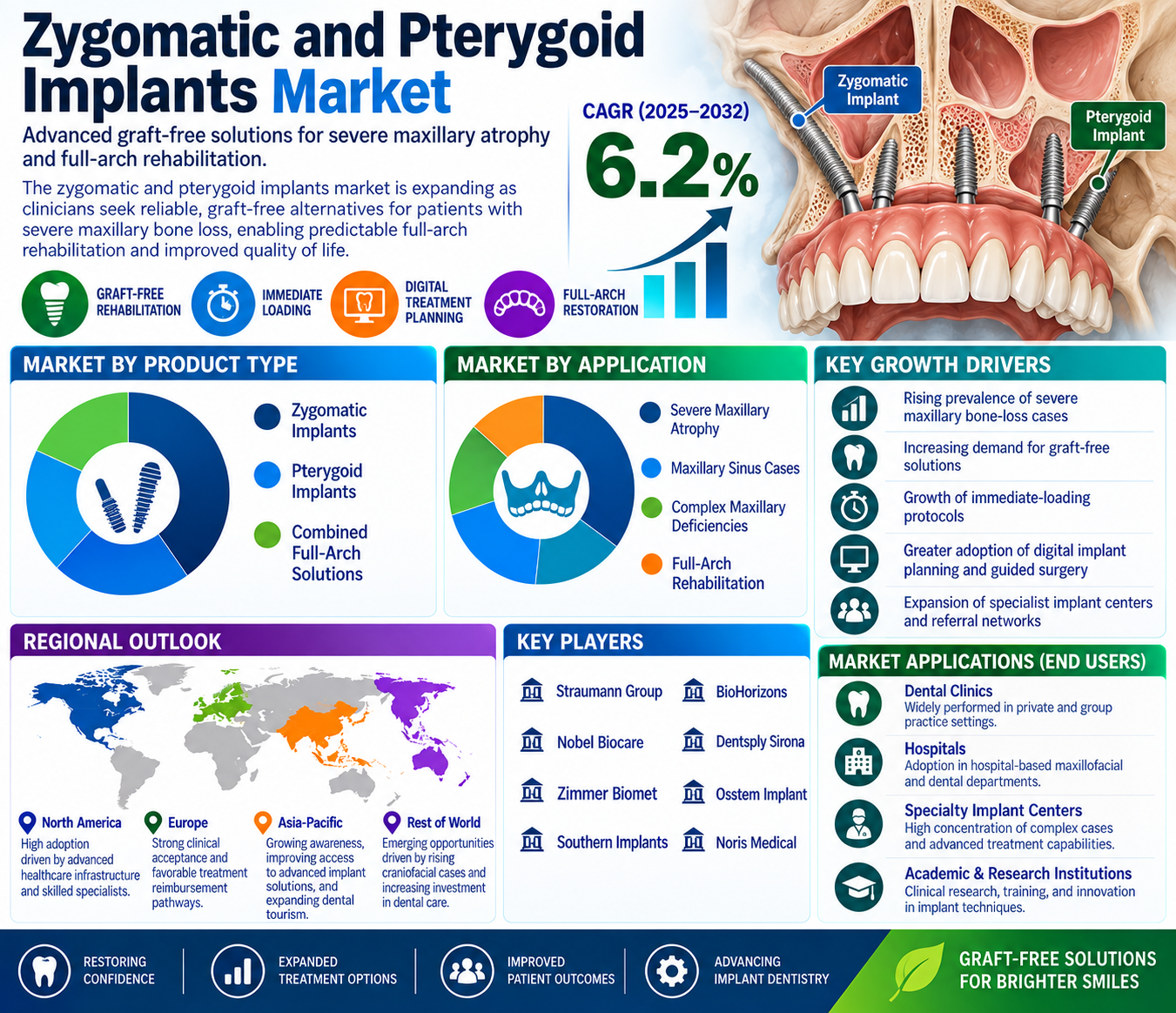
The global zygomatic and pterygoid implants market continues to expand as dental professionals increasingly adopt advanced implant solutions for patients with severe maxillary atrophy, insufficient bone volume, failed conventional implants, and complex oral reconstruction requirements. Zygomatic and pterygoid implants provide alternative anchorage options for patients who may otherwise require extensive bone grafting procedures. Rising demand for immediate full-arch rehabilitation, increasing use of CBCT-based treatment planning, growing availability of specialist implant centers, and expanding adoption of digitally guided implant surgery continue to support market growth. Advancements in implant surface technologies, long-implant designs, prosthetic connections, immediate-loading protocols, and digital workflows are further accelerating market development. The global zygomatic and pterygoid implants market is expanding at a CAGR of 6.2% from 2026 to 2034. Recent market estimates indicate that the market is expected to maintain steady growth during the forecast period.
Key Growth Driver
Increasing adoption of graft-free rehabilitation and immediate-loading solutions for patients with severe maxillary bone atrophy is accelerating market growth globally.
Patients with severe upper-jaw bone loss frequently have limited suitability for conventional dental implants without bone augmentation. Zygomatic implants achieve anchorage in the zygomatic bone, while pterygoid implants provide posterior anchorage in the pterygomaxillary region, helping clinicians manage difficult maxillary cases. Increasing clinical preference for reducing extensive grafting procedures, shortening treatment pathways, and providing fixed full-arch rehabilitation is supporting market adoption. Modern systems are also benefiting from improved surgical planning, advanced surface technologies, digital scanning, photogrammetry, and prosthetic workflow integration. Nobel Biocare, for example, positions its NobelZygoma system as a graftless solution for severely resorbed maxillae with immediate-treatment capabilities.
Segment Highlight
Zygomatic implants, longer implant configurations, and immediate-loading procedures continue to create significant growth opportunities.
Based on product type, Zygomatic Implants account for a major share of the market due to their established use in the rehabilitation of severely resorbed maxillae and their ability to provide remote anchorage where conventional implant placement is difficult. Pterygoid Implants continue to gain adoption as a posterior anchorage option, particularly in full-arch cases requiring support in the posterior maxilla. Combined use of conventional, zygomatic, and pterygoid implants is also becoming increasingly important in complex full-arch reconstruction.
By implant length, the 31–50 mm segment accounted for approximately 47.87% of 2025 market revenue, while implants above 50 mm are expected to record faster growth through 2031. Demand for longer implant configurations is being supported by complex anatomical cases requiring remote anchorage in zygomatic bone.
By application, severe maxillary atrophy represents an important growth area as clinicians increasingly use advanced implant techniques for patients with significant bone resorption. Maxillary sinus-related cases also represent a major application segment. Increasing treatment of patients with failed grafts, post-surgical defects, advanced resorption, and difficult posterior maxillary anatomy continues to support adoption.
By procedure approach, Immediate Loading accounted for approximately 61.08% of procedures in 2025 and continues to expand as clinicians seek to provide faster fixed-prosthetic rehabilitation. Delayed-loading protocols remain important depending on bone quality, primary stability, anatomical conditions, and individual treatment requirements.
Regional Opportunity
North America remains the leading market, while Asia-Pacific is emerging as the fastest-growing region for zygomatic and pterygoid implants.
North America accounted for approximately 42.05% of global market value in 2025, supported by advanced dental infrastructure, widespread adoption of implant dentistry, specialist oral and maxillofacial surgery networks, high availability of digital dental technologies, and strong demand for full-arch rehabilitation. The United States represents a major contributor due to established implant centers and increasing adoption of advanced graft-free treatment approaches.
Europe continues to represent an important market supported by established implantology practices, specialist training programs, medical tourism, and increasing clinical use of immediate-loading techniques. Meanwhile, Asia-Pacific is expected to experience the fastest growth, with one recent estimate indicating approximately 9.1% annual growth. Expansion is supported by increasing dental implant adoption across China and India, advanced implant dentistry in Japan and South Korea, medical tourism, rising healthcare expenditure, and improving access to advanced oral rehabilitation procedures.
Competitive Landscape
Market participants are focusing on advanced implant designs, remote anchorage solutions, digital workflow integration, immediate-loading protocols, and clinical education to strengthen their competitive position.
Leading manufacturers are investing in specialized zygomatic and long-implant systems, enhanced implant surfaces, optimized prosthetic connections, guided surgical workflows, and digital treatment-planning technologies. Clinical education has also become an important competitive strategy because zygomatic and pterygoid implant placement requires specialist skills and detailed knowledge of complex maxillary anatomy.
Companies are increasingly integrating CBCT imaging, intraoral scanning, photogrammetry, CAD/CAM prosthetics, and digitally planned full-arch workflows to improve treatment efficiency and predictability. Straumann's Neodent portfolio, for example, includes zygomatic and pterygoid-oriented remote anchorage solutions for severely resorbed maxillae, while Nobel Biocare continues to develop its NobelZygoma platform with advanced implant and tissue-interface technologies.
Key companies operating in the market include Straumann Group, Nobel Biocare, Zimmer Biomet, BioHorizons Implant Systems, MIS Implants Technologies, Southern Implants, CAMLOG, Osstem Implant, MegaGen Implant, Dentsply Sirona, Bicon, Hiossen, Euroteknika, Noris Medical, Adin Dental Implant Systems, Dentium, Neodent, BEGO, Neoss, and Sweden & Martina.
Zygomatic and Pterygoid Implants Industry News
Sep 2026: Straumann supported an advanced ZAGA Cadaver Course in New York focused on remote anchorage solutions, surgical planning, and clinical use of zygomatic and pterygoid implants for severe maxillary atrophy.
Sep 2026: Straumann's ZAGA training program in Barcelona included a dedicated pterygoid implant module alongside advanced zygomatic rehabilitation techniques, highlighting growing industry focus on specialist education for remote anchorage procedures.
Aug 2026: Straumann-supported clinical education programs continued to address full-arch rehabilitation using zygomatic implants, including treatment planning, immediate loading, surgical techniques, and management of complex cases.
2026: Nobel Biocare continued expanding adoption of its NobelZygoma TiUltra system, incorporating TiUltra and Xeal surface technologies and design features intended to support complex graftless maxillary rehabilitation and immediate-treatment workflows.
Dec 2025: The U.S. FDA issued a substantially equivalent decision for the Pterygoid Indication for GM Helix Implants submitted by JJGC, associated with Straumann USA, expanding the regulatory support for implant use in the pterygoid region.
Historical & Forecast Period
This study report represents analysis of each segment from 2024 to 2034 considering 2025 as the base year. Compounded Annual Growth Rate (CAGR) for each of the respective segments estimated for the forecast period of 2026 to 2034.
The current report comprises of quantitative market estimations for each micro market for every geographical region and qualitative market analysis such as micro and macro environment analysis, market trends, competitive intelligence, segment analysis, porters five force model, top winning strategies, top investment markets, emerging trends and technological analysis, case studies, strategic conclusions and recommendations and other key market insights.
Research Methodology
The complete research study was conducted in three phases, namely: secondary research, primary research, and expert panel review. key data point that enables the estimation of Zygomatic and Pterygoid Implants Market By Length (Upto 30 mm, 31-40 mm, 41-50 mm, Above 50 mm), By Application (Maxillary Sinuses, Severe Atrophy of Maxillary Bone, Others), By Usage Area (Dental and Orthodontic Clinics, Hospitals) - Growth, Future Prospects & Competitive Analysis, 2026 – 2034 market are as follows:
Market forecast was performed through proprietary software that analyzes various qualitative and quantitative factors. Growth rate and CAGR were estimated through intensive secondary and primary research. Data triangulation across various data points provides accuracy across various analyzed market segments in the report. Application of both top down and bottom-up approach for validation of market estimation assures logical, methodical and mathematical consistency of the quantitative data.
| ATTRIBUTE | DETAILS |
|---|---|
| Research Period | 2024-2034 |
| Base Year | 2025 |
| Forecast Period | 2026-2034 |
| Historical Year | 2024 |
| Unit | USD Million |
| Segmentation | |
Product Type
|
|
Implant Length
|
|
Application
|
|
Procedure Approach
|
|
End User
|
|
|
Region Segment (2024-2034; US$ Million)
|
Frequently Asked Questions


